Need Counselling

B.Com Commerce
 Job Pressure
Medium
 Academic Pressure
Medium
 Early Salary
1.5 LPA - 4.2 LPA
Mid Level Salary5 LPA - 10.6 LPA
Senior Salary7 LPA - 25 LPA
Table of Contents
Bachelor of Commerce Course Highlights
| Course Level | Undergraduate |
| Course Duration | 3 Years |
| Course Name | Bachelor of Commerce Course |
| Short Name | B.Com |
| Course Stream | Commerce and Finance |
| Course Type | Degree Course |
| Bachelor of Commerce Course Eligibility Criteria | 10+2/ Relevant Bachelor’s Degree |
| Bachelor of Commerce Course Selection Procedure | Merit-Based and Entrance Based |
| Bachelor of Commerce Course Fees | INR 1,00,000 - INR 5,00,000 |
| Bachelor of Commerce Course Job | Investment Manager, Business Consultant, Auditor, Banker, Lecturer, Insurance Consultant, Stock Broker, Tax Consultant |
| Bachelor of Commerce Course Placement Opportunities | Banking Sector, Auditing Firms, Auditing Departments, Auditing Companies |
| Bachelor of Commerce Course Salary | INR 1,50,000 - INR 4,35,000 |
About the Programme B.Com in Commerce Course
Bachelor of Commerce is an undergraduate degree course that requires three years to complete. It is the study of business or related subjects which includes finance, accounting, banking, and management.
Purpose of the course
This course provides students with a global perspective on business along with skills and knowledge.
Why choose B.Com?
B.Com is a commerce degree that provides students a wide range of business majors. It equips students with analytical, leadership, and management skills. It also improves their communication and problem-solving skills.
Eligibility Criteria B.Com in Commerce Course
- Applicants must have passed their Senior Secondary (10+2) or equivalent from a recognized board.
- They must have scored a minimum of 55% marks in the Senior Secondary or equivalent.
- SC/ ST has a 5% of relaxation in the minimum aggregate.
Bachelor of Commerce Course Syllabus
| Semester I | Semester II |
|---|---|
| Accounts-I | Accounts-II |
| English | Maths |
| Economics-I | Management |
| Maths/ Computer | Economics-II |
| Environment & Public Health | Computers |
| Business Communication | General Awareness I |
| Computer Applications & IT | General Awareness II |
| Second Language | - |
| Semester III | Semester IV |
| Income Tax Laws | Corporate Accounting-II |
| Banking & Insurance | Elements of Company Law-II |
| Microeconomics I | Managerial Communication |
| Financial Markets & Institutions | Indian Banking System & Central Banking |
| Indian Economy | Elements of Company Law-II |
| Corporate Accounting-I | Marketing Management Subjects |
| Business Communication | - |
| Semester V | Semester VI |
| Cost Accounting | Advance Accounting Paper-II |
| Entrepreneurship | BCom Indirect Taxes Paper-II |
| Marketing Management-I | Marketing Management-II |
| Banking & Financial Systems | Contemporary Indian Economic Issues & Policies |
| Income Tax | Mercantile Law-II |
Career Opportunities
B.Com graduates can gain employment in Accounting, Marketing, Taxation, Finance, Stock Marketing, Human Resource Management, Banking, and Auditing.
- Public Sector: Civil Services, Defence Accounts Services.
- Private Sector: Leading organizations like Genpact, Accenture, Infosys, IBM, Deutsche Bank, Wipro, Convergys, and Dell offer jobs for B.Com graduates.
Apply Now Get More Information
1)Private Sector Career Options
- Accounting
- Administrative
- Auditor
- Human Resource Department
- Network Marketing
- Promotion and Advertising
- Banking and Insurance
- Market Research
- Event Management
- Statistical Officer
- Bank Manager
- Accountant
2)Private Employment Area
- Colleges
- Universities
- Policy Planning
- Banks
- Business Consultancies
- Corporate Houses
- Investment Banking
3)Public Employment Area
- Indian Defense Accounts Services
- Civil Services etc
- Investment Banking
- Banks
- Public Accounting Firms
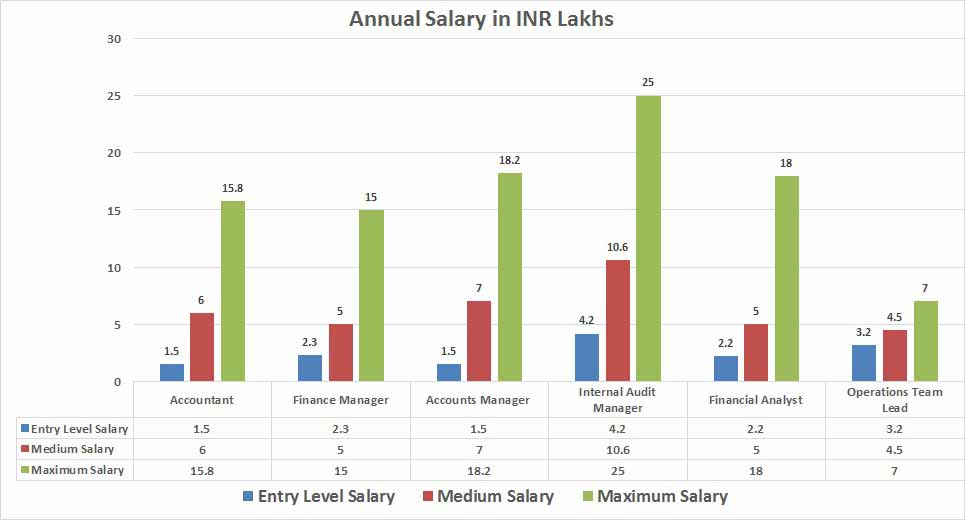
Salary Trends B.Com in Commerce Course
| Bachelor of Commerce [B.Com] | Entry Level Salary (LPA) | Medium Salary (LPA) | Maximum Salary (LPA) |
|---|---|---|---|
| Accountant | 1.5 | 6 | 15.8 |
| Finance Manager | 2.3 | 5 | 15 |
| Accounts Manager | 1.5 | 7 | 18.2 |
| Internal Audit Manager | 4.2 | 10.6 | 25 |
| Financial Analyst | 2.2 | 5 | 18 |
| Operations Team Lead | 3.2 | 4.5 | 7 |
Frequently Asked Questions (FAQs)
What is B.Com (Bachelor of Commerce)? Who is eligible to apply for B.Com? What subjects are studied in a B.Com degree? What skills will I develop during the B.Com course? What career opportunities are available after B.Com? Which industries hire B.Com graduates? What are some popular job roles for B.Com graduates? Can I pursue higher studies after B.Com? Is entrepreneurship an option after B.Com?
10.What is the future scope and salary potential after B.Com?
B.Com is a three‑year undergraduate degree that focuses on business, finance, accounting, taxation, economics and related commerce subjects to prepare students for careers in business and finance.
To pursue B.Com, students must have passed 10+2 or equivalent from a recognised board. Many colleges require a minimum percentage (e.g., around 55 % or equivalent), though this can vary by institution.
The curriculum typically includes financial accounting, economics, business law, taxation, banking and insurance, cost accounting, business communication and management principles — giving a strong foundation in commerce and business.
Students build analytical thinking, financial literacy, communication, problem‑solving, business management and numerical skills, which are valuable across industries.
B.Com graduates can work in accounting, finance, auditing, taxation, banking, insurance, marketing, human resources, business analysis, and corporate operations roles.
Professionals with a B.Com degree are in demand across sectors such as banking and financial services, accounting firms, corporate finance departments, retail and e‑commerce, consulting firms, insurance, and government services.
Common roles include Accountant, Financial Analyst, Tax Consultant, Auditor, Banking Professional, Business Consultant, Marketing Executive, Operations Manager and E‑commerce Specialist.
Yes. After B.Com, students can pursue M.Com (Master of Commerce), MBA (Master of Business Administration), professional courses like CA, CS, CMA, CFA, or specialised diplomas/certifications to enhance expertise and career opportunities.
Absolutely. B.Com gives a strong business foundation, enabling students to start their own business, financial consultancy, online retail store, or service venture based on their interests and skills.
Salary and scope depend on the role, experience and additional qualifications, but fresh graduates typically enter roles with competitive packages. With skills and certifications (e.g., CA, MBA), professionals can grow into senior finance, management or consulting roles with significantly higher salaries.
Other Popular Courses
Applications for Admissions are open
 IILM University, GurugramGurgaon
 Guru Kashi UniversityBathinda
 Karnavati UniversityGandhinagar
 Sri Sukhmani Institute of ManagementNew Delhi
 Acharya Bangalore Business SchoolBangalore
 UID Ahemdabad & Delhi NCRGurgaon
 Lovely Professional UniversityJalandhar
 Rai Technology UniversityBangalore
 I.T.S Engineering CollegeGreater Noida
 Gian Sagar medical College & HospitalPatiala
 DBS Global UniversityDehradun
 Hierank Business SchoolNoida
 Bennett University, Greater NoidaGreater Noida
 Sunder Deep Group of InstitutionsGhaziabad
 Kalka Dental collegeMeerut
 Saraswati Group of Colleges, MohaliMohali
 GNIOT Institute of Management Studies (GIMS)Greater Noida
 GD Goenka University, GurgaonGurgaon
 City College JayanagarBengaluru
 Apeejay Stya UniversitySohna
 Manav Rachna University, FaridabadFaridabad
 Lamrin Tech Skill UniversityRupnagar
 Guru Nanak Dev Dental College & Research InstitutePatiala
 I.T.S College of Health and Wellness Sciences, Greater NoidaGreater Noida
 SRM University - APGuntur
 Nims UniversityJaipur
 Manav Rachna International Institute Of Research And StudiesFaridabad
 Muthoot Business SchoolKochi
 Centurion University of Technology and Management, BhubaneswarBhubaneswar
 ITS Dental College, Greater NoidaGreater Noida