Need Counselling

B.Tech Food Science
 Job Pressure
Medium
 Academic Pressure
Medium
 Early Salary
1.8 LPA LPA - 3.2 LPA LPA
Mid Level Salary2.8 LPA LPA - 3.5 LPA LPA
Senior Salary11.5 LPA LPA - 20.3 LPA LPA
Table of Contents
- B.Tech Food Technology Course Highlights
- About B.Tech in Food Science
- Purpose of B.Tech in Food Science
- B.Tech in Food Science Eligibility
- B.Tech in Food Technology Syllabus
- How to apply for B.Tech in Food Science
- B.Tech in Food Science Scope (Job Types)
- Top Recruiting Companies
- B.Tech in Food Science Salary
- Watch the video
B.Tech Food Technology Course Highlights
| Time Period | 4 Years (8 Semester) |
| Course Level | Undergraduate Level |
| Fee Details | INR 50,000-1,00,000 per semester |
| Exam Pattern | Semester wise |
| Eligibility Criteria | 10+2 with PCM or PCB with minimum 50% marks from any recognized board. |
| Admission Process | Entrance Exam and Merit Based |
| Starting Salary | INR 2-6 LPA |
| Job Opportunities | Students get a chance to become Production Manager, Food Engineer, Nutrition Specialist, Food Processing Engineer, Food Executive, Food Storage Manager, Analytical Science etc. |
About B.Tech in Food Science
Bachelor of Technology in Food Science is an undergraduate degree course which is meant for students who want to make a career in Food Industry or are interested in starting their own venture.
The course curriculum is divided into eight semesters. The duration is four years i.e., two semesters per year. The curriculum covers all major topics pertaining to Food Science such as Food Microbiology, Vegetables and Fruits Processing, Baking Technology, and more. After finishing this course, students can confidently work as Food Technologist, researchers, and dieticians in various private and government organizations, with salaries ranging between INR 20000 to 40000 per month. The fee structure for the B.Tech Food Science course is approximately around INR 2 lakhs.
Purpose of B.Tech in Food Science
There is no denying the fact that Food Industry is growing at a very fast pace, thus providing great career opportunities to students who want to make a career in the same. The basic purpose of this course is to provide in-depth knowledge to students about scientific concepts of Food Science and then help them put their knowledge into it as well upon completing the course. The major subjects covered in this course are chemistry, biochemistry, and microbiology among others. These subjects provide a thorough understanding to students about converting raw agricultural materials into processed foods.
B.Tech in Food Science Eligibility
Students must possess at least 50% marks in aggregate in Physics, Chemistry and Mathematics in their Higher Secondary Examination from a reputed Board or University
B.Tech in Food Technology Syllabus
| Semester I | Semester II |
|---|---|
| Chemistry | Mathematics |
| Mathematics | Material Science |
| Physics | Biology |
| Computer Literacy | Food Biochemistry |
| Engineering Graphics | Basic Engineering |
| Personality and Development I | Personality and Development II |
| Electrical Engineering | Workshop |
| Semester III | Semester IV |
| Food Microbiology | Heat and Mass Transfer |
| Applied mechanics and strength of materials | Food Processing Engineering |
| Mathematics | Kinematics of Machinery |
| Unit operations in food processing | Fruit and Vegetable processing |
| Stoichiometry and Engineering thermodynamics | Crop Processing Engineering |
| Semester V | Semester VI |
| Refrigeration and Air Conditioning | Instrumentation and process control |
| Dairy Plant Engineering | Open Elective I |
| Biochemistry: Processing and Preservation | Food Fermentation |
| Fat and Oil Processing | Food Plant Safety |
| Post-harvest Physiology | Food and Waste Management |
| Computer Skills | Hazard Analysis |
| Semester VII | Semester VIII |
| Food Processing and Management | Practical |
| Food Packaging Technology | Project |
| Bakery & Confectionery | Internship |
| Open Elective II | Open Elective IV |
| Open Elective III | Open Elective V |
How to apply for B.Tech in Food Science
Students need to clear the JEE (Joint Entrance Examination) in order to get admission in B.Tech Food Science. The application forms for the same are released in the month of November and exams are conducted in the month of April. More details pertaining to this course are also available online.
B.Tech in Food Science Scope (Job Types)
1) Private Sector Career options after B.Tech in Food Science
- Associate Quality/audit Analyst
- Manager-Operation Food Industries
- Scientist E Food Science Technology Food Nutrition
- Scientists / Sr. Scientists - Food Testing
- Product development
- Product Owner
- Asst. Manager R & D in a Food Industry
2) Private Sector Employment areas after B.Tech in Food Science
- Retail
- Catering and Bar work
- Food Packaging Companies
- Food Manufacturing
- Beverage Companies
- Food Quality Control Organizations
- Food Processing Companies
3) Public Sector Employment areas after B.Tech in Food Science
- Department of Food and Public Distribution
Apply Now Get More Information
Top Recruiting Companies

B.Tech in Food Science Salary
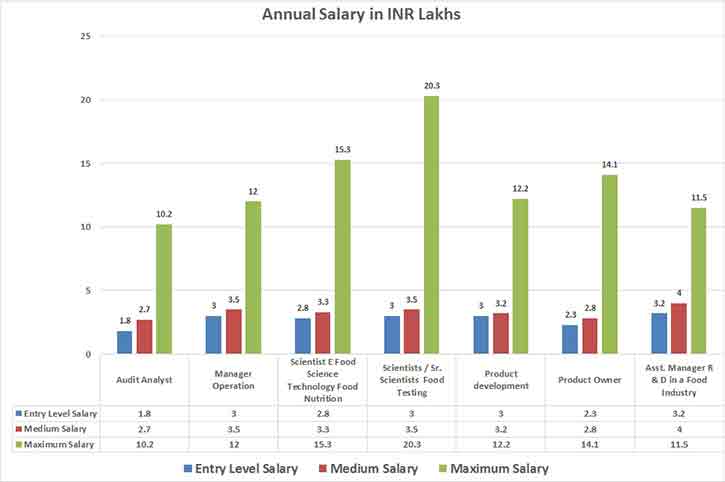
| Bachelor of Technology [B.Tech] (Food Science) | Entry Level Salary (LPA) | Medium Salary (LPA) | Maximum Salary (LPA) |
|---|---|---|---|
| Audit Analyst | 1.8 | 2.7 | 10.2 |
| Manager Operation | 3 | 3.5 | 12 |
| Scientist E Food Science Technology Food Nutrition | 2.8 | 3.3 | 15.3 |
| Scientists / Sr. Scientists Food Testing | 3 | 3.5 | 20.3 |
| Product development | 3 | 3.2 | 12.2 |
| Product Owner | 2.3 | 2.8 | 14.1 |
| Asst. Manager R & D in a Food Industry | 3.2 | 4 | 11.5 |
Frequently Asked Questions (FAQs) 2. Who is eligible to study this course? 3. How long does the B.Tech Food Science programme last? 4. What subjects are studied in this course? 5. How do admissions work for this programme? 6. What skills will I gain from this degree? 7. What career options are available after B.Tech in Food Science? 8. Which industries hire Food Science graduates? 9. What is the average starting salary after this course? 10. Is B.Tech in Food Science a good career choice?
1. What is B.Tech in Food Science?
B.Tech in Food Science is a 4‑year undergraduate engineering programme that teaches the science, technology, processing, preservation, quality control, and safety of food products and systems used in the food industry.
Students must have completed Class 12 (10+2) with Science subjects — typically Physics, Chemistry, and either Mathematics or Biology — from a recognised board, and usually with around 50–60% marks, though this can vary by college. Admissions often include entrance exams such as JEE Main, state CETs, and institute tests.
The course lasts 4 years, normally divided into eight semesters, combining theory, practical lab work, projects, and sometimes internships.
Key topics include food chemistry, food microbiology, food processing and engineering, quality and safety control, product development, nutrition, packaging technology, and regulatory standards.
Admission is usually based on performance in entrance exams (e.g., JEE Main, JEE Advanced, state‑level CETs, CUET) and Class 12 marks. Some institutes also consider institute‑specific tests or merit lists.
You will develop food analysis and processing skills, quality and safety control, lab techniques, product development, understanding of nutrition and food laws, and problem‑solving abilities relevant to food technology and science.
Graduates can work in roles such as Food Technologist, Quality Control Manager, Food Safety Inspector, Food Process Engineer, Product Development Manager, Packaging Technologist, Nutrition Consultant, or Research Scientist.
Jobs are available in food processing and manufacturing companies, beverage and dairy industries, quality and safety labs, research institutes, government regulatory bodies, nutrition and food consultancy firms, and packaging sectors.
Starting salaries for B.Tech Food Science graduates in India vary but typically range from around ₹3 LPA to ₹6 LPA for freshers, with higher pay (₹7 LPA or more) possible with experience, specialised roles, or managerial positions.
Yes — it’s a solid choice if you enjoy science, food processing, product innovation, quality control, and safety, and want a career in the fast‑growing food and nutrition industry with diverse job opportunities.
Watch the video
BTech Food Science Course details in Hindi | Food Science | Eligibility, Exam, Fee, Scope and Salary
Other Popular Courses
Applications for Admissions are open
 MERI CollegeNew Delhi
 I.T.S Dental college, Murad NagarGhaziabad
 Kalka Dental collegeMeerut
 NIIT UniversityAlwar
 IILM University, GurugramGurgaon
 Somnath Goel Paramedical InstituteYamunanagar
 I.T.S Engineering CollegeGreater Noida
 Guru Nanak Ayurvedic Medical College & HospitalMuktsar
 ITS Dental College, Greater NoidaGreater Noida
 UNITEDWORLD INSTITUTE OF DESIGNAhmedabad
 Mai Bhago Ayurvedic Medical CollegeFirozpur
 Nims UniversityJaipur
 Swami Devi Dyal Hospital and Dental CollegePanchkula
 Rai Technology UniversityBangalore
 Sunder Deep Group of InstitutionsGhaziabad
 Amity University, GurugramGurgaon
 Solan Homoeopathic Medical College & HospitalSolan
 Lovely Professional UniversityJalandhar
 Muthoot Business SchoolKochi
 Harmony Ayurvedic Medical College & HospitalFirozpur
 Pimpri Chinchwad UniversityPune
 Kalka Group of InstitutionsMeerut
 ATLAS SkillTech UniversityMumbai
 I.T.S College of Health and Wellness Sciences, Greater NoidaGreater Noida
 Chanakya UniversityBangalore
 Sri Sukhmani Institute of ManagementNew Delhi
 Karnavati UniversityGandhinagar
 Atria UniversityBangalore
 IIFA Lancaster Institute of DesignBangalore
 UID Ahemdabad & Delhi NCRGurgaon