Need Counselling

M.Pharma
 Job Pressure
Medium
 Academic Pressure
Medium
 Early Salary
1.7 LPA - 2.4 LPA
Mid Level Salary2.7 LPA - 3.6 LPA
Senior Salary4.7 LPA - 26 LPA
Table of Contents
- M.Pharma Course Highlights
- About the Programme Master of Pharmacy
- M.Pharma Course Description
- What is Master of Pharmacy (M.Pharma)?
- Eligibility Criteria Master of Pharmacy
- M.Pharma Course Syllabus
- Master of Pharmacy Scope(Job Types)
- Top Recruiting Companies after Master of Pharmacy
- Salary Trends Master of Pharmacy
M.Pharma Course Highlights
| Duration | 2 years |
| Course Level | Post graduate |
| Full Form | Masters of Pharmacy in Pharmaceutics |
| Examination Type | Semester |
| Eligibility | 55% in B.Pharm |
| Admission process | Entrance exam based |
| Course fees | INR 50,000 to INR 4,00,000 |
| Average Salary | INR 2,50,000 |
| Top Recruiting Places | MNCs, Government, healthcare |
| Job position | Researcher, Quality Control, Regulatory Affairs |
About the Programme Master of Pharmacy
The art and science that deals with the preparation, preservation, dispensing and proper utilization of medical are named Pharmacy. This is a branch of healthcare science that connects health science to chemical science for the proper utilization, safe and effective use of pharmaceutical or medical drugs.
Pharma is derived from the Greek word pharmakos which mean poison. The word pharmakos is itself derived from pharmakon that means "drug", "medicine" or "poison".
M.Pharma Course Description
Master of Pharmacy is a two-year academic program divided into four semesters. Students are examined through written and practical exams at the completion of each semester. At the end of the final semester, students have to submit a thesis.
Any of the recognized Indian universities don’t provide M.Pharma through distance learning or as a correspondence course.
What is Master of Pharmacy (M.Pharma)?
M. Pharma helps to get specialization in formulation development, manufacturing technology, and process development areas which are important for manufacturing and systematic medical drug delivery system.
Dosage form design; advanced pharmaceutical methods of analysis; drug regulatory affairs; biopharmaceutics and pharmacokinetics; dosage form technology; advances in industrial pharmacy are some of the major subjects which get included in the theoretical and practical session of the first year.
The second year involves projects upon stability studies, formulation development, etc. One can opt for specialization in Industrial Pharmacy, Pharmaceutics, and Pharmacology, etc.
Eligibility Criteria Master of Pharmacy
- One who has passed B.Pharma with a minimum aggregate of 55% is eligible to enroll for M.Pharma.
- GATE scores are eligible to bet for this course.
M.Pharma Course Syllabus
| Semester 1 | Semester 2 |
|---|---|
| Drug Delivery | Advanced Biopharmaceutics |
| Modern Pharmaceutical Analytical Techniques | Molecular Pharmaceutics |
| Regulatory Affairs | Computer-Aided Drug Delivery System |
| Modern Pharmaceutics | Cosmetic and Cosmeceuticals |
| Semester 3 | Semester 4 |
| Dissertation-I | Dissertation-II |
| Seminar-I | Seminar-II |
Master of Pharmacy Scope(Job Types)
1)Private Sector Career options
- Pharmacist
- Medical Representative
- Clinical Researcher
- Drug Control Director
- Oncologist
2)Private Sector Employment areas
- Research Council
- Health Centers
- Educational Institutes
- Food and Drug Administration
- Hospitals
3)Public Sector Employment areas
- Department of National Defense
Top Recruiting Companies after Master of Pharmacy
Salary Trends Master of Pharmacy
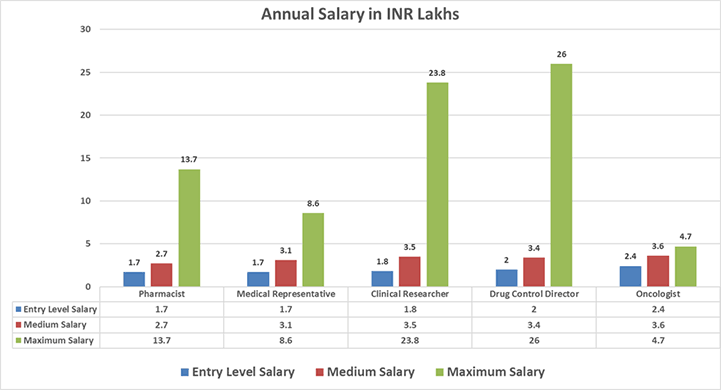
| Master of Pharmacy [M.Pharm] | Entry Level Salary (LPA) | Med Salary (LPA) | Max Salary (LPA) |
|---|---|---|---|
| Pharmacist | 1.7 | 2.7 | 13.7 |
| Medical Representative | 1.7 | 3.1 | 8.6 |
| Clinical Researcher | 1.8 | 3.5 | 23.8 |
| Drug Control Director | 2 | 3.4 | 26 |
| Oncologist | 2.4 | 3.6 | 4.7 |
Frequently Asked Questions (FAQs) 1. What is M.Pharma?
M.Pharma (Master of Pharmacy) is a 2‑year postgraduate degree in pharmacy that provides advanced study and research skills in drug science, formulation, pharmacology, quality control, clinical pharmacy, and regulatory affairs. It deepens your expertise beyond B.Pharm.
2. How long is the M.Pharma programme?
The course typically lasts 2 years, divided into 4 semesters with theory, practical labs, and often a research project or dissertation.
3. Who is eligible to study M.Pharma?
To be eligible, you must have completed a B.Pharm (Bachelor of Pharmacy) degree from a recognised university, usually with a minimum of around 50–60% marks (varies by institution).
4. How do admissions work for M.Pharma?
Admission is usually based on merit in B.Pharm and/or entrance exams such as GPAT, state pharmacy tests or university‑level exams. Some colleges may also consider interviews or counselling.
5. What specialisations are available in M.Pharma?
Common specialisations include:
• Pharmaceutics
• Pharmacology
• Pharmaceutical Chemistry
• Pharmacognosy
• Drug Regulatory Affairs
• Quality Assurance & Quality Control
• Clinical Pharmacy
• Pharmaceutical Biotechnology
• Pharmaceutical Analysis
These allow you to focus on areas you’re most interested in.
6. What skills will I learn in this programme?
You’ll gain advanced drug formulation and development skills, research and analytical skills, understanding of regulatory frameworks, quality testing, clinical trial planning, and problem‑solving relevant to the pharmaceutical industry.
7. What career options are available after M.Pharma?
Graduates can work in roles such as:
• Research Scientist / Drug Developer
• Quality Control/Quality Assurance Analyst
• Clinical Research Associate (CRA)
• Regulatory Affairs Officer
• Medical Writer
• Hospital/Clinical Pharmacist
• Pharmacologist
• Product/Process Development Specialist
• Drug Inspector
• Lecturer/Professor in pharmacy colleges
8. Where can M.Pharma graduates work?
Job opportunities are available in pharmaceutical companies, research and development labs, regulatory agencies, hospitals and clinical research organisations, government drug control departments, academic institutions, and even in sales, marketing and management roles in the pharma sector.
9. What is the average salary after completing M.Pharma?
In India, entry‑level salaries for M.Pharma graduates typically range around ₹3 LPA to ₹6 LPA, with potential to increase to ₹7–₹10 LPA or more in specialised research, regulatory or managerial roles as experience grows. Advanced roles in quality or regulatory functions can pay higher.
10. Can I pursue higher studies after M.Pharma?
Yes — after M.Pharma you can pursue Ph.D. in Pharmaceutical Sciences or related fields, MBA (e.g., Pharma Management), or specialised research fellowships which can lead to careers in academia, advanced R&D, or leadership roles in the pharmaceutical industry.
Other Popular Courses
Applications for Admissions are open
 Amity University, GurugramGurgaon
 SDGI Global UniversityGhaziabad
 Manav Rachna International Institute Of Research And StudiesFaridabad
 IILM University, Greater NoidaGreater Noida
 IIFA Lancaster Institute of DesignBangalore
 I.T.S Dental college, Murad NagarGhaziabad
 I.T.S College of Health and Wellness Sciences, Greater NoidaGreater Noida
 Mai Bhago Ayurvedic Medical CollegeFirozpur
 Vidya Siri College of PharmacyBangalore
 Kalka Dental collegeMeerut
 ATLAS SkillTech UniversityMumbai
 Karnavati UniversityGandhinagar
 Manav Rachna University, FaridabadFaridabad
 Nims UniversityJaipur
 Greater Noida Institute of TechnologyGreater Noida
 GD Goenka University, GurgaonGurgaon
 Bhojia Dental College and HospitalSolan
 HRIT UniversityGhaziabad
 Shoolini UniversitySolan
 Centurion University of Technology and Management, BhubaneswarBhubaneswar
 Sunder Deep Group of InstitutionsGhaziabad
 Shri Bhawani Niketan Shiksha Samitijaipur
 Acharya Bangalore Business SchoolBangalore
 Hierank Business SchoolNoida
 Gokul Global UniversitySiddhpur
 Guru Nanak Dev Dental College & Research InstitutePatiala
 Gian Sagar medical College & HospitalPatiala
 NIIT UniversityAlwar
 JK Business School GurugramGurgaon
 Saraswati Group of Colleges, MohaliMohali