Need Counselling

B.Sc Economics
 Job Pressure
Medium
 Academic Pressure
Medium
 Early Salary
2 LPA - 3.5 LPA
Mid Level Salary3.95 LPA - 5.5 LPA
Senior Salary11 LPA - 15 LPA
Table of Contents
B.Sc Economics Course Highlights
| Examination Type | Semester System |
| Course Level | Undergraduate |
| Duration of the Course | 3 years |
| Eligibility | 10+2 in any stream from a recognized board |
| Admission Process | Direct Admission followed by Counselling/ Entrance-based |
| Average Course Fee | INR 50,000 to 1.0 lacs |
| Average Starting Salary | INR 1,50,000 to INR 5,00,000 |
| Top Job Areas | Colleges, Universities, Banking and Finance Sector, Production firms. |
| Top Job Positions | Banker, Financial Advisor, Research Analyst, Subject Matter Expert |
B.Sc Economics Syllabus
| Semester I | Semester II |
|---|---|
| Macroeconomics I | Macro Economics II |
| Microeconomics I | Micro Economics II |
| Indian Economy | Indian Economy II |
| Statistics for Economics I | Statistics for Economics II |
| Foundation of Mathematics | Mathematical Economics I |
| Core Environmental Studies | - |
| Semester III | Semester IV |
| Theory and Application of Public Finance | Research Methodology |
| Law and Economics Theory | International Economics |
| Introductory Econometrics | Primary and secondary research |
| Development of Economics | Liberal arts |
| Semester V | Semester VI |
| IT Applications in Economics | Economic Thoughts |
| Economic Journalism | Portfolio Management |
| Microeconomics III | Environmental Economics |
| Macroeconomics III | International Relations |
B.Sc in Economics Course Scope(Job Types)
Private Sector Career Options
- Research Analyst- Macro Economics
- Manager-Economics Modelling
- Budget analyst
- Economic Affairs specialist
- Economics-Lecturer
Private Employment Area
- Business Consultancies
- Retail Marketing
- Information Agency for News Channels
- Online Marketing and Institute
- Trading Firms
Public Employment Area
- Banks
- Ministry of Finance
- Insurance Sector
Apply Now Get More Information
Top Recruiting Companies
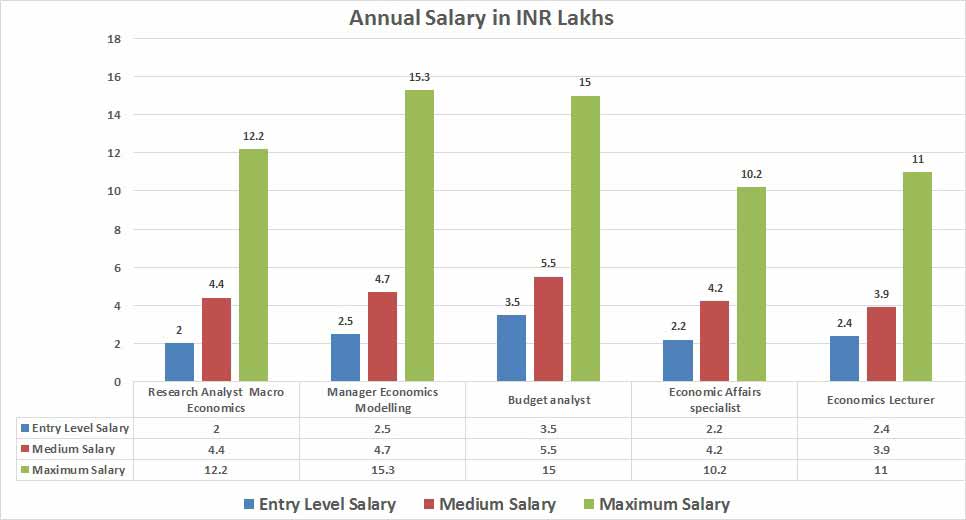
Salary Trends
| Bachelor of Science [B.Sc] (Economics) | Entry Level Salary (LPA) | Medium Salary (LPA) | Maximum Salary (LPA) |
|---|---|---|---|
| Research Analyst Macro Economics | 2 | 4.4 | 12.2 |
| Manager Economics Modelling | 2.5 | 4.7 | 15.3 |
| Budget analyst | 3.5 | 5.5 | 15 |
| Economic Affairs specialist | 2.2 | 4.2 | 10.2 |
| Economics Lecturer | 2.4 | 3.9 | 11 |
Frequently Asked Questions (FAQs) 1. What is B.Sc. Economics? 2. How long is the B.Sc. Economics course? 3. What are the eligibility criteria for admission? 4. How is admission done for B.Sc. Economics? 5. What subjects are covered in the syllabus? 6. What skills will I develop in this course? 7. What career options are available after B.Sc. Economics? 8. What is the average salary after graduation? 9. Can I pursue higher studies after this degree? 10. In which sectors can B.Sc. Economics graduates work?
B.Sc. Economics is a 3-year undergraduate science degree that focuses on the study of economic theories, quantitative methods, markets and the application of economics to real-world financial, social and policy issues.
The course typically lasts 3 years, divided into six semesters.
To be eligible, students must have completed 10+2 from a recognised board. While specific subject requirements vary by college, having mathematics or statistics at the 12th level is often preferred.
Many colleges admit students based on merit (12th marks) or through entrance exams such as CUET UG, SET, NPAT and others, depending on the institution.
The syllabus usually includes Microeconomics, Macroeconomics, Indian & Global Economy, Econometrics, Statistics for Economics, Mathematical Economics, Public Finance, Banking & Finance, among others.
Students develop quantitative analysis, critical thinking, economic modelling, statistical methods, communication and problem-solving skills essential for both research and industry roles.
Graduates can work in roles such as economic analyst, financial analyst, data analyst, market researcher, policy consultant, economist, investment banker, risk analyst and more.
Starting salaries vary by job and industry, but many entry-level roles range from around ₹2 LPA to ₹5 LPA, while experienced professionals can earn significantly more.
Yes — students often pursue M.A. Economics, M.Sc. Economics, MBA, M.Stat, or research/Ph.D. programmes to specialize further and enhance career prospects.
Economics graduates are employed in banking & finance, government research and policy bodies, consulting firms, analytics companies, international organisations, corporate strategy and academia.
Other Popular Courses
Applications for Admissions are open
 HRIT UniversityGhaziabad
 Rai Technology UniversityBangalore
 I.T.S Dental college, Murad NagarGhaziabad
 Sunder Deep Group of InstitutionsGhaziabad
 Somnath Goel Paramedical InstituteYamunanagar
 Vidya Siri College of PharmacyBangalore
 ITS Dental College, Greater NoidaGreater Noida
 Atria UniversityBangalore
 IIFA Lancaster Institute of DesignBangalore
 Shoolini UniversitySolan
 Chandigarh University OnlineMohali
 Gian Sagar medical College & HospitalPatiala
 Apeejay Stya UniversitySohna
 SDGI Global UniversityGhaziabad
 UID Ahemdabad & Delhi NCRGurgaon
 Bennett University, Greater NoidaGreater Noida
 Sri Sukhmani Institute of ManagementNew Delhi
 Pimpri Chinchwad UniversityPune
 Desh Bhagat UniversityFatehgarh Sahib
 Swami Devi Dyal Hospital and Dental CollegePanchkula
 Shri Bhawani Niketan Shiksha Samitijaipur
 Solan Homoeopathic Medical College & HospitalSolan
 I.T.S College of Health and Wellness Sciences, Greater NoidaGreater Noida
 Kalka Group of InstitutionsMeerut
 Acharya Bangalore Business SchoolBangalore
 Saraswati Group of Colleges, MohaliMohali
 Manav Rachna International Institute Of Research And StudiesFaridabad
 Greater Noida Institute of TechnologyGreater Noida
 IILM University, GurugramGurgaon
 Om Sterling Global UniversityHisar