Need Counselling

B.Sc in Nutrition & Dietetics
 Job Pressure
Medium
 Academic Pressure
Medium
 Early Salary
2L LPA - 4L LPA
Mid Level Salary3L LPA - 5L LPA
Senior Salary6L LPA - 8L LPA
Table of Contents
- B.Sc in Nutrition & Dietetics Course Highlights
- B.Sc in Nutrition & Dietetics Overview
- Eligibility Criteria for B.Sc in Nutrition & Dietetics Course
- Require Skills set B.Sc in Nutrition & Dietetics Course
- Common Entrance Examination for B.Sc in Nutrition & Dietetics Course
- B.Sc in Nutrition & Dietetics Course Syllabus
- Job Profile after B.Sc in Nutrition & Dietetics Course
- Top Recruiting Companies
- B.Sc in Nutrition & Dietetics Course Approx. Salary Trends in Lakh Per Annum*
- Video B.Sc in Nutrition and Dietetics | Course Details, Eligibility, Best Colleges, Career Options, Salary
B.Sc in Nutrition & Dietetics Course Highlights
| Course Level | Graduate |
| Duration | 3 Years |
| Examination type | Semester System |
| Eligibility | 10+2 with recognized board |
| Admission Process | Counselling after taking Entrance Examination |
| Course Fee | INR 2,00,000 to 5,00,000 |
| Average Starting Salary | INR 3,00,000 to 15,00,000 |
| Employment Areas | Canteen, Catering Departments (Star Hotel), Food Service Field, Health and Recreation Club, Health Care Field, Health Department (Govt./Pvt.), Hospitals, Nursing Care facilities, Restaurants, etc. |
| Job Profiles | Administrative Nutritionist, Area Business Manager, Consultant, Food Show Host, Medical Representative, Nutrition Trainer, Nutritional Sales Executive, Public Health/Community Dietitian, Researcher, Sports Nutritionist, Therapeutic Dietitian, etc. |
| Top Recruiting Organizations | Health Care, Health Department (Govt./Pvt.), Hospitals, Nursing Care, Restaurants, etc. |
B.Sc in Nutrition & Dietetics Overview
B. Sc. Nutrition and Dietetics or Bachelor of Science in Nutrition and Dietetics refers to a 3-year under-graduation graduate course in Nutrition and Dietetics where the relationship between the human body and food is studied in detail. Biochemistry, Chemistry, Dairy technology, food science and technology and polymer chemistry is are the subjects dealt with under this course program. This course opens new doors of opportunities for the students at the end of three years after the course has been successfully completed by them.
Eligibility Criteria for B.Sc in Nutrition & Dietetics Course
- The basic minimum eligibility for pursuing B.Sc. in Nutrition and Dietetics is an X and XII qualification from a recognized educational Board with Physics, Chemistry, and Biology as the main subjects at the intermediate level, with a minimum aggregate score of 50%. Some universities/ colleges also accept Botany/ Zoology/ Computer Science/ Biochemistry instead of Biology as one of the main subjects studied in class XII.
Require Skills set B.Sc in Nutrition & Dietetics Course
- Good communication and observation
- Ability to answer questions and offer advice
- Dealing with emotionally charged situations
- Decision Making Skills
- Organisational Skills
Common Entrance Examination for B.Sc in Nutrition & Dietetics Course
- Mangalore University Master of Science in Dietetics and Food Service Management Entrance Exam
- Annamalai University M.Sc in Dietetics entrance exam
- All India Institute of Hygiene & Public Health Entrance exam
- IGNOU M.Sc in Dietetics and Food Service Management Nutritional Biochemistry Exam
- S.N.D.T. WOMEN’S UNIVERSITY PGD in Dietetics entrance exams
- The University of Mumbai M.Sc in Dietetics Entrance Exam
- The University of Kerala M.Sc in Dietetics Entrance Exam
- Osmania University Entrance Exam
B.Sc in Nutrition & Dietetics Course Syllabus
| YEAR I | YEAR II |
|---|---|
| Communication Skills and Personality Development | Food Microbiology |
| Human Physiology | Food Quality and Analysis |
| Introduction to Food and Nutrition | Family Meal Planning |
| Food Chemistry | Industrial Management and Facility Planning |
| Food & Nutrition | Food Science |
| Computer Fundamentals | Fundamentals of Bakery & Confectionary |
| Public Health and Nutrition | Food Preservation |
| Nutritional Biochemistry | - |
| Human Nutrition | - |
| Maternal & Child Health | - |
| YEAR III | |
| Ethics and Environmental Studies | |
| Dietetics I | |
| Food Packaging & Marketing Management | |
| Food Processing Operations | |
| Dietetics II | |
| Food Biotechnology | |
| Food Service Management | |
| Diet & Patient Counselling | |
| Internship | |
Job Profile after B.Sc in Nutrition & Dietetics Course
- Administrative Nutritionist
- Area Business Manager
- Consultant
- Food Show Host
- Medical Representative
- Nutrition Trainer
- Nutritional Sales Executive
- Public Health/Community Dietitian
- Researcher
- Sports Nutritionist
- Therapeutic Dietitian
Top Recruiting Companies

B.Sc in Nutrition & Dietetics Course Approx. Salary Trends in Lakh Per Annum*
| Job Profile | Average Entry Level Salary | Average Medium Salary | Average Maximum Salary |
| Consultant | 6.0 | 7.0 | 8.0 |
| Food Show Host | 5.0 | 5.5 | 6.0 |
| Sports Nutritionist | 3.0 | 4.0 | 5.0 |
| Nutrition Trainer | 2.0 | 2.5 | 4.0 |
| Public Health/Community Dietitian | 2.0 | 3.5 | 5.0 |
Annual Salary Trend
Frequently Asked Questions (FAQs) 2. What subjects will I study in this course? 3. Who is eligible to study B.Sc in Nutrition & Dietetics? 4. How long is the B.Sc in Nutrition & Dietetics programme? 5. How do admissions work? 6. What skills will I learn from this degree? 7. What career options are available after this degree? 8. Where can B.Sc in Nutrition & Dietetics graduates work? 9. What is the average starting salary after completing this course? 10. Is B.Sc in Nutrition & Dietetics a good career choice?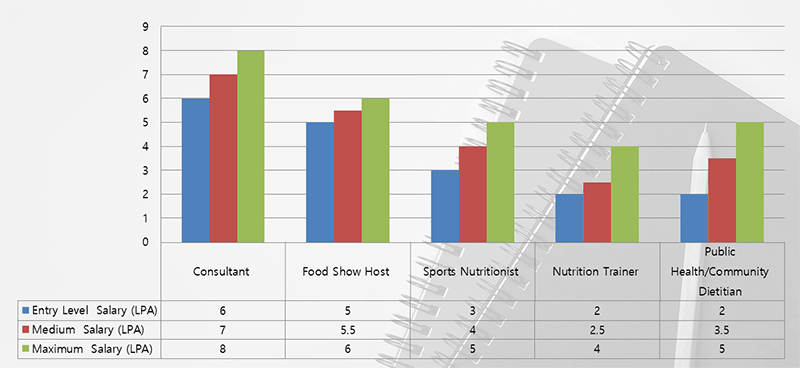
1. What is B.Sc in Nutrition & Dietetics?
B.Sc in Nutrition & Dietetics is a 3‑year undergraduate course that teaches how food and nutrition affect the human body, how to plan healthy diets, and how to help people improve their health through nutrition science.
You study subjects like introduction to food & nutrition, human physiology, food chemistry, food microbiology, dietetics, nutritional biochemistry, food service management, and diet counselling with practical labs and internships.
Students must have passed Class 12 (10+2) with Physics, Chemistry, and Biology (or related science subjects) from a recognised board, usually with at least 50% aggregate marks.
The programme normally lasts 3 years, divided into six semesters, including classroom study and practical training.
Admissions may be based on Class 12 marks, merit lists, or entrance exams depending on the college/university. Some institutions also consider interviews or counselling.
You’ll gain nutritional assessment, diet planning, counselling, food science understanding, health promotion, communication, and research skills useful in healthcare and wellness fields.
Graduates can work as Clinical Dietitian, Nutritionist, Sports Nutritionist, Public Health Nutritionist, Food Quality Analyst, Food Service Manager, Wellness Consultant, or Research Assistant.
They can be employed in hospitals, clinics, fitness centres, food and beverage companies, public health organisations, NGOs, wellness centres, research labs, and community nutrition programmes.
In India, average salaries for graduates are typically around ₹3 LPA to ₹6 LPA for entry‑level roles, and can go higher with experience or specialised positions.
Yes — it’s a good choice if you enjoy health, food science, helping people improve well‑being, and want to work in both healthcare and lifestyle sectors with potential for growth and specialisation.
Video B.Sc in Nutrition and Dietetics | Course Details, Eligibility, Best Colleges, Career Options, Salary
Watch the Video: B.Sc in Nutrition and Dietetics | Course Details, Eligibility, Best Colleges, Career Options, Salary
Other Popular Courses
Applications for Admissions are open
 Amity University, GurugramGurgaon
 Swami Devi Dyal Group of Professional InstitutionsPanchkula
 Institute of Management StudiesNoida
 I.T.S College of Health and Wellness Sciences, Greater NoidaGreater Noida
 GNIOT Institute of Management Studies (GIMS)Greater Noida
 HRIT UniversityGhaziabad
 Graphic Era University, DehradunDehradun
 Desh Bhagat UniversityFatehgarh Sahib
 I.T.S Engineering CollegeGreater Noida
 Ajeenkya DY Patil UniversityPune
 Mai Bhago Ayurvedic Medical CollegeFirozpur
 Hierank Business SchoolNoida
 K.R. Mangalam University, GurgaonGurgaon
 SRM University - APGuntur
 DBS Global UniversityDehradun
 Swami Devi Dyal Hospital and Dental CollegePanchkula
 Sunder Deep Group of InstitutionsGhaziabad
 Solan Homoeopathic Medical College & HospitalSolan
 Bhagwant Institute of TechnologyMuzaffarnagar
 Vidya Siri College of PharmacyBangalore
 Presidency UniversityBangalore
 Lovely Professional UniversityJalandhar
 IILM University, Greater NoidaGreater Noida
 Bennett University, Greater NoidaGreater Noida
 UID Ahemdabad & Delhi NCRGurgaon
 Somnath Goel Paramedical InstituteYamunanagar
 Kalka Dental collegeMeerut
 Rai Technology UniversityBangalore
 Chandigarh University OnlineMohali
 Atria UniversityBangalore