Need Counselling
B.Sc Physics
 Job Pressure
Medium
 Academic Pressure
Medium
 Early Salary
2 LPA - 3.5 LPA
Mid Level Salary4 LPA - 16.2 LPA
Senior Salary10.2 LPA - 36.2 LPA
Table of Contents
B.Sc Physics Course Highlights
| Duration | Course Duration of Bachelor of Science [B.Sc] (Physics) is 3 Years. |
| Degree | Bachelors |
| Full Form | Bachelor of Science in Physics |
| Age | 18-21 |
| Minimum Percentage | 50% |
| Average Fees Incurred | INR 10K - 1 LPA |
| Similar Options of Study | B.Sc (Applied Physics), B.Sc (Mathematics), B.Tech (Physics) etc. |
| Average Salary Offered | INR 7.8 LPA |
| Employment Roles | Senior Software Engineer, Software Engineer, Operations Manager, Service Delivery Manager, Solutions Architect, IT Consultant, High School Teacher, Senior Project Manager, Software Developer, etc. |
B.Sc Physics Syllabus
| Semester I | Semester II |
|---|---|
|
Mechanics & Props of Matter |
Optics |
|
Foundation Course in Maths |
Calculus |
|
C programming |
Environmental Studies |
|
Physical Chemistry 1 |
Organic Chemistry |
|
Physics Lab-1 |
Physics Lab-2 |
|
Chemistry Lab-1 |
Chemistry Lab-2 |
| Semester III | Semester IV |
|
Solid-state Physics |
Classical Mechanics & Relativity |
|
Inorganic Chemistry 1 |
Basic Electronics |
|
Electricity and magnetism |
Electromagnetic Theory |
|
Open Elective |
Nuclear Physics |
|
Biophysics and Radiation Science |
Mathematical Physics |
|
- |
Physics Lab |
| Semester V | Semester VI |
|
Quantum Mechanics |
Renewable Energy |
|
Oscillations & Waves |
Instrumentation |
|
Statistical Mechanics |
Digital Electronics |
|
Applied Optics |
Atomic & Molecular Physics |
|
- |
Particle & Astrophysics |
B.Sc in Physics Course Scope (Job Types)
Private Sector Career Options
- Content developer
- Treasury Management Specialist
- Quality control manager
- Statistician
- Radiologist
- Research Head
- Tutor
- Lecturer
- Associate Auditor
- Proof Reader
Private Employment Area
- Aerospace
- Engineering
- Oil and Gas Industries
- Manufacturing Industries
- Telecommunication Organizations
- Colleges
- Universities.
Public Employment Area
- Indian Forest Service
- Banks
- College
- Schools
- Ministry of Defence
- Ministry of Petroleum and Natural Gas
Apply Now Get More Information
Top Recruiting Companies
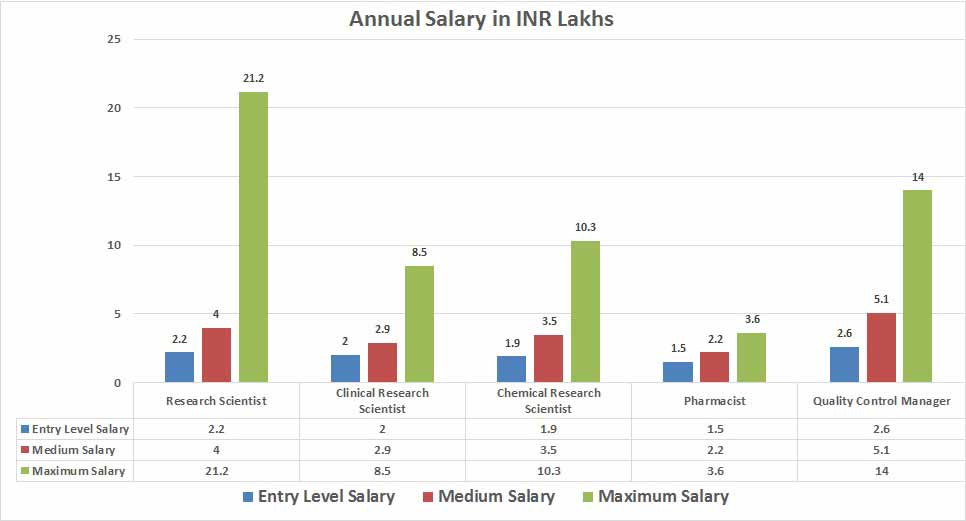
Salary Trends
| Bachelor of Science [B.Sc] (Physics) | Entry Level Salary (LPA) | Medium Salary (LPA) | Maximum Salary (LPA) |
|---|---|---|---|
| Research Head | 2.1 | 4 | 10.2 |
| R & D Executive | 2 | 4.3 | 20 |
| Radiologist | 3.3 | 16.2 | 36.2 |
| Data Scientist | 3.5 | 5.8 | 18.2 |
| Quality Control Manager | 2.3 | 4.6 | 18.1 |
Frequently Asked Questions (FAQs) 1. What is B.Sc. Physics? 2. What are the eligibility criteria for B.Sc. Physics? 3. How long does the course last? 4. What subjects are taught in B.Sc. Physics? 5. How is the admission done for B.Sc. Physics? 6. What skills are developed in this course? 7. What career options are available after B.Sc. Physics? 8. Can I pursue higher studies after B.Sc. Physics? 9. What is the average salary after completing B.Sc. Physics? 10. What industries hire B.Sc. Physics graduates?
B.Sc. Physics is a 3-year undergraduate science degree that focuses on the study of fundamental physical principles, laws of nature and applications of physics in technology and research.
To enroll, students typically need to have passed 10+2 (Senior Secondary) with Physics, Chemistry and Mathematics (or Biology) and usually a minimum aggregate of around 50% (criteria vary by institution).
The B.Sc. Physics program has a duration of 3 years, often divided into six semesters.
The syllabus typically covers Classical Mechanics, Electricity & Magnetism, Quantum Mechanics, Thermodynamics, Optics, Statistical Mechanics, Mathematical Physics, and Physics labs.
Many colleges admit students based on 12th class marks (merit). Some institutions may also use entrance exams or cutoff lists.
Students gain analytical thinking, problem-solving, numerical skills, laboratory techniques and scientific reasoning, which are valuable in research and technology roles.
Graduates can work in roles such as lab technician, research associate, statistician, nanotechnologist, technical writer, teacher, environmental consultant, and more. Opportunities also exist in aerospace, engineering, energy, space and research sectors.
Yes. Graduates often pursue M.Sc. Physics, M.Sc. in related fields, MCA, MBA, or research programs. Advanced qualifications improve career prospects, especially in research and academia.
Entry-level salaries vary widely; on average careers start around INR 2–3.5 LPA, with mid-level and senior professionals earning higher packages depending on role and specialization.
Physics graduates are in demand in research institutions (like ISRO, IISc, BARC), colleges and schools (teaching), engineering and manufacturing industries, IT and analytics, environmental consultancies, and government research organisations.
Other Popular Courses
Applications for Admissions are open
 Karnavati UniversityGandhinagar
 Sunder Deep Group of InstitutionsGhaziabad
 Vidya Siri College of PharmacyBangalore
 Chanakya UniversityBangalore
 GD Goenka University, GurgaonGurgaon
 Mai Bhago Ayurvedic Medical CollegeFirozpur
 Lovely Professional UniversityJalandhar
 SRM University - APGuntur
 IILM University, Greater NoidaGreater Noida
 IILM University, GurugramGurgaon
 Solan Homoeopathic Medical College & HospitalSolan
 City College JayanagarBengaluru
 Rai Technology UniversityBangalore
 Greater Noida Institute of TechnologyGreater Noida
 Swami Devi Dyal Hospital and Dental CollegePanchkula
 Saraswati Group of Colleges, MohaliMohali
 Centurion University of Technology and Management, BhubaneswarBhubaneswar
 IIFA Lancaster Institute of DesignBangalore
 Shri Bhawani Niketan Shiksha Samitijaipur
 Somnath Goel Paramedical InstituteYamunanagar
 Guru Nanak Dev Dental College & Research InstitutePatiala
 Hierank Business SchoolNoida
 GNIOT Institute of Management Studies (GIMS)Greater Noida
 Harmony Ayurvedic Medical College & HospitalFirozpur
 Shoolini UniversitySolan
 Lamrin Tech Skill UniversityRupnagar
 HRIT UniversityGhaziabad
 JK Business School GurugramGurgaon
 Acharya Bangalore Business SchoolBangalore
 ITS Dental College, Greater NoidaGreater Noida