Need Counselling
B.Tech Printing Technology
 Job Pressure
Medium
 Academic Pressure
Medium
 Early Salary
1.8 LPA LPA - 3.6 LPA LPA
Mid Level Salary2.3 LPA LPA - 4.1 LPA LPA
Senior Salary8.1 LPA LPA - 18.2 LPA LPA
Table of Contents
- B.Tech Printing Technology Course Highlights
- About B.Tech in Printing Technology
- Purpose of B.Tech in Printing Technology
- B.Tech in Printing Technology Eligibility
- B.Tech Printing Technology Syllabus
- How to apply for B.Tech in Printing Technology
- B.Tech in Printing Technology Scope (Job Types)
- Top Recruiting Companies
- B.Tech in Printing Technology Salary
B.Tech Printing Technology Course Highlights
| Course Level | Under-graduate |
| Duration | 4 Years |
| Examination Type | Semester System / Year-wise |
| Eligibility | 10+2 with minimum 55% marks in science subjects |
| Admission Process | Performance in entrance examination |
| Course Fee | INR 1 to 2 Lakhs |
| Average Starting Salary | INR 1.8 Lakhs to 3.6 Lakhs |
| Top Recruiting Companies | Indian Express, Bennet and Coleman, Shree ji printers, Ananda bazar Publications, The Times of India, Multi Flex Laxmi Print, Printing Machine Manufacturers in India, Publication Division of India, Security Printing and Minting Corporation of India, State Textbook Corporations |
| Job Profiles |
|
About B.Tech in Printing Technology
The Bachelor of Technology in Printing Technology is an undergraduate degree program that is really helpful for students who want to make a career in Printing Industry.
The complete course curriculum is divided into eight semesters. Each semester provides theoretical as well as practical knowledge to students who have enrolled themselves for this course. The course curriculum consists of core subjects, electives, practicals, and project work.
There is no denying the fact that print communication is one of the most influential modes of journalism and the youth of today are most interested in making a career in this field as it will add great heights to their career. The fee structure for B Tech Printing Technology ranges between INR 1 lakhs to 2 lakhs.
Purpose of B.Tech in Printing Technology
The basic purpose of this course is to entitle students to learn various aspects in the field of printing technology such as graphic designing, digital printing, commercial printing, advertising, etc. The students develop an ability to handle the execution of projects independently and confidently after finishing the course. After successful completion of this course, graduates can handle job profiles like branding designer, project manager, printing engineer, and the salary for the same ranges between INR 15000 to INR 30000 per month.
B.Tech in Printing Technology Eligibility
Students who have passed their 10+ 2 examinations from a reputed Board or University with a minimum of 50% marks as aggregate in Physics, Chemistry, and Mathematics are eligible to apply for this course.
B.Tech Printing Technology Syllabus
| Sem. I | Sem. II |
|---|---|
| Essentials of Communication | Communication Skills in English |
| Mathematics I | Mathematics II |
| Physics I | Physics II |
| Chemistry | Fundamentals of computers and programming |
| Electrical Technology | Manufacturing processes |
| Engineering Graphics and Drawing | E.M.E Lab |
| Chemistry Lab | Physics Lab |
| Electrical Technology Lab | Computer Lab |
| Physics Lab | Workshop practice |
| Sem. III | Sem. IV |
| Introduction to Printing Processes | Graphic Design |
| The technology of Typography and Typesetting | Design and Planning for Print Production |
| Printer’s Science | Flexography |
| Computer Application in Printing | Printing Materials |
| Theory of Printing Machines | Electronic Composition |
| Digital Electronic Circuits | Electrical Machines and its Utilization in Printing |
| Printing Process Lab | Electronic Composition Lab |
| Typography and Typesetting Lab | Flexography Lab |
| Computer Application in Printing Lab | Graphic Design Lab |
| - | Industrial Training |
| Sem V | Sem VI |
| Reproduction Technology | Printing Management |
| Gravure Technology | Print Finishing |
| Offset Technology I | Printing Substrates |
| Printing Image Generation I | Printing Ink Technology |
| Print Media Ethics | Printing Image Generation II |
| Advertising and Multimedia reproduction technology lab | Offset Technology II |
| Gravure Lab | Print Finishing Lab |
| Offset Technology I Lab | Printing Ink Technology Lab |
| Industrial Training | Printing Image Generation Lab |
| - | Offset Technology II Lab |
| Sem VII | Sem VIII |
| Entrepreneurship Development | Packaging Technology |
| Colour Separation Techniques | Printing Machinery Maintenance |
| Computer Graphics in Printing | News Paper Technology |
| Quality Control | Printer’s Costing and Estimating |
| Book Publishing | Digital Printing |
| Continuous Stationery and Security Printing | Printing Plant Layout |
| Quality Control Lab | Packaging Lab |
| Colour Separation Lab | News Paper Lab |
| Seminar | Project |
| Industrial Training | - |
How to apply for B.Tech in Printing Technology
Students who are interested in taking admission in B.Tech Printing Technology need to undergo Joint Entrance Examination (JEE) conducted by the University. The application forms for the same are released in the month of December and examinations are held in the month of April. More details pertaining to the course are also available online.
B.Tech in Printing Technology Scope (Job Types)
1) Private Sector Career options after B.Tech in Printing Technology
- Engineer- Screen room Printing
- Application Specialist
- Branding Designer
- Packaging Development Manager
- Project Manager
- Printing Trainee Engineer
2) Private Sector Employment areas after B.Tech in Printing Technology
- Media
- Publishing Houses
- Printing houses
- Branding Designing Companies
- PR Companies
- Textile Industries
- Advertising Agencies
3) Public Sector Employment areas after B.Tech in Printing Technology
- Ministry of Culture
- Ministry of Textiles
Top Recruiting Companies

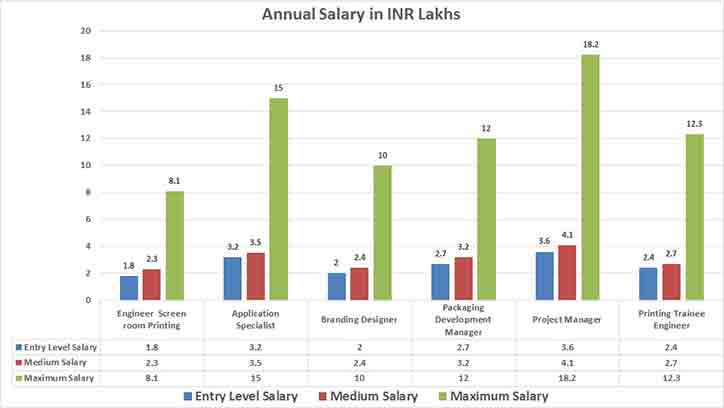
B.Tech in Printing Technology Salary
| Bachelor of Technology [B.Tech] (Printing Technology) | Entry Level Salary (LPA) | Medium Salary (LPA) | Maximum Salary (LPA) |
|---|---|---|---|
| Engineer Screen room Printing | 1.8 | 2.3 | 8.1 |
| Application Specialist | 3.2 | 3.5 | 15 |
| Branding Designer | 2 | 2.4 | 10 |
| Packaging Development Manager | 2.7 | 3.2 | 12 |
| Project Manager | 3.6 | 4.1 | 18.2 |
| Printing Trainee Engineer | 2.4 | 2.7 | 12.3 |
Frequently Asked Questions (FAQs)
1. What is B.Tech in Printing Technology?
B.Tech in Printing Technology is a 4‑year undergraduate engineering programme that teaches the science, technology, and processes behind printing and print production, including digital, offset, screen, and packaging printing.
2. Who is eligible to study this course?
To be eligible, students must complete Class 12 (10+2) with Physics, Chemistry, and Mathematics (PCM) and usually have a minimum of around 50 % marks (varies by institute).
3. How long is the B.Tech Printing Technology programme?
The programme lasts 4 years, typically divided into eight semesters with classroom study, lab work, and projects.
4. What subjects are studied in this programme?
Students learn both engineering basics and printing‑specific topics such as printing processes, graphic and layout design, colour science, digital printing, packaging technology, and print finishing techniques.
5. How do admissions work for B.Tech in Printing Technology?
Admissions are usually based on entrance exam scores (like JEE Main, state CETs) or merit in Class 12, depending on the college’s criteria.
6. What skills will I learn from this degree?
You’ll gain skills in print production technology, colour and quality control, pre‑press and post‑press operations, printing equipment handling, graphic design, and print workflow management.
7. What types of jobs can I get after B.Tech in Printing Technology?
Graduates can work as Printing Engineer, Production Manager, Printing Technologist, Quality Control Supervisor, Prepress Operator, Packaging Specialist, and Print Media Designer.
8. Which industries hire graduates of this course?
Job opportunities exist in printing and publishing houses, packaging companies, advertising and media firms, digital print technology companies, and textile printing units.
9. What is the average starting salary after this course?
Salaries vary by role and company, but many fresh graduates earn around ₹3–₹8 lakh per year in India, depending on skills and employer demand.
10. Is B.Tech in Printing Technology a good career choice?
Yes, it’s a good choice if you enjoy working with print and media technologies, graphic design, production systems, and technical processes, and want to enter industries that depend on print and packaging solutions.
Other Popular Courses
Applications for Admissions are open
 Muthoot Business SchoolKochi
 Greater Noida Institute of TechnologyGreater Noida
 Shri Bhawani Niketan Shiksha Samitijaipur
 ITS Dental College, Greater NoidaGreater Noida
 Guru Nanak Dev Dental College & Research InstitutePatiala
 Sri Sukhmani Institute of ManagementNew Delhi
 Somnath Goel Paramedical InstituteYamunanagar
 Lovely Professional UniversityJalandhar
 Sunder Deep Group of InstitutionsGhaziabad
 Saraswati Group of Colleges, MohaliMohali
 IILM University, Greater NoidaGreater Noida
 GD Goenka University, GurgaonGurgaon
 Mai Bhago Ayurvedic Medical CollegeFirozpur
 Guru Nanak Ayurvedic Medical College & HospitalMuktsar
 Kalka Group of InstitutionsMeerut
 Harmony Ayurvedic Medical College & HospitalFirozpur
 Sage University, IndoreIndore
 City College JayanagarBengaluru
 Lamrin Tech Skill UniversityRupnagar
 Himachal Institute of Dental Sciences, SirmaurSirmaur
 Bhagwant Institute of TechnologyMuzaffarnagar
 IIFA Lancaster Institute of DesignBangalore
 Solan Homoeopathic Medical College & HospitalSolan
 Ganga Group Of InstitutionsNew Delhi
 Bhojia Dental College and HospitalSolan
 Manav Rachna University, FaridabadFaridabad
 Rai Technology UniversityBangalore
 ATLAS SkillTech UniversityMumbai
 Gian Sagar medical College & HospitalPatiala
 JK Lakshmipat Universityjaipur