Need Counselling
M.Tech Energy Engineering
 Job Pressure
Medium
 Academic Pressure
Medium
 Early Salary
1.8 LPA - 5.1 LPA
Mid Level Salary3.8 LPA - 7.2 LPA
Senior Salary10.2 LPA - 16 LPA
Table of Contents
- M.Tech Energy Engineering Course Highlights
- About the Programme M.Tech in Energy Engineering
- What is M.Tech in Energy Engineering?
- M.Tech in Energy Engineering Eligibility Criteria
- M.Tech Energy Engineering Syllabus
- M.Tech in Energy Engineering Career Options
- M.Tech in Energy Engineering Scope (Job Types)
- Top Recruiting Companies
- M.Tech in Energy Engineering Salary
M.Tech Energy Engineering Course Highlights
| Duration | 2 Years |
| Course Level | Postgraduate |
| Full-Form | Master of Technology in Energy Engineering |
| Examination Type | Semester based |
| Eligibility | BE/BTech in relevant discipline with 60% aggregate marks |
| Admission Process | Merit or Entrance based |
| Course Fee | INR 50,000 - INR 2,59,000 |
| Average Salary | INR 3.75 LPA - INR 15 LPA |
| Job Positions | Energy Efficiency Engineer, Technical Resource Manager, Test & Balance Engineer, Lecturers/ Professors etc |
| Top Recruiting Companies | BHEL, Aditya Birla Group, Ezon Energy Solutions, Fission Labs, Accenture, M&M, Siemens etc |
About the Programme M.Tech in Energy Engineering
M.Tech with a major in Energy Engineering is a postgraduate degree course which is offered in many universities in India. It generally requires two years to complete when done on a regular basis. But the duration of the course may vary when done in correspondence basis.
The main objective of this course is to provide students a thorough understanding of production, development, utilization, maintenance and management of energy. It also enables them to tackle the issues of environment sustainability.
What is M.Tech in Energy Engineering?
M.Tech in Energy Engineering covers a broad range of topics such as solar, wind energy, tidal energy, OTEC, and biogas etc. The course also deals with energy efficiency, plant engineering, energy services, facility management, environmental compliance and alternative energy technologies.
M.Tech in Energy Engineering Eligibility Criteria
- Students applying for this course must have a Bachelor’s degree or any equivalent (in the related stream) from a recognized university in which they must have scored a minimum of 50% aggregate.
- SC/ ST students have 5% of relaxation in the minimum aggregate.
M.Tech Energy Engineering Syllabus
| Semester-1 | Semester-2 |
|---|---|
| Fuels and Combustion | Energy Systems Modelling & Analysis |
| Advanced Engineering Mathematics | Power System Measurement |
| Advance Heat Transfer | Instrumentation for Thermal Systems |
| Fundamentals of Control Systems | Energy Management |
| Energy Resources, Economics & Environment | Open Elective-II |
| Seminar | Project & Seminar |
| Elective -I | Thermal Utilities |
| Semester-3 | Semester-4 |
| Stage Projects | Evaluation of Project Viva |
| Open Elective IV | Training & Internship |
| Open Elective III | Project work Phase II |
| Project Evaluation | Seminar |
| Model Simulation & evolutionary Technique | - |
M.Tech in Energy Engineering Career Options
Career Options for M.Tech (Energy Engineering) graduates are many. Some of these are Energy Management Engineer, Energy Audit Engineer, Energy Analyst, Energy Optimization & Conservation Engineer, Energy Efficient Devices Designer, Renewable Energy Engineer and Senior Expert.
M.Tech in Energy Engineering Scope (Job Types)
1) Private Sector Career options after M.Tech in Energy Engineering
- Service maintenance engineer
- Industrial engineer
- Electrical engineer- Industrial
- Maintenance Engineer-Construction
- Process Engineer- Plant Design
2) Private Sector Employment areas after M.Tech in Energy Engineering
- Construction Companies
- Utility
- Plant Designing
- Power Plants
3) Public Sector Employment areas after M.Tech in Energy Engineering
- Ministry of New and Renewable Energy
- Ministry of Power
Top Recruiting Companies

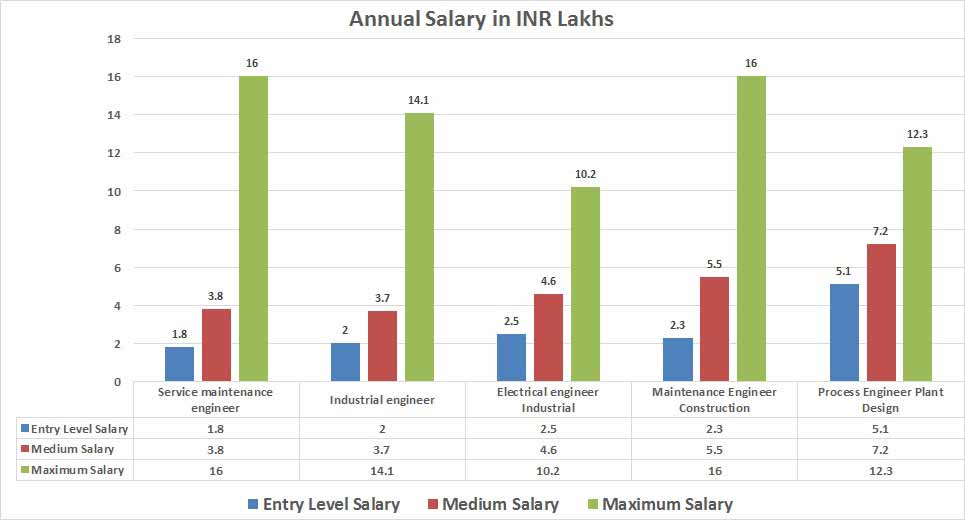
M.Tech in Energy Engineering Salary
| Master of Technology [M.Tech] (Energy Engineering) | Entry Level Salary (LPA) | Medium Salary (LPA) | Maximum Salary (LPA) |
|---|---|---|---|
| Service maintenance engineer | 1.8 | 3.8 | 16 |
| Industrial engineer | 2 | 3.7 | 14.1 |
| Electrical engineer Industrial | 2.5 | 4.6 | 10.2 |
| Maintenance Engineer Construction | 2.3 | 5.5 | 16 |
| Process Engineer Plant Design | 5.1 | 7.2 | 12.3 |
Frequently Asked Questions (FAQs)
1. What is M.Tech in Energy Engineering?
M.Tech in Energy Engineering is a 2‑year postgraduate engineering programme that teaches advanced knowledge of energy production, utilisation, management, renewable energy technologies, and sustainability to address real‑world energy challenges. 2. Who is eligible to study this course? 3. How long does the M.Tech Energy Engineering programme last? 4. What subjects are studied in this course? 5. How do admissions work for M.Tech in Energy Engineering? 6. What skills will I gain from this degree? 7. What career options are available after this course? 8. Which industries hire Energy Engineering graduates? 9. What is the average salary after completing this degree? 10. Is M.Tech in Energy Engineering a good career choice?
Students must have a Bachelor’s degree (B.Tech/B.E.) in relevant disciplines (like Mechanical, Electrical, Chemical, Energy, or similar engineering streams) with minimum required marks (often around 50 % or more).
The course normally lasts 2 years, divided into four semesters of theory, practical work, and project/research.
Students learn topics such as energy systems modelling, energy management, renewable energy technologies (solar, wind, biogas), heat transfer, control systems, and energy economics.
Admission is usually based on entrance exam scores (such as GATE) or merit from undergraduate studies, followed by counselling or institute selection.
You will get skills in energy analysis, renewable energy systems design, energy conservation, project management, sustainable practices, and technical problem‑solving.
Graduates can work as Energy Management Engineer, Renewable Energy Engineer, Energy Audit Specialist, Energy Analyst, Efficiency Engineer, Project Engineer, or Lecturer/Researcher.
Job opportunities exist in renewable energy companies, power generation & utilities, consulting firms, manufacturing plants, energy services firms, and government energy bodies.
Starting salaries typically range from around ₹3.75 LPA to ₹15 LPA or more, depending on skills, job role, and company.
Yes, it’s a promising choice if you enjoy technology, sustainable energy, environmental solutions, and innovation, since the world is increasingly focusing on clean energy and efficient power systems with strong future career demand.
Other Popular Courses
Applications for Admissions are open
 City College JayanagarBengaluru
 Sri Sukhmani Institute of ManagementNew Delhi
 Lovely Professional UniversityJalandhar
 Guru Nanak Dev Dental College & Research InstitutePatiala
 Shoolini UniversitySolan
 Guru Nanak Ayurvedic Medical College & HospitalMuktsar
 Desh Bhagat UniversityFatehgarh Sahib
 Karnavati UniversityGandhinagar
 K.R. Mangalam University, GurgaonGurgaon
 Acharya Bangalore Business SchoolBangalore
 Somnath Goel Paramedical InstituteYamunanagar
 Gokul Global UniversitySiddhpur
 HRIT UniversityGhaziabad
 Sunder Deep Group of InstitutionsGhaziabad
 DBS Global UniversityDehradun
 SDGI Global UniversityGhaziabad
 IILM University, GurugramGurgaon
 Guru Kashi UniversityBathinda
 JK Business School GurugramGurgaon
 Atria UniversityBangalore
 I.T.S Dental college, Murad NagarGhaziabad
 Om Sterling Global UniversityHisar
 GD Goenka University, GurgaonGurgaon
 Solan Homoeopathic Medical College & HospitalSolan
 Kalka Group of InstitutionsMeerut
 Harmony Ayurvedic Medical College & HospitalFirozpur
 Vidya Siri College of PharmacyBangalore
 Muthoot Business SchoolKochi
 IILM University, Greater NoidaGreater Noida
 Ajeenkya DY Patil UniversityPune