Need Counselling

B.A in History
 Job Pressure
Medium
 Academic Pressure
Medium
 Early Salary
1.5 LPA - 2.2 LPA
Mid Level Salary2.6 LPA - 5.8 LPA
Senior Salary6 LPA - 10 LPA
About B.A. in History Course
A Bachelor of Arts is a bachelor’s degree for an undergraduate course with a specialization in History with a duration of 3 years.
This course is designed for students to build their own foundation in the fields of history. It allows them to find the roots of the existence of humans, other creatures, and things.
Why Bachelor of Arts (History)?
This introduces students to ancient times (including the civilization, culture, places, and laws). Also, it promotes the critical thinking, knowledge, analytical and research skills of students.
Eligibility Criteria:
- Applicants must have passed Higher Senior Secondary (10+2) or any equivalent exam from a recognized board. Many of the colleges have a minimum aggregate at Higher Senior Secondary Level as an eligibility criterion.
- SC/ ST have 5% of relaxation in the minimum aggregate.
Career Options:
Bachelor of Arts in History opens up a lot of career opportunities but it is always advisable to go for a Master (Post Graduation) as it adds value to the Bachelor’s Degree.
Some of the career options for B.A. (History) graduates are History Research, Archaeology, Teaching, Public Service, Journalism, Subject Matter Expert, Archivist, Auctioneer, Social Worker, Travel and Tourism Expert, etc.
Private Sector Career Options
- Archaeologist
- Historian
- Auctioneer
- Public Service
- Teacher
- Executive/Associate
- Social Worker
- Subject Matter Expert
- Travel and Tourism Expert
- Archivist
Private Employment Area
- BPO/KPO
- Travel and Tourism
Public Employment Area
- Public Service
- PSBs
Top Recruiting Companies

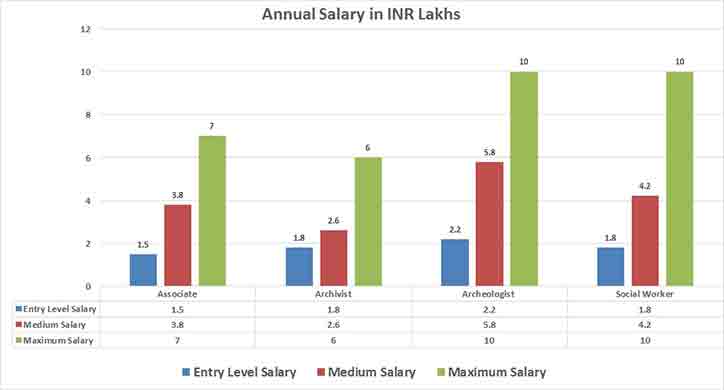
Salary Trends
| Bachelor of Arts [BA] (History) | Entry Level Salary (LPA) | Medium Salary (LPA) | Maximum Salary (LPA) |
|---|---|---|---|
| Associate | 1.5 | 3.8 | 7 |
| Archivist | 1.8 | 2.6 | 6 |
| Archeologist | 2.2 | 5.8 | 10 |
| Social Worker | 1.8 | 4.2 | 10 |
Frequently Asked Questions (FAQs) 2. How long is the course? 3. Who is eligible to study B.A in History? 4. How are admissions done? 5. What subjects are studied in this programme? 6. What skills will I gain from this course? 7. What career options are available after B.A in History? 8. Where can history graduates work? 9. What salary can I expect after graduation? 10. Can I pursue higher studies after B.A in History?
1. What is B.A in History?
B.A in History is a three‑year undergraduate degree that focuses on studying the past events, societies, cultures and civilizations, and understanding how human history has shaped the present and future.
The course normally lasts 3 years, usually structured into six semesters, with a mix of theory, fieldwork, and projects.
To be eligible, you must have completed Class 12 (10+2) from a recognised board in any stream. Many colleges require a minimum percentage of marks (often around 50 % or higher).
Admissions are typically merit‑based on 12th marks in many colleges. Some universities also use entrance exams such as CUET UG or institution‑specific tests for admission.
The syllabus covers Indian history (ancient, medieval and modern), world history, historical methods and research, historiography, archaeology, cultural and social history, and related allied subjects. Projects and fieldwork are often included.
You’ll develop critical thinking, analytical reasoning, research and writing skills, interpretation of historical sources, communication, and an understanding of social and cultural change over time.
Graduates can pursue careers such as historian, archivist, museum curator, teacher (with further qualification), research analyst, writer/editor, tourism/hertage expert, public relations professional, and civil services roles.
Job settings include museums, archives, research institutions, schools and colleges (after B.Ed/M.A), cultural organisations, media houses, publishing, tourism and heritage sites, government departments and think‑tanks.
In India, entry‑level salaries for history graduates typically range roughly from ₹2 LPA to ₹6 LPA or more, depending on role, employer, skills, and experience. Roles with specialised skills (e.g., research or archival management) may pay higher.
Yes — after this degree you can do M.A in History, M.Phil or Ph.D., or professional studies like B.Ed (for teaching), MBA, law (LLB), journalism, archaeology or museum studies to expand your career opportunities.
Other Popular Courses
Applications for Admissions are open
 ITS Dental College, Greater NoidaGreater Noida
 Alliance UniversityBangalore
 Manav Rachna International Institute Of Research And StudiesFaridabad
 I.T.S College of Health and Wellness Sciences, Greater NoidaGreater Noida
 Hierank Business SchoolNoida
 IIFA Lancaster Institute of DesignBangalore
 Harmony Ayurvedic Medical College & HospitalFirozpur
 Bhojia Dental College and HospitalSolan
 Gian Sagar medical College & HospitalPatiala
 I.T.S Engineering CollegeGreater Noida
 SRM University - APGuntur
 Solan Homoeopathic Medical College & HospitalSolan
 Lovely Professional UniversityJalandhar
 IILM University, Greater NoidaGreater Noida
 NIIT UniversityAlwar
 Vidya Siri College of PharmacyBangalore
 Lamrin Tech Skill UniversityRupnagar
 Guru Kashi UniversityBathinda
 Amity University, GurugramGurgaon
 Mai Bhago Ayurvedic Medical CollegeFirozpur
 Rai Technology UniversityBangalore
 UID Ahemdabad & Delhi NCRGurgaon
 Chanakya UniversityBangalore
 Atria UniversityBangalore
 Nims UniversityJaipur
 Shri Bhawani Niketan Shiksha Samitijaipur
 Kalka Group of InstitutionsMeerut
 Somnath Goel Paramedical InstituteYamunanagar
 IILM University, GurugramGurgaon
 Centurion University of Technology and Management, BhubaneswarBhubaneswar