Need Counselling
MD in Anatomy
 Job Pressure
Medium
 Academic Pressure
Medium
 Early Salary
2L LPA - 4L LPA
Mid Level Salary4L LPA - 7L LPA
Senior Salary6L LPA - 8L LPA
Table of Contents
- MD in Anatomy Course Highlights
- MD in Anatomy Overview
- Eligibility Criteria for MD in Anatomy Course
- Require Skills set
- MD in Anatomy Course Syllabus
- Common Entrance Examination for MD in Anatomy Course
- Job Profile after MD in Anatomy Course
- Top Recruiting Companies
- MD in Anatomy Course Approx. Salary Trends in Lakh Per Annum*
- Annual Salary Trend
- Watch the video What are the career options after MD in Anatomy Course | eligibility, entrance exam, fee and scope
MD in Anatomy Course Highlights
| Course Level | Post Graduate |
| Duration | 3 Years |
| Examination type | Semester System |
| Eligibility | M.B.B.S. degree with minimum 55% marks from a recognized university board |
| Admission Process | Based on Entrance Exam |
| Course Fee | INR 10,000 to 2,80,000 |
| Average Starting Salary | INR 1,00,000 to 9,00,000 |
MD in Anatomy Overview
M. D. Anatomy of Doctor of Medicine in Anatomy is a two-year post-graduate degree course in the field of Anatomy. It deals in providing training and knowledge about using descriptions and communications for describing the body in a proper framework and through appropriate vocabulary. It concerns the human body structure and includes a wide range of training programs like Gross and Regional Anatomy, Anthropology, Comparative Embryology, General Histology, Staining Techniques, Outline of Evolution, Radiological Anatomy, Surface Anatomy and marking of Human Body, etc.
Eligibility Criteria for MD in Anatomy Course
- Prospective students should have completed an M.B.B.S. degree with minimum 55% marks from a recognized university board
- Some reputed colleges and universities conduct an entrance examination for admission
MD Anatomy Admission
Require Skills set
- Have a thorough understanding of the complex equipment to operate it
- Handle stressful situations.
- Pay keen attention to even minute details
- Communicate with the healthcare team effectively
- Thorough understanding of the Homeopathic.
- Keep updating themselves with the new developments in the profession.
MD in Anatomy Course Syllabus
- Embryology
- Histology
- Neuroanatomy
- Immunology
- Radiology,surface marking
- Histochemical methods
- Gross anatomy
- Cytogenetics
- Applied anatomy
Common Entrance Examination for MD in Anatomy Course
- Aligarh Muslim University Entrance Exam
- All India Post Graduate Medical Entrance Examination (AIPGMEE)
- Allahabad University Entrance Exam
- Amrita Vishwa Vidyapeetham University Entrance Exam
- Anna University Entrance Exam
- Annamalai University Entrance Exam
- Assam Agricultural University Entrance Exam
- Assam University Entrance Exam
- Baba Farid University of Health Sciences Entrance Exam
- Babasaheb Bhimrao Ambedkar Bihar University Entrance Exam
- Banaras Hindu University Entrance Exam
- Bangalore University Entrance Exam
- Bharathiar University Entrance Exam
- Bharati Vidyapeeth University Entrance Exam
- Bhavnagar University Entrance Exam
- Calicut University Entrance Exam
- Chaudhary Charan Singh University Entrance Exam
- Chettinad University Entrance Exam
- Chhatrapati Shahuji Maharaj Medical University Entrance Exam
- Dibrugarh University Entrance Exam
Job Profile after MD in Anatomy Course
- Anatomy Reader
- Lecturer
- Public Health Specialists
- Professor
- Medical Coder
- Medical Coder Trainee
- Medical Transcriptionist
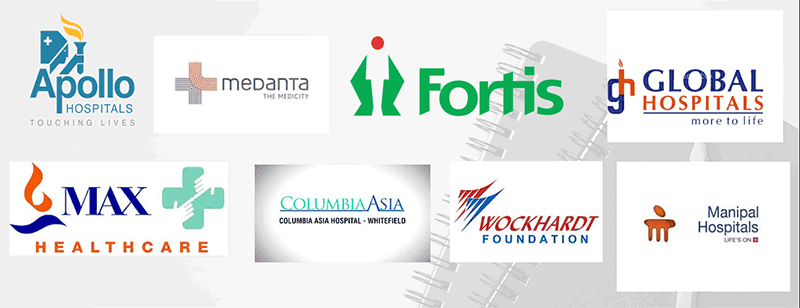
Top Recruiting Companies
MD in Anatomy Course Approx. Salary Trends in Lakh Per Annum*
| Job Profile | Average Entry Level Salary | Average Medium Salary | Average Maximum Salary |
| Anatomy Reader | 4.0 | 5.0 | 7.0 |
| Medical Coder | 2.0 | 2.5 | 4.2 |
| Lecturer | 2.0 | 3.2 | 4.0 |
| Team Leader | 6.0 | 6.5 | 8.0 |
| Configuration Analyst | 1.2 | 2.4 | 3.6 |
| Proof Reader | 2.4 | 3.6 | 5.0 |
Annual Salary Trend
Frequently Asked Questions (FAQs) 2. Who is eligible to study MD in Anatomy? 3. How long is the MD in Anatomy programme? 4. How do admissions work for MD in Anatomy? 5. What subjects are studied in MD in Anatomy? 6. What skills will I gain from this degree? 7. What career options are available after MD in Anatomy? 8. Where can MD Anatomy graduates work? 9. What is the average salary after MD in Anatomy? 10. Is MD in Anatomy a good career choice?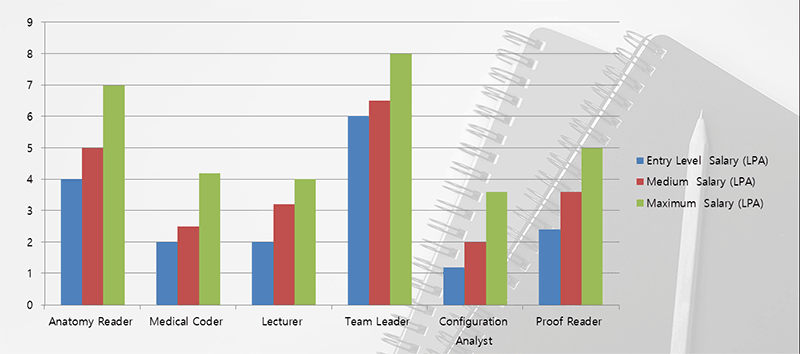
1. What is MD in Anatomy?
MD in Anatomy (Doctor of Medicine in Anatomy) is a postgraduate medical course that focuses on the detailed study of the human body’s structure, including gross anatomy, embryology, histology and neuroanatomy, often with practical dissections and clinical correlations. It develops strong anatomical knowledge used in medical science.
To be eligible, you must have an MBBS degree from a recognised medical college, complete a one‑year compulsory internship, and qualify in the NEET‑PG or equivalent postgraduate medical entrance exam. You must also be registered with the National Medical Commission (NMC) or a State Medical Council.
The programme typically lasts 3 years of full‑time study, covering theoretical and practical anatomical sciences.
Admissions are usually based on NEET‑PG exam scores followed by counselling conducted by national or state authorities. Some institutes may also accept other medical postgraduate entrance tests like AIIMS PG or JIPMER PG.
The curriculum covers topics such as gross and regional anatomy, neuroanatomy, embryology, histology, medical imaging anatomy, applied anatomy, research methodology, and dissection techniques, with practical labs and dissections.
You’ll learn deep anatomical knowledge, dissection skills, microscopic techniques, radiological interpretation, clinical correlations, research and teaching skills, which are essential for academic and research work.
Graduates can work as Anatomy Lecturer/Professor in medical colleges, Medical Researcher, Clinical Anatomist, Forensic or Biomedical Scientist, Medical Writer, or Medical Illustrator. They may also pursue Ph.D. or advanced research.
Job opportunities include medical colleges and universities, research institutes, hospitals, forensic laboratories, educational publishers, and healthcare training centres where advanced anatomical expertise is needed.
In India, salaries vary by role and experience. Entry‑level salaries can start from around ₹2 LPA to ₹7 LPA, and experienced professionals in teaching, research, or specialised roles may earn ₹6 LPA to ₹15 LPA or more.
Yes — it’s a solid choice if you enjoy biological sciences, anatomy, research, and teaching. It offers stable academic and research careers, and strong foundational knowledge that supports work in healthcare education, forensic services, and allied medical fields.
Watch the video What are the career options after MD in Anatomy Course | eligibility, entrance exam, fee and scope
Watch the video: What are the career options after MD in Anatomy
Other Popular Courses
Applications for Admissions are open
 GNIOT Institute of Management Studies (GIMS)Greater Noida
 SDGI Global UniversityGhaziabad
 Chanakya UniversityBangalore
 Swami Devi Dyal Hospital and Dental CollegePanchkula
 Apeejay Stya UniversitySohna
 Harmony Ayurvedic Medical College & HospitalFirozpur
 I.T.S Dental college, Murad NagarGhaziabad
 Amity University, GurugramGurgaon
 IIFA Lancaster Institute of DesignBangalore
 Gian Sagar medical College & HospitalPatiala
 I.T.S College of Health and Wellness Sciences, Greater NoidaGreater Noida
 Kalka Group of InstitutionsMeerut
 NIIT UniversityAlwar
 Shoolini UniversitySolan
 Hierank Business SchoolNoida
 ITS Dental College, Greater NoidaGreater Noida
 Presidency UniversityBangalore
 Rai Technology UniversityBangalore
 Bhojia Dental College and HospitalSolan
 Somnath Goel Paramedical InstituteYamunanagar
 Shri Bhawani Niketan Shiksha Samitijaipur
 City College JayanagarBengaluru
 Vidya Siri College of PharmacyBangalore
 Ajeenkya DY Patil UniversityPune
 Guru Kashi UniversityBathinda
 Manav Rachna University, FaridabadFaridabad
 Sri Sukhmani Institute of ManagementNew Delhi
 Om Sterling Global UniversityHisar
 K.R. Mangalam University, GurgaonGurgaon
 IILM University, Greater NoidaGreater Noida