Need Counselling
M.Sc in Anatomy
 Job Pressure
Medium
 Academic Pressure
Medium
 Early Salary
2L LPA - 4L LPA
Mid Level Salary4L LPA - 6L LPA
Senior Salary8L LPA - 12L LPA
Table of Contents
- M.Sc in Anatomy Course Highlights
- M.Sc in Anatomy Overview
- Eligibility Criteria for M.Sc in Anatomy Course
- Require Skills set
- Common Entrance Examination for M.Sc in Anatomy Course
- M.Sc in Anatomy Course Syllabus
- Job Profile after M.Sc in Anatomy Course
- Top Recruiting Companies
- M.Sc in Anatomy Course Approx. Salary Trends in Lakh Per Annum*
- Annual Salary Trend
- Watch the video M.Sc Anatomy Course, Admission Eligibility, Fees, Scope and Salary
M.Sc in Anatomy Course Highlights
| Course Level | Post Graduate |
| Duration | 2 Years |
| Examination type | Semester and Annual System |
| Eligibility | B.Sc. in (Anatomy) |
| Admission Process | Entrance exam and Merit-Based |
| Course Fee | INR 5,000 to 5,00,000 |
| Average Starting Salary | INR 2,00,000 to 10,00,000 |
| Employment Areas | Applied Arts & Science Institutions, Biomedical Research Laboratories (Colleges/Universities), Defense Services, Government Research Institutes, Hospitals, Industrial Biotechnology Companies, Private Clinics, etc. |
| Job Profiles | Associate Professor Anatomy, Health Industry, Medical Scientist, Research Assistant, Sr. Medical Coder, Teaching/Research, etc. |
| Top Recruiting Organizations | CIPLA, Fortis, Kauvery Hospital, Cadila Healthcare, AIIMS, etc. |
M.Sc in Anatomy Overview
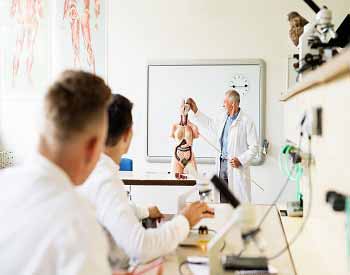
Master of Anatomy provides a substantial base for the study of anatomy deeply; which actually is the base of teaching or research. It gives a good opportunity to learn and study about the human body through dissections with safe handling of the body from its arrival to disposal. It is basically a scientific way to study the morphology of the human body.
One gets a chance to learn about Gross anatomy, Microscopic anatomy, and Neuroanatomy in detail through theoretical sessions as well practical and viva voice.
Eligibility Criteria for M.Sc in Anatomy Course
- The candidate should obtain a minimum of 50% marks in the entrance exam organized by the University or college for enrollment.
M.Sc Anatomy Admission
Require Skills set
- Good communication and observation
- Ability to answer questions and offer advice
- Dealing with emotionally charged situations
- Decision Making Skills
- Organisational Skills
Common Entrance Examination for M.Sc in Anatomy Course
- Calicut University PG Admissions
- Madras University PG Admission
- SRM University UG and PG Medical Admission
- KUHS PG Medical Admission
- Amrita Vishwa Vidyapeetham PG Medical, Dental and Pharmacy Admission
- Manipal University PG Admission
M.Sc in Anatomy Course Syllabus
| YEAR I | YEAR II |
|---|---|
| Basics of Anatomy | General Anatomy |
| Basics of Biochemistry | Practical |
| Basics of Physiology | Dissertation |
| Research Methodology and Biostatistics | - |
Job Profile after M.Sc in Anatomy Course
- Associate Professor Anatomy
- Health Industry
- Medical Scientist
- Research Assistant
- Sr. Medical Coder
- Teaching/Research
Top Recruiting Companies
M.Sc in Anatomy Course Approx. Salary Trends in Lakh Per Annum*
| Job Profile | Average Entry Level Salary | Average Medium Salary | Average Maximum Salary |
| Medical Coder | 2.0 | 3.0 | 4.0 |
| Assistant Professor/ Lecturer | 8.0 | 9.0 | 12 |
| Research Assistant | 6.0 | 6.5 | 8.0 |
| Medical Scientist | 5.0 | 6.0 | 7.0 |
| Genetic Counselors | 4.0 | 5.0 | 6.0 |
Annual Salary Trend
Frequently Asked Questions (FAQs) 2. How long does the M.Sc in Anatomy programme last? 3. Who is eligible to study M.Sc in Anatomy? 4. How are admissions done for this course? 5. What subjects are studied in M.Sc in Anatomy? 6. What skills will I gain from this degree? 7. What career options are available after M.Sc in Anatomy? 8. Where can M.Sc Anatomy graduates work? 9. What is the average starting salary after this course? 10. Is M.Sc in Anatomy a good career choice?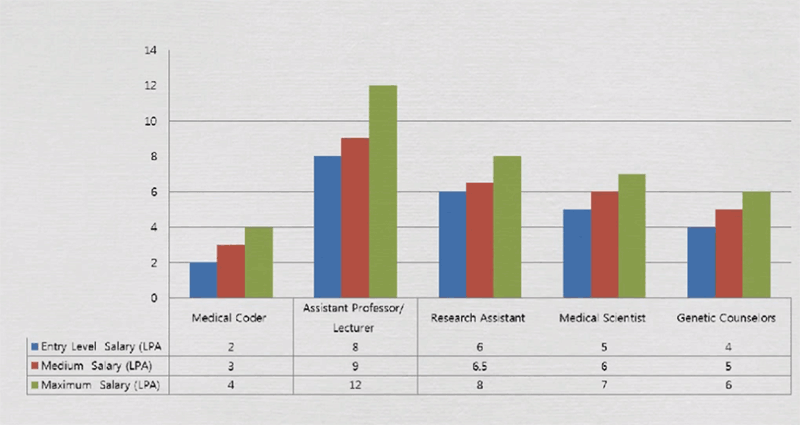
1. What is M.Sc in Anatomy?
M.Sc in Anatomy is a postgraduate science programme that provides an in‑depth study of the human body’s structure, including gross anatomy, embryology, histology, and neuroanatomy through theory and practical lab work.
Typically, the course duration is 2 years (4 semesters) in many universities, though some institutions offer a 3‑year programme based on their curriculum structure.
Eligibility generally requires a Bachelor’s degree in Anatomy or a related life sciences field (e.g., B.Sc Anatomy, life sciences) with at least around 50% marks, and some places accept other science graduates with biological subjects.
Admissions are usually based on merit in the qualifying degree and/or entrance exams conducted by universities. Counselling or direct selection may be part of the process.
The syllabus typically includes basics of anatomy, physiology, biochemistry, embryology, neuroanatomy, applied anatomy, practical laboratory work, research methodology, and dissertation/project work.
You will learn advanced anatomical knowledge, laboratory dissection and analysis skills, research methods, data interpretation, clinical correlation understanding, and academic writing skills.
Graduates can work as Anatomy Professors/Lecturers, Research Assistants, Medical Scientists, Medical Coders, Biomedical Technicians, Medical Writers, or Lab Instructors.
Job opportunities exist in colleges and universities, research labs, hospitals, diagnostic centers, biotech and pharmaceutical firms, teaching institutes, and government research organisations.
Typical entry‑level salary ranges from around ₹2 LPA to ₹10 LPA in India, varying by job role, organisation, and experience.
Yes — it’s a good choice if you enjoy biological sciences and detailed study of the human body, and want a career in teaching, research, healthcare education, or lab‑based scientific work. It also provides a foundation for further studies like Ph.D. or specialised research roles.
Watch the video M.Sc Anatomy Course, Admission Eligibility, Fees, Scope and Salary
Watch the video: M.Sc Anatomy Course
Other Popular Courses
Applications for Admissions are open
 Ajeenkya DY Patil UniversityPune
 Woxsen UniversityHyderabad
 SRM University - APGuntur
 Chandigarh University OnlineMohali
 Sri Sukhmani Institute of ManagementNew Delhi
 Amity University, MohaliMohali
 Sunder Deep Group of InstitutionsGhaziabad
 Somnath Goel Paramedical InstituteYamunanagar
 Apeejay Stya UniversitySohna
 Om Sterling Global UniversityHisar
 Hierank Business SchoolNoida
 Jayoti Vidyapeeth Women’s UniversityJaipur
 Amity University, GurugramGurgaon
 JK Business School GurugramGurgaon
 Presidency UniversityBangalore
 Karnavati UniversityGandhinagar
 Bennett University, Greater NoidaGreater Noida
 Gian Sagar medical College & HospitalPatiala
 ATLAS SkillTech UniversityMumbai
 St Andrews Institute Of Technology And ManagementGurgaon
 Solan Homoeopathic Medical College & HospitalSolan
 Swami Devi Dyal Group of Professional InstitutionsPanchkula
 IIFA Lancaster Institute of DesignBangalore
 GNIOT Institute of Management Studies (GIMS)Greater Noida
 MERI CollegeNew Delhi
 Manav Rachna University, FaridabadFaridabad
 UNITEDWORLD INSTITUTE OF DESIGNAhmedabad
 Rai Technology UniversityBangalore
 Atria UniversityBangalore
 Chanakya UniversityBangalore