Need Counselling
M.Sc Pharmaceutical Chemistry
 Job Pressure
Medium
 Academic Pressure
Medium
 Early Salary
3L LPA - 6L LPA
Mid Level Salary5L LPA - 7L LPA
Senior Salary7L LPA - 9L LPA
Table of Contents
- M.Sc in Pharmaceutical Chemistry Course Highlights
- M.Sc in Pharmaceutical Chemistry Course Overview
- Eligibility criteria for M.Sc in Pharmaceutical Chemistry Course
- Require Skills set
- Common Entrance Examination for M.Sc in Pharmaceutical Chemistry Course
- M.Sc in Pharmaceutical Chemistry Course Syllabus
- Job Profile after M.Sc in Pharmaceutical Chemistry Course
- Top Recruiting Companies
- M.Sc in Pharmaceutical Chemistry Course Approx. Salary Trends in Lakh Per Annum*
- Annual Salary Trend
- Watch the video M.Sc in Pharmaceutical Chemistry | Course Details in Hindi | Scope, Salary, Top Recruiting Companies
M.Sc in Pharmaceutical Chemistry Course Highlights
| Course Level | Post Graduate |
| Duration | 2 Years |
| Examination type | Semester/Annual System |
| Eligibility | B.Sc. completed from a recognized university |
| Admission Process | Merit-based/ Based on the performance in Entrance Test |
| Course Fee | INR 1,000 to 2,00,000 |
| Average Starting Salary | INR 3,00,000 to 12,00,000 |
| Employment Areas | Pharmaceutical industry, colleges & universities, biotechnological companies, chemical or biomedical industries, scientific industries, govt./ pvt. hospitals, defense services, etc. |
| Job Profiles | Scientist/Research Officer, Research Executive, Professor, Quality Control & Quality Assurance Analyst, Scientific Data Entry Specialist, Patent Analyst, Pharmaceutical Patent Analyst, Assistant Manager, etc. |
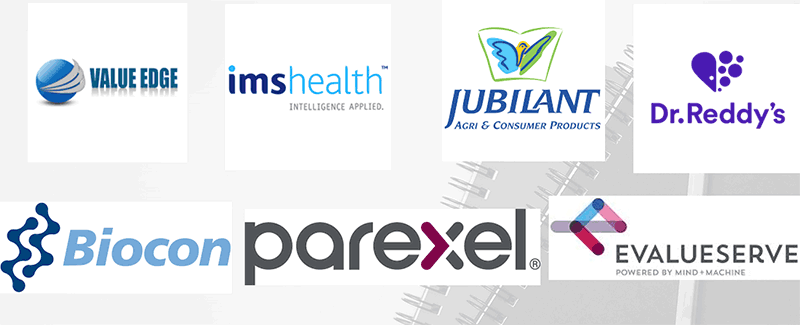
| Top Recruiting Organizations | Value Edge Research, Dr. Reddy’s Laboratories, eValueserve, IMS Health, Jubilant, Biocon, Parexel, NCBS, TIFR, Indian Institute of Technology, Gratisol labs limited, Hygro Chemicals Pvt. Ltd., Novartis Healthcare Pvt. Ltd., Syngene International Limited, Hemmo Pharmaceuticals Private limited, Bakson Drugs Pharmaceuticals Pvt. Ltd., Locusera Solutions Pvt Ltd., etc. |
M.Sc in Pharmaceutical Chemistry Course Overview
M. Sc. Pharmaceutical Chemistry or Master of Science in Pharmaceutical Chemistry is a two-year post-graduate course in Pharmacy. This course concentrates on synthetic organic chemistry, pharmacology and also on specializing in other biological arenas. Students get involved in designing, synthesizing and developing chemicals for the pharmaceutical agents (drugs). This course is highly rewarding at the end of its completion and can fetch jobs in various segments of the medical industry.
Eligibility criteria for M.Sc in Pharmaceutical Chemistry Course
- Graduation (B.Sc.), completed from a recognized university.
- A minimum aggregate score of 50% (45% for SC/ST/OBC candidates) at the level of graduation.
Require Skills set
- Skills in Information Technology
- Aptitude for research and analysis
- Project Management Skills
- Time Management and Organizational Skills
- Ability to critically evaluate data
- Interpersonal and team-work abilities
Common Entrance Examination for M.Sc in Pharmaceutical Chemistry Course
- Acharya Nagarjuna University M.Sc. Chemistry Entrance Exam
- Annamalai University M.Sc. in Chemistry Entrance Examination
- Banaras Hindu University (BHU) M.Sc. Chemistry Entrance Exam
- Calicut University M.Sc. Chemistry Entrance Exam
- Cochin University of Science and Technology Common Admission Test
- Department of Chemistry, University of Pune M.Sc. Chemistry Entrance Exam
- Indian Institute of Science M.Sc. Chemistry Entrance exam
- Indian Institute of Technology Joint Admission Test (IIT JAM)
M.Sc in Pharmaceutical Chemistry Course Syllabus
| Year I | Year II |
| Advanced Organic Chemistry | Phyto-chemistry Lab |
| Pharmaceutical Chemistry I | Communicative English II (Common to M.Sc., M.C.A.) |
| Chemical & Instrumental Methods of Drug Analysis | Process Chemistry in Pharmaceutical Industry |
| Organic Synthesis Lab | Medicinal Chemistry |
| Medicinal Chemistry Lab | Analytical Techniques in Chemistry |
| Communicative English I (common to M.Sc., M.C.A.) | Computer Application/Basics (Common to Organic Chemistry) |
| Advanced Chromatographic Techniques | Computer Application/Basics Lab |
| Pharmaceutical Chemistry II | Chemical Methods of Drug Analysis Lab |
| Bio Organic Chemistry (common to organic chemistry) | Pharmaceutical Quality Control and Quality Assurance |
| Phyto-chemistry (Common to Organic Chemistry) | Enzyme Technology |
| Pharmaceutical Chemistry Lab | Project Work |
Job Profile after M.Sc in Pharmaceutical Chemistry Course
- Scientist/Research Officer
- Research Executive
- Professor
- Quality Control & Quality Assurance Analyst
- Scientific Data Entry Specialist
- Patent Analyst
- Pharmaceutical Patent Analyst
- Assistant Manager
Top Recruiting Companies
M.Sc in Pharmaceutical Chemistry Course Approx. Salary Trends in Lakh Per Annum*
| Job Profile | Average Entry Level Salary | Average Medium Salary | Average Maximum Salary |
| Research Scientist | 6.0 | 6.75 | 8.0 |
| Research Officer | 6.0 | 7.5 | 9.0 |
| Professor | 7.0 | 8.0 | 9.0 |
| Data Entry Specialists | 3.0 | 4.5 | 6.0 |
| Assistant Manager | 5.0 | 6.0 | 7.0 |
Annual Salary Trend
Frequently Asked Questions (FAQs) 2. How long is the M.Sc Pharmaceutical Chemistry course? 3. Who is eligible to study M.Sc in Pharmaceutical Chemistry? 4. How do admissions work for this course? 5. What subjects are included in the M.Sc Pharmaceutical Chemistry syllabus? 6. What skills will I learn in this programme? 7. What career options are available after this degree? 8. Where can M.Sc Pharmaceutical Chemistry graduates work? 9. What is the average starting salary after completing this course? 10. Is M.Sc in Pharmaceutical Chemistry a good career choice?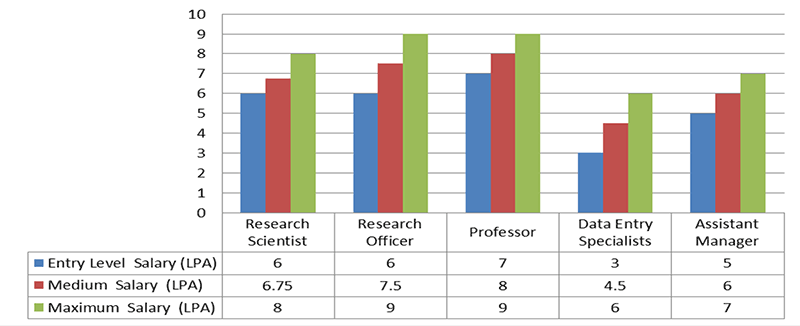
1. What is M.Sc in Pharmaceutical Chemistry?
M.Sc in Pharmaceutical Chemistry is a postgraduate science programme that focuses on the study of drugs — including design, synthesis, analysis and development of medicinal compounds used in healthcare. It combines chemistry fundamentals with drug discovery and pharmaceutical applications.
The programme usually lasts 2 years, divided into four semesters with theory, practical laboratory work, and project research.
Candidates must hold a Bachelor’s degree (B.Sc.) in Science or related fields with Chemistry as one of the subjects and a minimum aggregate score (commonly around 45–55 %) at graduation.
Admissions are generally based on merit from the qualifying degree or entrance exams conducted by some universities; specific criteria may vary by institution.
Typical topics include advanced organic and medicinal chemistry, methods of drug analysis, chromatographic techniques, chemical synthesis, pharmaceutical quality control, and research project work.
You’ll gain drug synthesis and analysis skills, laboratory and instrumentation techniques, research and data interpretation, quality control procedures, and problem‑solving abilities suited for pharmaceutical and research roles.
Graduates can work as Pharmaceutical Scientist, Research Officer, Quality Control/Quality Assurance Analyst, Pharmaceutical Patent Analyst, Assistant Manager, Research Executive, or Professor in various settings.
Job opportunities exist in pharmaceutical companies, research and development (R&D) labs, biotechnology companies, chemical industries, academic institutions, regulatory agencies and hospital research units.
Salaries vary by role and experience. In India, entry‑level packages typically range from around ₹3 LPA to ₹8 LPA or more, and higher salaries (up to ₹15–₹20 LPA or beyond in specialised roles or experienced positions) are possible.
Yes — it is a strong choice if you enjoy chemistry and pharmaceuticals, as the degree opens pathways into drug discovery, formulation, quality and regulatory science, research, academia, and industry leadership roles with growing demand due to the expanding healthcare and pharma sectors.
Watch the video M.Sc in Pharmaceutical Chemistry | Course Details in Hindi | Scope, Salary, Top Recruiting Companies
Watch the video:M.Sc in Pharmaceutical Chemistry | Course Details in Hindi | Scope, Salary, Top Recruiting Companies
Other Popular Courses
Applications for Admissions are open
 JK Lakshmipat Universityjaipur
 Amity University, GurugramGurgaon
 Vidya Siri College of PharmacyBangalore
 GD Goenka University, GurgaonGurgaon
 Nims UniversityJaipur
 Guru Nanak Ayurvedic Medical College & HospitalMuktsar
 Himachal Institute of Dental Sciences, SirmaurSirmaur
 Somnath Goel Paramedical InstituteYamunanagar
 Saraswati Group of Colleges, MohaliMohali
 ATLAS SkillTech UniversityMumbai
 Chanakya UniversityBangalore
 Muthoot Business SchoolKochi
 SRM University - APGuntur
 Guru Kashi UniversityBathinda
 Centurion University of Technology and Management, ParalakhemundiParalakhemundi
 SDGI Global UniversityGhaziabad
 DBS Global UniversityDehradun
 Apeejay Stya UniversitySohna
 ITS Dental College, Greater NoidaGreater Noida
 Bhojia Dental College and HospitalSolan
 Ganga Group Of InstitutionsNew Delhi
 UID Ahemdabad & Delhi NCRGurgaon
 Sunder Deep Group of InstitutionsGhaziabad
 Manav Rachna International Institute Of Research And StudiesFaridabad
 Atria UniversityBangalore
 Manav Rachna University, FaridabadFaridabad
 Lamrin Tech Skill UniversityRupnagar
 Shoolini UniversitySolan
 Gian Sagar medical College & HospitalPatiala
 Guru Nanak Dev Dental College & Research InstitutePatiala