Need Counselling

B.A Philosophy
 Job Pressure
Medium
 Academic Pressure
Medium
 Early Salary
1.5 LPA - 2.6 LPA
Mid Level Salary3.8 LPA - 5.4 LPA
Senior Salary8 LPA - 13.8 LPA
Table of Contents
- BA Philosophy Course Highlights
- About the Programme B.A in Philosophy Course
- Why study B.A in Philosophy?
- Eligibility Criteria B.A in Philosophy Course
- BA Philosophy Syllabus
- Career Options B.A in Philosophy Course
- B.A in Philosophy Course Scope(Job Types)
- Top Recruiting Companies B.A in Philosophy Course
- B.A in Philosophy Course Salary Trends
BA Philosophy Course Highlights
| Duration | 3 years |
| Course Level | Undergraduate |
| Full-form | Bachelor of arts in philosophy |
| Examination Type | Semester / year wise |
| Eligibility | 10+2 (minimum 50% marks )and relaxation to SC/ST/OBC |
| Admission process | Merit based selection or entrance exam |
| Course Fee | INR 5,000- INR 1,50,000 |
| Average Salary | INR 1.56 lakh – INR 10 lakh |
| Top Recruiters | Kotak Securities, CAPGEMINI, United Airlines, Axis Bank, etc. |
| Job Position | Teacher, Public Service, Social Worker, Journalist, Sales Executive, etc. |
About the Programme B.A in Philosophy Course
Bachelor of Arts in Philosophy is a bachelor’s degree for an undergraduate course that takes 3 years to complete. It is the study of assumptions with an exploration into the reality of human activities. It covers science, psychology, law, media, history, and politics.
This course is designed to introduce students to the reality of several assumptions of life.
Why study B.A in Philosophy?
The study of Philosophy develops intellectual qualities, enhances analytical skills, and improves the logical capabilities of students. It gives them the ability to question various assumptions and then answer them with real and scientific facts. It also boosts their ability to think critically and innovatively.
Eligibility Criteria B.A in Philosophy Course
- All candidates applying for Bachelor of Arts (Philosophy) must have completed Senior Secondary (10+2) or any equivalent exam with the required aggregate.
- 5% of relaxation in the minimum aggregate.
BA Philosophy Syllabus
| Semester 1 | Semester 2 |
|---|---|
| Traditional Logic | Virtue Ethics : Aristotle |
| Logic | Ethics |
| Basic Logical Concepts | The fundamental Questions of Ethics |
| Symbolic Logic | Nishkama Karma (Bhagavadgita) |
| Informal Fallacies | Non-Violence (M.K. Gandhi) |
| Semester 3 | Semester 4 |
| Logic | Spinoza : Substance |
| Indian Philosophy | Western Philosophy |
| IInductive Logic | Plato : Knowledge and Opinion |
| Theories of Causation | Leibnitz : Theory of Monads |
| Theories of Reality | Hume : Theory of Causation |
| Semester 5 | Semester 6 |
| Ethics and Philosophy of Religion | Purusharthas |
| Optional Paper | Nature of Svadharma |
| Karma and Rebirth | Varnashrama Dharma |
| Indian Logic and Epistemology | Vedic System of Values |
| Philosophy of Language, Epistemology and Metaphysics (Western) | Concept of Man and Humanity |
Career Options B.A in Philosophy Course
There are many career options available for Philosophy graduates. Some of these are Teachers, HR Executive, Journalist, Sales Executive, Social Worker, and PR & Advertising Executives.
B.A in Philosophy Course Scope(Job Types)
1)Private Sector Career Options
- Teacher
- HR Executive
- Journalist
- Sales Executive
- Social Worker
- PR & Advertising Executive
Apply Now Get More Information
2)Private Employment Area
- PR and Advertising firms
- Public Health and Welfare Organization
- Private Businesses
- Law Firms
- International Agencies
- Education
- Human Resource
- Media & Mass Communication
3)Public Employment Area
- Public Health and Welfare Organization
- Law Firms
Top Recruiting Companies B.A in Philosophy Course

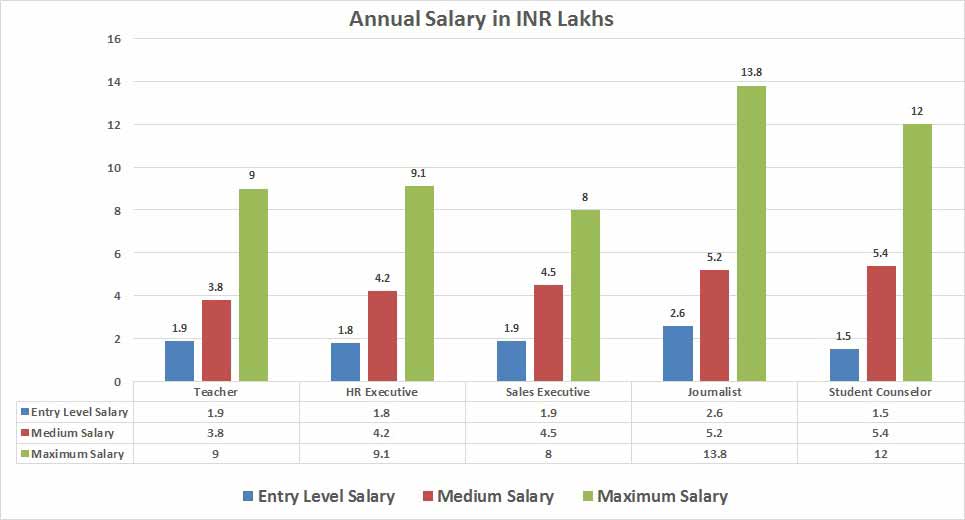
B.A in Philosophy Course Salary Trends
| Bachelor of Arts [BA] (Philosophy) | Entry Level Salary (LPA) | Medium Salary (LPA) | Maximum Salary (LPA) |
|---|---|---|---|
| Teacher | 1.9 | 3.8 | 9 |
| HR Executive | 1.8 | 4.2 | 9.1 |
| Sales Executive | 1.9 | 4.5 | 8 |
| Journalist | 2.6 | 5.2 | 13.8 |
| Student Counselor | 1.5 | 5.4 | 12 |
Frequently Asked Questions (FAQs) 1. What is a B.A in Philosophy? 2. How long does the programme last? 3. Who is eligible to apply for this course? 4. What topics or subjects are studied in this course? 5. What skills do students gain from this programme? 6. What career options are available after B.A in Philosophy? 7. Where can B.A in Philosophy graduates work? 8. What is the typical starting salary after graduation? 9. Can I pursue higher studies after B.A in Philosophy? 10. Is B.A in Philosophy a good career choice?
B.A in Philosophy is a 3‑year undergraduate degree that focuses on studying fundamental questions about existence, knowledge, values, logic, ethics and human reasoning from Indian and Western philosophical perspectives. The course introduces major philosophical ideas and trains students in critical thinking and logical analysis.
The standard duration of a B.A in Philosophy is three years, usually split into six semesters.
Candidates must have completed Class 12 (10+2) or an equivalent qualification from a recognised board. Some colleges may require a minimum percentage (commonly around 50%) in 10+2 for eligibility.
Typical subjects include logic, ethics, Indian and Western philosophy, theories of reality, epistemology, philosophy of religion and metaphysics. Students learn classical and contemporary philosophical texts and ideas.
Students develop critical thinking, analytical reasoning, logical argumentation, effective communication, and problem‑solving skills. These skills are applicable in many fields beyond philosophy itself.
Graduates can pursue roles such as teacher/lecturer, journalist, HR executive, content writer, sales executive, public relations professional, researcher, counselor, policy analyst, or social worker.
Opportunities exist in educational institutions, media and publishing houses, NGOs, corporate HR and communications, public policy and advocacy organisations, research centres and public service roles.
Entry‑level salaries for philosophy graduates in India typically range from approximately ₹2.5 LPA to ₹5 LPA or more in roles like content writing, teaching and corporate entry positions. Salaries can be higher in experienced or specialised roles.
Yes. Common further studies include a Master’s degree in Philosophy (M.A), M.Phil, Ph.D., or professional programmes like law (LLB), MBA, public policy or teaching (B.Ed). Higher studies can open paths in academia, research and specialised professions.
B.A in Philosophy is a flexible and intellectually rigorous degree that excels at building analytical and communication skills. It suits students interested in critical thought, ethics, culture, writing, teaching or research. Career outcomes depend on additional skills, internships and further qualifications.
Other Popular Courses
Applications for Admissions are open
 Mai Bhago Ayurvedic Medical CollegeFirozpur
 Swami Devi Dyal Hospital and Dental CollegePanchkula
 Manav Rachna University, FaridabadFaridabad
 GD Goenka University, GurgaonGurgaon
 K.R. Mangalam University, GurgaonGurgaon
 Acharya Bangalore Business SchoolBangalore
 Bhojia Dental College and HospitalSolan
 Amity University, GurugramGurgaon
 Ramkumari College of Veterinary SciencesJhunjhunu
 Shri Bhawani Niketan Shiksha Samitijaipur
 Shoolini UniversitySolan
 UID Ahemdabad & Delhi NCRGurgaon
 DBS Global UniversityDehradun
 Gian Sagar medical College & HospitalPatiala
 ITS Dental College, Greater NoidaGreater Noida
 Swami Devi Dyal Group of Professional InstitutionsPanchkula
 Gokul Global UniversitySiddhpur
 Pimpri Chinchwad UniversityPune
 Hierank Business SchoolNoida
 Kalka Dental collegeMeerut
 UNITEDWORLD INSTITUTE OF DESIGNAhmedabad
 IILM University, Greater NoidaGreater Noida
 Manav Rachna International Institute Of Research And StudiesFaridabad
 Somnath Goel Paramedical InstituteYamunanagar
 Centurion University of Technology and Management, BhubaneswarBhubaneswar
 I.T.S Engineering CollegeGreater Noida
 Sri Sukhmani Institute of ManagementNew Delhi
 Karnavati UniversityGandhinagar
 IILM University, GurugramGurgaon
 UPES UniversityDehradun