Need Counselling
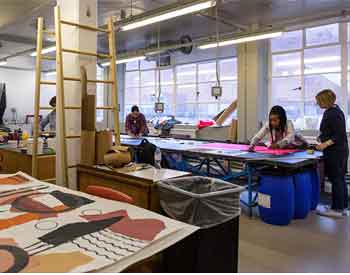
B.A Textile Design
 Job Pressure
Medium
 Academic Pressure
Medium
Table of Contents
B.A in Textile Design Course Highlights
| Program Level | Degree |
| Program Full Name | BACHELOR OF ARTS IN TEXTILE DESIGN |
| Duration of the Program | 3 Years |
| Examination Type | Year |
| Eligibility | 10+2 |
| Admission Process | Entrance Exam and Merit Based |
| Average Program Fee | Upto Rs. 1 Lakh |
About the Programme B.A in Textile Design Course
The Bachelor of Arts course in Textile Design helps the students to gain a detailed understanding of various clothing designs, textile processing, and production activities. Students can prepare clothing designs and patterns in print and soft copy.
BA course in Textile Design is a three-year academic program, consisting of six semesters. In every semester, students are taught designing and creative methodologies for manufacturing textiles. Students who have a creative mind and also have a passion for clothing should opt for this course. On completion of this course, students gain a dimensional perspective for various clothing patterns, textiles, and furnishing product designing. Textiles can be related to home, office-based, and garments.
Students can earn remuneration of around Rs. 2.1 lakhs per annum to Rs. 3.5 lakhs per annum. Students can work as designers and technicians. They occupy job positions such as Textile technologists and Textile designers.
Purpose of B.A in Textile Design Course
Students who are possessed with creative and designing skills should opt for this course. Students are trained with respect to the processing and production of textiles. They can even start an independent practice or work in various textile manufacturing firms. They can also pursue higher education in many academic institutions.
B.A in Textile Design Course Eligibility
For eligibility, students must have scored at least 50% marks in the 10+2 examination from any stream like Science or Commerce or Arts. Students from other recognized boards or academic institutions can also pursue this course.
B.A in Textile Design Course Syllabus
Subjects of Study
| Weaving |
| Practical |
| Dyeing & Printing |
| Practical I |
| Weaving/ Dyeing & Printing |
| Practical II |
| Weaving Dyeing & Printing |
| Practical III |
| Weaving/ Printing |
| Practical IV |
| Weaving Printing |
| Practical VI |
How to apply B.A in Textile Design Course
Students are requested to refer to respective college websites for additional details. Most of the colleges offer admission for this course on the basis of merit systems. Some of the colleges of institutes also ask for designs, graphics, and artworks from the students to evaluate their designing and innovative capabilities. Few colleges also ask for SOP or essays from the students in addition to the application form.
Frequently Asked Questions (FAQs) 1. What is B.A in Textile Design? 2. How long is the B.A in Textile Design programme? 3. Who is eligible to apply for this course? 4. How are admissions done? 5. What subjects are covered in B.A Textile Design? 6. What skills will I gain from this degree? 7. What career options are available after B.A in Textile Design? 8. Where can B.A in Textile Design graduates work? 9. What is the typical salary range after this course? 10. Can I pursue higher studies after B.A in Textile Design?
B.A in Textile Design is a three‑year undergraduate degree that teaches the creative and technical aspects of fabric and textile creation, including weaving, dyeing, printing, surface ornamentation and design thinking for fashion, interiors and industrial textile applications.
The standard duration of the course is 3 years (6 semesters) in most universities and colleges.
Students must have completed Class 12 (10+2) from a recognised board in any stream (Arts, Science, Commerce). Some institutions may require a minimum percentage (around 45–50%) and/or a design aptitude test or portfolio review.
Admissions are generally merit‑based on 10+2 results, though many colleges conduct entrance or design aptitude tests such as NIFT GAT/CAT, NID DAT, Pearl Academy Entrance, CUET or institute‑level exams followed by portfolio review and counselling.
The curriculum typically includes textile science, fabric construction, colour theory, weaving and knit structures, dyeing and printing, traditional and sustainable textiles, computer‑aided textile design (CAD), fashion forecasting, product development and merchandising.
Students develop creative design skills, pattern making, textile CAD software proficiency, colour analysis, trend forecasting, material evaluation, and an understanding of textile production and quality control.
Graduates can work as Textile Designer, Print Designer, Merchandising Executive, Colour Specialist, Quality‑Control Analyst, Product Developer, Design Consultant or Fabric Analyst, among other design and production roles.
Job opportunities exist in fashion and apparel brands, textile mills, export houses, home furnishings and interior design firms, design studios, retail and merchandising companies, and manufacturing units.
Entry‑level salaries for textile and fashion design roles in India generally range around ₹3 LPA to ₹6 LPA, with mid‑level designers often earning ₹7 LPA to ₹10 LPA or more in established companies or design studios as experience grows.
Yes. After graduation, students can pursue postgraduate degrees such as M.A/M.Sc in Textile Design, M.Des, MBA in Fashion Management, or specialised diplomas in design, merchandising and product development to enhance skills and career prospects.
Other Popular Courses
Applications for Admissions are open
 Kalka Dental collegeMeerut
 City College JayanagarBengaluru
 Bennett University, Greater NoidaGreater Noida
 JK Business School GurugramGurgaon
 Shoolini UniversitySolan
 IIFA Lancaster Institute of DesignBangalore
 Ajeenkya DY Patil UniversityPune
 I.T.S College of Health and Wellness Sciences, Greater NoidaGreater Noida
 Presidency UniversityBangalore
 Shri Bhawani Niketan Shiksha Samitijaipur
 IILM University, GurugramGurgaon
 GNIOT Institute of Management Studies (GIMS)Greater Noida
 Amity University, GurugramGurgaon
 NIIT UniversityAlwar
 Nims UniversityJaipur
 SRM University - APGuntur
 Acharya Bangalore Business SchoolBangalore
 ITS Dental College, Greater NoidaGreater Noida
 I.T.S Dental college, Murad NagarGhaziabad
 K.R. Mangalam University, GurgaonGurgaon
 Apeejay Stya UniversitySohna
 Centurion University of Technology and Management, BhubaneswarBhubaneswar
 Guru Kashi UniversityBathinda
 IILM University, Greater NoidaGreater Noida
 Sunder Deep Group of InstitutionsGhaziabad
 MERI CollegeNew Delhi
 Harmony Ayurvedic Medical College & HospitalFirozpur
 Pimpri Chinchwad UniversityPune
 UNITEDWORLD INSTITUTE OF DESIGNAhmedabad
 Chanakya UniversityBangalore