Need Counselling

B.DES Fashion Technology
 Job Pressure
Medium
 Academic Pressure
Medium
 Early Salary
1.9 LPA - 2.12 LPA
Mid Level Salary3.1 LPA - 4.2 LPA
Senior Salary7.2 LPA - 18 LPA
Table of Contents
- Bachelor in Fashion Technology course Highlights
- Bachelor in Fashion Technology course Overview
- Bachelor in Fashion Technology course Course description
- Bachelor in Fashion Technology course Purpose of Course
- Bachelor in Fashion Technology course Eligibility
- Bachelor in Fashion Technology course Syllabus
- Bachelor in Fashion Technology course How to apply
- Bachelor in Fashion Technology course Private Sector Career Options
- Bachelor in Fashion Technology course Scope(Job Types)
- Top Recruiting Companies
- Bachelor in Fashion Technology course Salary Trends
Bachelor in Fashion Technology course Highlights
| Course Level | Undergraduate |
| Admission Process | Entrance Exam |
| Duration | 4 years |
| Full-Form | Bachelor in Fashion Technology |
| Examination Type | Semester wise |
| Eligibility | 10+2 with Physics, Chemistry and Mathematics as compulsory subjects |
| Course Fee | INR 40,000 – INR 2,70,000 |
| Average Salary | INR 2,00,000 – INR 4,50,000 |
| Job Positions | Fit Analysts, Production Controller, Merchandising Executives, Apparel Production Manager, Illustrator, Apparel Merchandiser, Production Pattern Maker, Fabric Quality Controller, Supply Chain Manager, Technical Designer, Shop Floor Manager, Sampling Room Coordinator, Production Planner, Fashion Data Analyst, Technical Audit Manager, Product Engineer, Lean System Manager, Plant Manager, Sustainable Manager, Industrial Engineer |
| Top Recruiting Companies | Arvind Mills, Pantaloon, Raymonds Pvt Ltd, The Shirt Company, Madura Garments, Celebrity Fashions, Fiber& Fabrics International Pvt. Ltd, Color Plus, Modern Denim, Scotts Apparels Group, Gokaldas Exports, Brandix, Bombay Rayon Fashions Ltd., RMX Joss, Gokaldas Exports, Integra Apparels, AYN Accessories (Hong Kong) |
Bachelor in Fashion Technology course Overview
The Bachelor in Fashion Technology course provides the students with a detailed understanding of the management elements of the fashion industry. On completion of this course, students can conceptualize, design, develop, and market fashion products for various clients.
Bachelor in Fashion Technology course Course description
Bachelor in Fashion Technology course is a three-year course and every year consists of two semesters. In addition to the academic program, students need to complete an internship program. This program is scheduled for two to three weeks and is in the third year. After completion of this course, students can go for higher education opportunities and other courses. Students can work in various sectors such as fashion and textile designing, and apparel merchandising.
Graduates from this field can earn around Rs. 1.8 lakhs per annum to Rs. 3 lakhs per annum, depending on their skills and levels of expertise. After gaining years of experience, the remuneration goes up gradually.
Bachelor in Fashion Technology course Purpose of Course
Recently, the fashion industry is offering lucrative and innovative opportunities for students. Thus field is a combination of fashion and technology sectors. During this course, students can learn about methodologies and tools to be utilized in the fashion industry. Students possessing the imaginative ability, creative skills, and management capacities should opt for this course.
Bachelor in Fashion Technology course Eligibility
In order to be eligible for this course, students should have qualified their 10+2 examination in Science stream. They must have scored at least 50% marks in subjects Physics, Chemistry, and Maths. Students from recognized boards or institutes can also apply for this academic program.
Bachelor in Fashion Technology course Syllabus
Even though the most of the course is practical oriented, especially in the third and the fourth year, following are the subjects that are mostly covered in a Bachelor in Fashion Technology course.
| Semester I | Semester II |
|---|---|
| Fundamentals of Textiles | Introduction to Garment Manufacturing Techniques |
| Pattern Making | Introduction to Global Fashion and Textile Industry |
| Textile Science | Fundamentals of Apparel Production |
| Computer Application in Fashion Industry | Apparel Production Technology |
| Semester III | Semester IV |
| Advanced Pattern Making | Visual Merchandising and Presentation |
| Garment Construction | Advanced Garment Construction |
| Fashion Marketing And Merchandising | Production Planning |
| Technical textiles | Application of Information Technology in the Apparel Manufacturing business |
| Semester V | Semester VI |
| Garment Assembling | Export Merchandising |
| Industrial Engineering | Sustainable Production |
| Database Management for Apparel Business | Entrepreneurship |
| Retail Management | Applications of Artificial Intelligence |
| Semester VII | Semester VIII |
| Electives-I | Electives-II |
Bachelor in Fashion Technology course How to apply
Few colleges in India offer this creative course. Hence, students should refer online sources for getting additional information regarding application process and eligibility. Some colleges also offer admission on merit-based system. Students are also supposed to attend counseling session conducted by the respective technology institute.
Bachelor in Fashion Technology course Private Sector Career Options
- Assistant Manager (Fashion House)
- Textile Designer
- Apparel Designer
- Retail Merchandiser
- Production Manager
- Fashion Writer
Bachelor in Fashion Technology course Scope(Job Types)
1)Private Employment Area
- Fashion House
- E-Commerce Fashion Website
- Fashion Magazines
- Self-Employed/Entrepreneur/Startup/Fashion Blog
2)Public Employment Area
Ministry of Textiles
Top Recruiting Companies

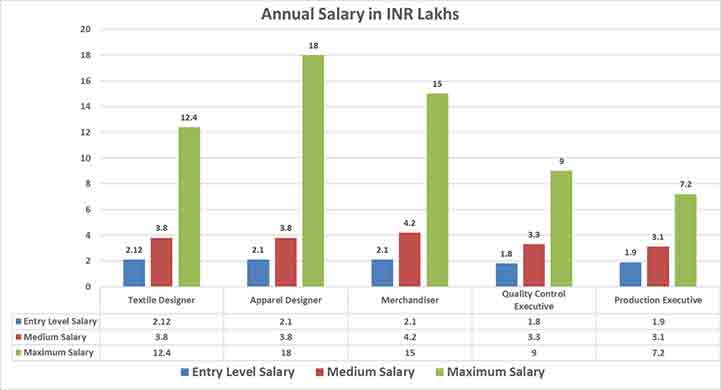
Bachelor in Fashion Technology course Salary Trends
| Bachelor in Fashion Technology | Entry Level Salary (LPA) | Med Salary (LPA) | Max Salary (LPA) |
|---|---|---|---|
| Textile Designer | 2.12 | 3.8 | 12.4 |
| Apparel Designer | 2.1 | 3.8 | 18 |
| Merchandiser | 2.1 | 4.2 | 15 |
| Quality Control Executive | 1.8 | 3.3 | 9 |
| Production Executive | 1.9 | 3.1 | 7.2 |
Frequently Asked Questions (FAQs)
What is B.Des in Fashion Merchandising? What does a fashion merchandiser do? Who is eligible to apply for this course? How long does the programme last? What subjects will I study in this course? Will I get practical or industry experience? What skills will I develop in this programme? What career opportunities are available after B.Des in Fashion Merchandising? Which industries hire fashion merchandising graduates?
10. What is the future scope and salary potential?
B.Des in Fashion Merchandising is a four‑year undergraduate design programme that combines creative fashion knowledge with business and retail skills to help students plan, develop and present fashion products effectively in markets and stores.
A fashion merchandiser ensures that fashion products are right for the right market at the right time, handling planning, pricing, assortment, buying, visual displays and sales strategies for brands, retail stores or online platforms.
Students who have completed 10 + 2 (Class XII) from a recognised board in any stream (Science, Commerce, Arts) are eligible to apply. Specific minimum marks can vary by institute, and some may require design aptitude tests.
The B.Des in Fashion Merchandising typically lasts 4 years, divided into semesters with a mix of theory, practical projects, studio work and internships.
Students learn fashion fundamentals, merchandising principles, retail management, fashion marketing, trend forecasting, visual merchandising, product planning, supply chain basics and digital commerce strategies as part of their coursework.
Yes — the course usually includes hands‑on projects, internships with fashion houses or retail brands, live case studies, work on real displays and merchandising simulations to prepare you for the workplace.
You’ll build market research, trend analysis, product planning, pricing strategy, visual communication, retail operations and business communication skills — all valuable for fashion business and buying roles.
Graduates can work as Fashion Merchandisers, Retail Buyers, Visual Merchandisers, Fashion Marketing Specialists, Product Planners, Brand Assistants, Store Managers, E‑commerce Managers and other roles in fashion business.
Professionals are employed across retail chains, fashion brands, export houses, e‑commerce platforms, buying agencies, brand consultancies and fashion event companies.
With organised fashion retail and online shopping on the rise, skilled merchandisers are in demand. Salary varies by role and experience, with entry‑level packages generally growing as you move into strategic retail or brand management roles.
Other Popular Courses
Applications for Admissions are open
 Kalka Group of InstitutionsMeerut
 Shoolini UniversitySolan
 Chandigarh University OnlineMohali
 Acharya Bangalore Business SchoolBangalore
 NIIT UniversityAlwar
 Desh Bhagat UniversityFatehgarh Sahib
 Solan Homoeopathic Medical College & HospitalSolan
 Shri Bhawani Niketan Shiksha Samitijaipur
 Saraswati Group of Colleges, MohaliMohali
 Hierank Business SchoolNoida
 Om Sterling Global UniversityHisar
 Guru Kashi UniversityBathinda
 Rai Technology UniversityBangalore
 K.R. Mangalam University, GurgaonGurgaon
 Kalka Dental collegeMeerut
 Gian Sagar medical College & HospitalPatiala
 GNIOT Institute of Management Studies (GIMS)Greater Noida
 Atria UniversityBangalore
 Manav Rachna International Institute Of Research And StudiesFaridabad
 Swami Devi Dyal Hospital and Dental CollegePanchkula
 Centurion University of Technology and Management, BhubaneswarBhubaneswar
 Harmony Ayurvedic Medical College & HospitalFirozpur
 Vidya Siri College of PharmacyBangalore
 Sunder Deep Group of InstitutionsGhaziabad
 Pimpri Chinchwad UniversityPune
 Bhagwant Institute of TechnologyMuzaffarnagar
 Nims UniversityJaipur
 I.T.S Dental college, Murad NagarGhaziabad
 Chanakya UniversityBangalore
 SRM University - APGuntur