Need Counselling

B.Sc Statistics
 Job Pressure
Medium
 Academic Pressure
Medium
 Early Salary
1.7 LPA - 2.5 LPA
Mid Level Salary2.7 LPA - 4 LPA
Senior Salary9 LPA - 18.3 LPA
Table of Contents
- B.Sc Statistics Course Highlights
- B.Sc Statistics Overview
- Why Study B.Sc Statistics
- Eligibility Criteria for B.Sc Statistics
- B.Sc Statistics Syllabus
- B.Sc Statistics Admission Process
- Specialization Tracks
- Top Recruiters for B.Sc Statistics Course
- B.Sc Statistics Course Scope(Job Types)
- Top Recruiting Companies after B.Sc Statistics
- Salary Trends for B.Sc Statistics
B.Sc Statistics Course Highlights
| Examination Type | Semester |
| Course Level | Undergraduate |
| Duration of the Course | 3 years |
| Eligibility | 10+2 from a recognized educational board with Maths as one of the major subjects. |
| Admission Process | Merit or Entrance Examination |
| Average Course Fee | INR 20,000-1,50,000 |
| Average Salary | INR 4.5-8 LPA |
| Top Recruiting Companies | Federal bank, Cognizant, IBM, UBS, L&T, Infosys, Wipro, Deloitte, Future First, HDFC Bank, Google, etc. |
| Top Job Areas | Banks, Finance institutions, Educational institutes, R&D firms, Insurance companies, Government organizations, Trading companies, etc. |
| Top Job Positions | Risk analyst, Statistician, Actuary Manager, Research professional, Credit Risk Strategist, Analysis/Statistics Manager, Subject Matter Expert - Statistics, etc |
B.Sc Statistics Overview
BSc Statistics stands for Bachelor of Science in Statistics. This Course Duration for 3-4 years, the course imparts comprehensive knowledge in theories of Mathematics, Probability, and Statistics along with reasoning and proofs. This UG degree involves an introduction to highly advanced notions and assumptions, precise proofs, data analysis and modelling, regression, etc. Statistical software, programming terminologies, and exploration programs are a vital part of the course configuration of numerous universities worldwide.
Why Study B.Sc Statistics
The students will get pertinent skills like data analysis, observation of patterns, reduction of conclusions, etcBSc Statistics is the right course to develop problem-solving skills in an individual this course helps the students to use logical ways to formulate theories and apply similarly to solve problems in the job sector.
Eligibility Criteria for B.Sc Statistics
If you are enthusiastic about pursuing a BSc in statistics, it is crucial to accept all the entry requisites that the universities of abroad demand. Nominees who must have finalized the formal education of 10 + 2 from recognised board petitions must have Mathematics as their core patients in class 12.
Apply Now Get More Information
B.Sc Statistics Syllabus
| Semester 1 | Semester 2 |
|---|---|
| Demoivre’s theorem | Differential Calculus |
| Equations theories, Fundamental theorem of algebra and its consequences. | Review of Differential Equations |
| Inequalities | Review of integration and definite integrals |
| Semester 3 | Semester 4 |
| Statistical Methods | Index Numbers |
| Measures of location (or central tendency) and dispersion | Demand Analysis |
| Probability Theory | Utility and Production Functions |
| Random Variables | Mathematical Finance |
| The expectation of random variables and their properties | Time Series |
| Semester 5 | Semester 6 |
| Sample Surveys | Numerical Analysis |
| Basic sampling methods | Inverse interpolation |
| Stratified random sampling | Numerical integration |
| Fundamental theorem of algebra and its consequences | General Linear models |
B.Sc Statistics Admission Process
Merit-Based: the learners based on merit. In that case, their overall score in the 10+2 grade is very important. Entrance Based: Post authorizing the entrance exams, the shortlisted students may also expect to occur for a Group Discussion and Personal Interview round.
Specialization Tracks
Required at both the UG and PG levels, there are distinct tracks/concentrations which you can prefer in a BSc Statistics course to increase advanced and domain-specific proficiency. Some of the alternatives have been given a rundown below:
- Decision Analytics
- Data Science
- Statistics and Applied Mathematics
- Quantitative Finance
- Bioinformatics
- Monetary Mathematics
- Statistical Biology
Top Recruiters for B.Sc Statistics Course
Now that you are aware of all are the major job profiles that are vacant after finalizing BSc Statistics along with the salary frame, here are some of the top recruiters of this field-
- Infosys
- Wipro
- Cognizant
- UBS
- IBM
- HDFC Bank
Apply Now Get More Information
B.Sc Statistics Course Scope(Job Types)
1)Private Sector Career Options
- Financial Analyst
- Data Analyst
- Financial Accountant
- Operations Officer-Banking
- Analyst- Broking
- Credit Control Executive
- Market Research Analyst
- Content Writer
2)Private Employment Area
- Banking industry
- Financial Services
- Broking Industries
- Accounting and Finance
- Academic and Educational Institutions
3)Public Employment Area
- Ministry of Commerce and Industry/ Ministry of Business
- Ministry of Finance
- Ministry of Law and Justice
Apply Now Get More Information
Top Recruiting Companies after B.Sc Statistics

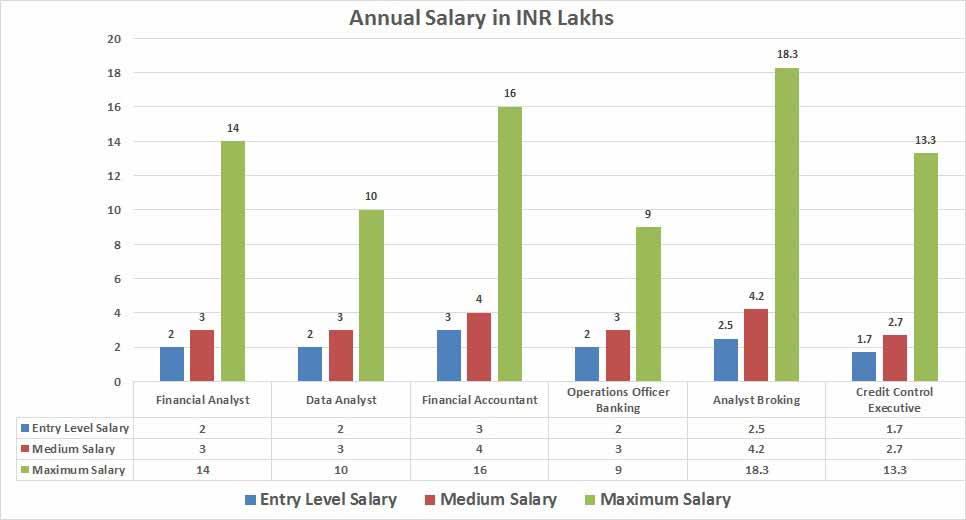
Salary Trends for B.Sc Statistics
| Bachelor of Science [B.Sc] (Statistics) | Entry Level Salary (LPA) | Medium Salary (LPA) | Maximum Salary (LPA) |
|---|---|---|---|
| Financial Analyst | 2 | 3 | 14 |
| Data Analyst | 2 | 3 | 10 |
| Financial Accountant | 3 | 4 | 16 |
| Operations Officer Banking | 2 | 3 | 9 |
| Analyst Broking | 2.5 | 4.2 | 18.3 |
| Credit Control Executive | 1.7 | 2.7 | 13.3 |
Frequently Asked Questions (FAQs)
1. What is B.Sc. Statistics? 2. What is the duration of this course? 3. What are the eligibility criteria for admission? 4. How is admission done for B.Sc. Statistics? 5. What subjects are taught in this course? 6. What skills will I develop in this program? 7. What career opportunities are available after B.Sc. Statistics? 8. What is the average salary after graduating? 9. Can I pursue higher studies after this degree? 10. In which sectors can B.Sc. Statistics graduates find jobs?
B.Sc. Statistics is a three-year undergraduate science degree that focuses on the collection, analysis, interpretation and presentation of numerical data, preparing students to work with real-world data and draw meaningful insights.
The course typically lasts 3 years, usually divided into six semesters.
Students must have completed 10+2 from a recognized board, often with mathematics as a compulsory subject and a minimum aggregate (commonly around 50–60% depending on the institute).
Admissions can be merit-based (12th class marks) or through entrance exams or university/college selection processes, depending on the institution.
Core subjects typically include descriptive statistics, probability theory, sampling techniques, statistical inference, regression analysis, linear algebra and data analysis methods. Many programs also introduce students to statistical software and data computing tools.
Students develop quantitative analysis, problem-solving, data interpretation, critical thinking and proficiency in statistical methods — often with exposure to tools like R, Python, SAS or SPSS.
Graduates can work in roles such as data analyst, statistician, market research analyst, risk analyst, financial analyst, business analyst and research professional across sectors like finance, healthcare, government, IT and consulting.
Entry-level salaries for B.Sc. Statistics graduates typically range from around ₹3 LPA to ₹7 LPA or more, depending on job role, location and experience; mid- to senior-level roles can offer higher packages.
Yes — many students go on to M.Sc. Statistics, M.Sc. Data Science, M.Phil/Ph.D. in Statistics, MBA or other postgraduate programs to enhance knowledge and career prospects.
Statistics graduates find opportunities in banks and financial institutions, research and consulting firms, government statistical offices, healthcare and pharmaceuticals, insurance, analytics companies and educational institutions.
Other Popular Courses
Applications for Admissions are open
 Harmony Ayurvedic Medical College & HospitalFirozpur
 Chandigarh University OnlineMohali
 Vidya Siri College of PharmacyBangalore
 Bhagwant Institute of TechnologyMuzaffarnagar
 Guru Nanak Ayurvedic Medical College & HospitalMuktsar
 I.T.S Engineering CollegeGreater Noida
 Swami Devi Dyal Hospital and Dental CollegePanchkula
 Shoolini UniversitySolan
 Nims UniversityJaipur
 Gian Sagar medical College & HospitalPatiala
 ATLAS SkillTech UniversityMumbai
 Greater Noida Institute of TechnologyGreater Noida
 GNIOT Institute of Management Studies (GIMS)Greater Noida
 UID Ahemdabad & Delhi NCRGurgaon
 Shri Bhawani Niketan Shiksha Samitijaipur
 ITS Dental College, Greater NoidaGreater Noida
 Desh Bhagat UniversityFatehgarh Sahib
 Somnath Goel Paramedical InstituteYamunanagar
 Mai Bhago Ayurvedic Medical CollegeFirozpur
 I.T.S Dental college, Murad NagarGhaziabad
 Muthoot Business SchoolKochi
 NIIT UniversityAlwar
 MERI CollegeNew Delhi
 Sunder Deep Group of InstitutionsGhaziabad
 IILM University, Greater NoidaGreater Noida
 City College JayanagarBengaluru
 IILM University, GurugramGurgaon
 GD Goenka University, GurgaonGurgaon
 Alliance UniversityBangalore
 Ajeenkya DY Patil UniversityPune