Need Counselling
M.Sc Life Science
 Job Pressure
Medium
 Academic Pressure
Medium
 Early Salary
1.4 LPA - 2.4 LPA
Mid Level Salary2.6 LPA - 4.2 LPA
Senior Salary8.3 LPA - 20.2 LPA
Table of Contents
M.Sc in Life Science Course Highlights
| Duration | Course Duration of Master of Science [M.Sc] (Life Science) is 1.8 Years. |
| Degree | Masters |
| Full Form | Master of Science [M.Sc] (Life Science) |
| Age | No age Limit |
| Minimum Percentage | 55% in 10+2 from the recognized Board |
| Subjects Required | Physics, Chemistry , Mathematics and Biology |
| Average Fees Incurred | INR 4000 - 50,000 PA |
| Average Salary Offered | INR 2 - 5 LPA |
| Employment Roles | Manager, Research Scientist, Research Analyst, Food Scientist, Nutritionist, etc |
M.Sc in Life Science Course Overview
M.Sc. in Life Science is a post-graduate degree course offered in many universities in India. The course generally requires two years to complete when done on a regular basis. One can pursue this course through distance learning, however, the duration, in this case, can vary.
Purpose of the M.Sc in Life Science course:
The course is designed to introduce students to the detailed scientific knowledge of living organisms (plants, animals, microorganisms, human beings, etc). This includes the systematic study of biological processes.
What is M.Sc. in Life Science?
M.Sc. in Life Science is the scientific study of molecular and cellular mechanisms of living organisms. The course includes various specializations in it such as Biodynamic, Zoology, Developmental Biology, Molecular Biology, Evolutionary Genetics, Neuroinformatics, and Cognitive Neuroscience.
Why study M.Sc. in Life Science?
The course introduces students to various laboratory techniques as per the requirements of the industry. It helps them to understand and evaluate existing scientific researches and prepares them for the prospective challenges in the field of science.
M.Sc. in Life Science Eligibility Criteria
- Students applying for this course must have a Bachelor’s degree or any equivalent in a related stream from a recognized university.
- They must have scored a minimum of 50% aggregate. SC/ ST have 5% of relaxation in the minimum aggregate.
MSc Life Science Syllabus
| Semester I | Semester II |
|---|---|
| Cell and molecular biology | Microbiology |
| Biochemistry | Ecology |
| Genetics and molecular evolution | Plant Diversity |
| Biophysics | Plant Physiology |
| Life Science practical l | Life Science practical ll and lll |
| Plant Developmental biology | - |
| Semester III | Semester IV |
| Animal Physiology | Safety and first aid |
| Animal diversity | Dissertation |
| Animal Developmental | Seminar l |
| Immunology | Plant cell, tissue and organ culture and transformation |
| Biostatistics | Horticulture, floriculture and landscaping |
| Life Science practical IV | Economics and Ethnobotany |
| - | Animal Systematic and molecular Taxonomy |
Career Opportunities after M.Sc. in Life Science
Food Scientist, Immunologist, Product Manager, Nutritionist, Laboratory Technician, Biology Content Developer, Epidemiologist, Research Analyst, Consultant.
M.Sc in Life Science Course Scope(Job Types)
Private Sector Career Options
- Product manager
- Analyst and consultant in pharmaceuticals
- Food scientist
- Immunologist
- Microbiologist
- Molecular Biology
- Biostatistician
- Quality Control Executive
Apply Now Get More Information
Private Employment Area
- FMCG companies
- Health Care Institutes
- Hospitals
- Health Care Product Manufacturing Organizations
Public Employment Area
- Ministry of Health and Family Welfare
Top Recruiting Companies
Salary Trends
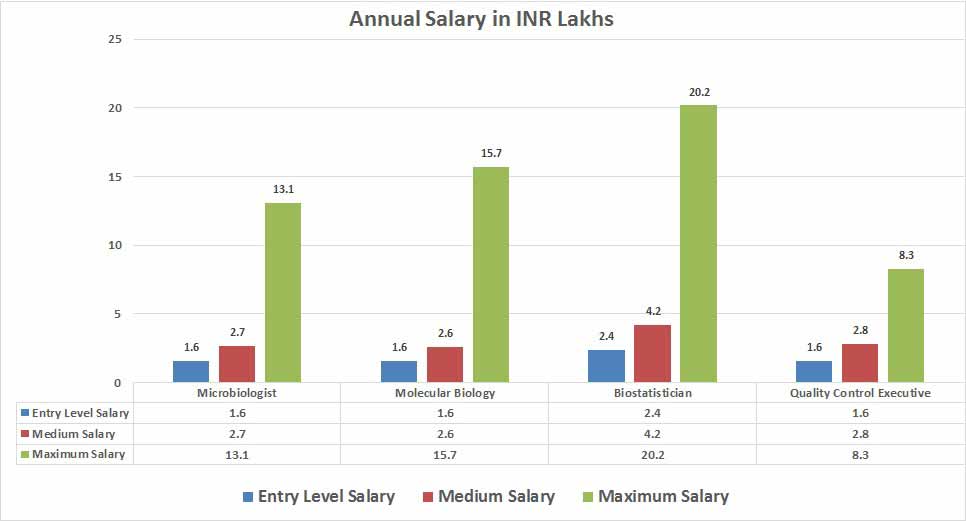
| Master of Science [M.Sc] (Life Science) | Entry Level Salary (LPA) | Medium Salary (LPA) | Maximum Salary (LPA) |
|---|---|---|---|
| Microbiologist | 1.6 | 2.7 | 13.1 |
| Molecular Biology | 1.6 | 2.6 | 15.7 |
| Biostatistician | 2.4 | 4.2 | 20.2 |
| Quality Control Executive | 1.6 | 2.8 | 8.3 |
Other Popular Courses
Applications for Admissions are open
 Pimpri Chinchwad UniversityPune
 Bennett University, Greater NoidaGreater Noida
 IILM University, Greater NoidaGreater Noida
 Chanakya UniversityBangalore
 K.R. Mangalam University, GurgaonGurgaon
 ITS Dental College, Greater NoidaGreater Noida
 Guru Nanak Dev Dental College & Research InstitutePatiala
 MERI CollegeNew Delhi
 Atria UniversityBangalore
 Muthoot Business SchoolKochi
 Guru Kashi UniversityBathinda
 I.T.S College of Health and Wellness Sciences, Greater NoidaGreater Noida
 Alliance UniversityBangalore
 Gokul Global UniversitySiddhpur
 GD Goenka University, GurgaonGurgaon
 Chandigarh University OnlineMohali
 Shoolini UniversitySolan
 Vidya Siri College of PharmacyBangalore
 Somnath Goel Paramedical InstituteYamunanagar
 Harmony Ayurvedic Medical College & HospitalFirozpur
 Karnavati UniversityGandhinagar
 Rai Technology UniversityBangalore
 I.T.S Engineering CollegeGreater Noida
 Bhagwant Institute of TechnologyMuzaffarnagar
 Greater Noida Institute of TechnologyGreater Noida
 Amity University, GurugramGurgaon
 JK Business School GurugramGurgaon
 Swami Devi Dyal Hospital and Dental CollegePanchkula
 Sri Sukhmani Institute of ManagementNew Delhi
 Solan Homoeopathic Medical College & HospitalSolan