Need Counselling
BDes Jewellery Design
 Job Pressure
Medium
 Academic Pressure
Medium
 Early Salary
2.5 LPA - 3 LPA
Mid Level Salary4 LPA - 8 LPA
Senior Salary5 LPA - 9 LPA
Table of Contents
- Bachelor in Jewellery Design Course Highlights
- Know All about Jewellery Design Course
- Where do jewelry designers work?
- Bachelor in Jewellery Design Course
- Common Entrance Exams
- Require Skills set:-Jewellery Design Course
- Bachelor in Jewellery Design Syllabus
- Top Colleges for Jewellery Design Course
- Career Options after Jewellery Design Course
- Job Positions (Profile) after Jewellery Design Course
- Top Recruiting Companies
- Approx. Salary Trends in Lakh Per Annum*
- Watch the video: Career in Jewellery Design India | BDES in Jewellery Design Course | Eligibility, Fee, Scope
- Watch the video: What is Jewellery Designing Course | Eligibility, College, Fee Structure, Scope in India, salary etc
Bachelor in Jewellery Design Course Highlights
| Type | Degree |
| Course Level | Graduation |
| Duration | 3 Years |
| Eligibility | 10+2 with a minimum aggregate score of 50% |
| Admission Process | Merit based or Entrance based |
| Course Fee | INR 2,00,000 to 2,50,000 |
| Average Starting Salary | INR 4,00,000 to 5,00,000 |
| Top Recruiting Sectors | Fashion Accessory Design, Fashion Media, Fashion Show Management, etc |
Know All about Jewellery Design Course
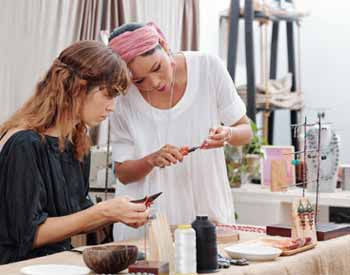
Jewellery designing is a creative art that combines knowledge of conceptualizing jewellery design and then manufacturing various jewellery products. It is an intricate field of study that borrows heavily from the rich historical heritage of India and other countries.
If you are a person with a creative imagination and a fair sense of design, then Jewellery designing can be a good career option for you. ... Jewellery designing courses are all about to know great designing skills, knowledge of metals, precious stones and much more.
Where do jewelry designers work?
Jewelry designers can be self-employed or work in a jewelry store, repair shop, or manufacturing plant. They spend much of their time at a workbench surrounded by the physical tools they need to get the job done. These may include torches, lasers, and various chemicals.
Bachelor in Jewellery Design Course
Successful completion of the 10+2 level of education in any stream, from a recognized board With a minimum aggregate score of 50%
Common Entrance Exams
- National Institute of Design (NID) Exam
- AIEED (All India Entrance Examination for Design)
- CEED (Common Entrance Examination for Design)
- National Institute of Fashion Technology (NIFT) Exam
- National Entrance Examination for Design (NEED)
- School of Fashion Technology (SOFT) Entrance Exam
Require Skills set:-Jewellery Design Course
- Effectively Communicate
- Presentation skills
- Drawing skills
- Innovativeness
- Strong artistic skills
- Cognitive skills
- Perseverance
- Good communication skills
Bachelor in Jewellery Design Syllabus
| Semester I | Semester II |
|---|---|
| Merchandising | Rendering Techniques |
| History of Art and Jewelry | Elements of Design |
| Export Procedure | Design Foundation for Jewellery |
| Retail Management | Designing with different techniques and ideas |
| Branding | Metallurgy and Casting process (Design Theory) |
| Semester III | Semester IV |
| Setting of Gemstones in Jewellery | International Market |
| Gemology | Commercial Skills |
| Diamond Grading | Indian Market |
| Manufacturing Costume Jewelry | Manufacturing Process |
| CAD | Accessory Design |
| Semester V | Semester VI |
| Materials for Design | Product Business Planning |
| Marketing and Advertising | Design Theories and Practices |
| Advanced CAD | Digital Representation |
| Methods and Instruments for Design | Seminar and Workshop |
| Projects and Summer Internship | - |
Top Colleges for Jewellery Design Course
| College Name | Average Annual Fees (Approx.)* |
|---|---|
| MANIPAL UNIVERSITY JAIPUR |
INR 305,000 P.A |
| LOVELY PROFESSIONAL UNIVERSITY JALANDHAR |
INR 126,000 P.A |
| JECRC UNIVERSITY JAIPUR |
INR 1,45,000 P.A |
| SHARDA UNIVERSITY GREATER NOIDA |
INR 164,000 P.A |
| NATIONAL INSTITUTE OF FASHION TECHNOLOGY NAVI MUMBAI |
INR 258,400 P.A |
| NATIONAL INSTITUTE OF FASHION TECHNOLOGY KANGRAX |
INR 164,000 P.A |
| MADRAS INSTITUTE OF FASHION TECHNOLOGY CHENNAI |
INR 100,300 P.A |
Career Options after Jewellery Design Course
1) Career Options:
- Corporate Houses
- Shopping Malls
- Fashion Marketing
- Design Production Management
- Fashion Media
- Boutiques
- Fashion Accessory Design
- Fashion Show Management
- Private Consultancies
Job Positions (Profile) after Jewellery Design Course
- Jewellery Designer
- Gemologist
- Jewellery Consultant
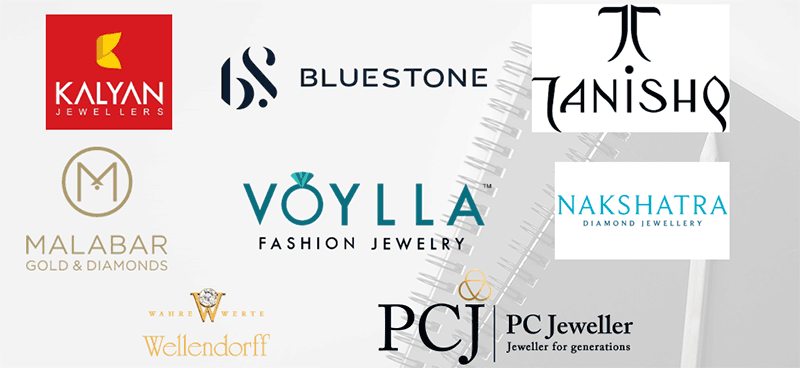
Top Recruiting Companies
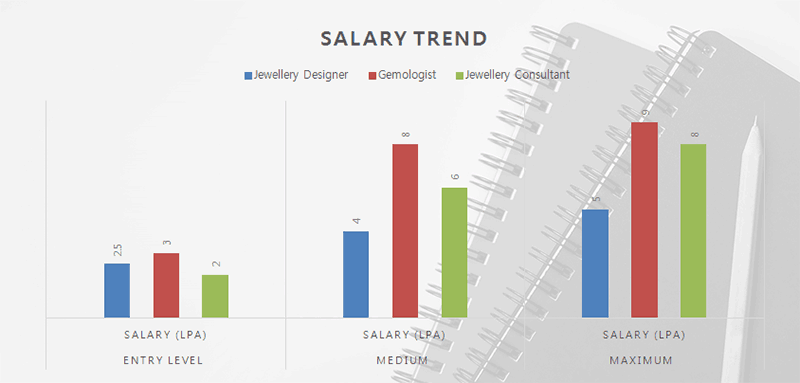
Approx. Salary Trends in Lakh Per Annum*
| Profile | Entry Level Salary (LPA) | Medium Salary (LPA) | Maximum Salary (LPA) |
|---|---|---|---|
| Jewellery Designer | 2.5 | 4.0 | 5.0 |
| Gemologist | 3.0 | 8.0 | 9.0 |
| Jewellery Consultant | 2.0 | 6.0 | 8.0 |
Annual Salary in INR
Frequently Asked Questions (FAQs)
What is B.Des in Jewellery Design? Who is eligible to apply for this course? How long does the B.Des Jewellery Design programme last? What subjects are taught in B.Des Jewellery Design? What skills will I develop in this course? Is practical experience part of the programme? What career opportunities are available after B.Des Jewellery Design? Which industries hire B.Des Jewellery Design graduates? Can I start my own business after completing this degree?
10. What is the expected salary range after graduating?
B.Des (Bachelor of Design) in Jewellery Design is a four‑year undergraduate degree that teaches you how to conceptualise, design and create jewellery pieces — blending creativity, material knowledge, craft techniques, and modern tools like CAD to make wearable art.
To be eligible, students usually need to have completed 10 + 2 (Class XII) from a recognised board with the minimum aggregate required by the institute (often around 45–50 %). Admissions can be based on merit or entrance exams.
This is a four‑year full‑time undergraduate programme and is typically divided into eight semesters with a mix of theory, studio work and practical projects.
The curriculum usually includes design fundamentals, visualization and representation, jewellery manufacturing, CAD (Computer‑Aided Design), gemology, materials and techniques, merchandising, marketing, and portfolio development.
You’ll build creative thinking, sketching and rendering, material and gemstone knowledge, tech skills (like CAD), craftsmanship techniques, trend forecasting, and professional communication skills — all essential for the jewellery industry.
Yes — practical training through workshops, studio sessions, internships, industry collaborations and hands‑on CAD projects is a core part of the course to prepare you for real‑world design challenges.
Graduates can work as Jewellery Designer, CAD Jewellery Designer, Gemologist, Jewellery Consultant, Merchandiser, Retail Buyer, Visual Merchandiser, Jewellery Stylist or even an Entrepreneur launching their own brand.
Jewellery designers are employed by jewellery houses, fashion accessory brands, design studios, retail chains, luxury brands and custom design boutiques, as well as work as freelancers or consultants.
Absolutely — with design skills, craft knowledge and business insight, many graduates start their own jewellery label, custom design studio or consultancy, or offer specialised services such as bespoke design or trend forecasting.
Entry‑level salaries for jewellery designers in India may range around ₹2.5 LPA – ₹5 LPA on average, while specialised roles like gemologist or senior designer can earn higher packages depending on experience and portfolio.
Watch the video: Career in Jewellery Design India | BDES in Jewellery Design Course | Eligibility, Fee, Scope
Watch the video: What is Jewellery Designing Course | Eligibility, College, Fee Structure, Scope in India, salary etc
Other Popular Courses
Applications for Admissions are open
 Ajeenkya DY Patil UniversityPune
 Muthoot Business SchoolKochi
 Guru Kashi UniversityBathinda
 Alliance UniversityBangalore
 Institute of Management StudiesNoida
 UID Ahemdabad & Delhi NCRGurgaon
 UPES UniversityDehradun
 Pimpri Chinchwad UniversityPune
 Gian Sagar medical College & HospitalPatiala
 Lamrin Tech Skill UniversityRupnagar
 Presidency UniversityBangalore
 Rai Technology UniversityBangalore
 Greater Noida Institute of TechnologyGreater Noida
 Doon Business SchoolDehradun
 Swami Devi Dyal Hospital and Dental CollegePanchkula
 SDGI Global UniversityGhaziabad
 Vidya Siri College of PharmacyBangalore
 Guru Nanak Dev Dental College & Research InstitutePatiala
 St Andrews Institute Of Technology And ManagementGurgaon
 Himachal Institute of Dental Sciences, SirmaurSirmaur
 IIFA Lancaster Institute of DesignBangalore
 Shri Bhawani Niketan Shiksha Samitijaipur
 NIIT UniversityAlwar
 Bennett University, Greater NoidaGreater Noida
 Saraswati Group of Colleges, MohaliMohali
 Shoolini UniversitySolan
 I.T.S Dental college, Murad NagarGhaziabad
 Ramkumari College of Veterinary SciencesJhunjhunu
 IILM University, Greater NoidaGreater Noida
 Sunder Deep Group of InstitutionsGhaziabad