Need Counselling
B.A in Home Science
 Job Pressure
Medium
 Academic Pressure
Medium
 Early Salary
1.2 LPA - 2.5 LPA
Mid Level Salary2 LPA - 3.5 LPA
Senior Salary1.8 LPA - 3.8 LPA
Table of Contents
- BA Home Science Course Highlights
- About the Programme B.A in Home Science Course
- Why Bachelor of Arts (Home Science)?
- Purpose of the course
- Eligibility Criteria B.A in Home Science Course
- BA Home Science Course Syllabus
- Employment areas B.A in Home Science Course
- B.A in Home Science Course Scope(Job Types)
- Top Recruiting Companies
- Salary Trends B.A in Home Science Course
BA Home Science Course Highlights
| Duration | Course Duration of Bachelor of Arts [BA] (Home Science) is 3 Years. |
| Degree | Bachelors |
| Full Form | Bachelor of Arts in Home Science |
| Age | No specific age |
| Minimum Percentage | 50% |
| Subjects Required | 10+2 or equivalent examination in any stream |
| Average Fees Incurred | INR 5000 - 1 LPA |
| Similar Options of Study | B.Sc (Home Science), M.Sc (Home Science), Diploma in Home Science |
| Average Salary Offered | INR 2.5 LPA |
| Employment Roles | Nutrition Expert, Child Care Giver, Cook/Chef, Food Analyst, Assistant Dress Designer, Demonstrator, Food Scientist, Health Care Worker, Hospital Attendant, Housekeeper, Nanny etc |
| Placement Opportunities | Community Development Programs, Commercial Restaurant, Consultancy & Counseling Centre, Apparel Merchandising, Cafeterias, Dress-Making, Extension Education, Fashion Designing, Fashion Journalism etc |
About the Programme B.A in Home Science Course
Bachelor of Arts (Home Science) is an undergraduate Honors degree that takes 3 years to complete. Earlier this course was confined to females (as it includes household skills, cookery, housekeeping, food, and nutrition) but now males are equally taking interest and opting for this course. This course is an interdisciplinary course with a blend of science and art.
Why Bachelor of Arts (Home Science)?
A degree in Home Science not only deals with food and nutrition but it also covers other topics such as hygiene, biology, child development, home management, decoration, tailoring, and housekeeping.
Purpose of the course
Bachelor of Arts with a specialization in Home Science is designed to help students learn the basic demands of the industry to carry out various responsibilities of life.
Eligibility Criteria B.A in Home Science Course
- One must have passed Higher Senior Secondary (10+2) or any equivalent exam with the required aggregate.
- SC/ ST candidates have 5% of relaxation in the minimum aggregate.
BA Home Science Course Syllabus
|
Semester I |
Semester II |
|---|---|
|
Human Development |
Family Resource Management |
|
Applied Physical Science |
Dynamics Of Human Communication |
|
Computational Skills |
Computational Skills |
|
Semester III |
Semester IV |
|
Home Science Extension Education |
Interior Design |
|
Human Nutrition |
Clothing Construction |
|
Fundamentals of Sociology: Social and Culture |
Fundamentals of Psychology: Behavioural Processes |
|
Semester V |
Semester VI |
|
Consumer Economics |
Consumer Products Safety and Legislation |
|
Diet Therapy I |
Advanced Home Science Extension and Communication |
|
Fashion Designing |
Diet Therapy II |
Employment areas B.A in Home Science Course
There are numerous employment areas for B.A Home Science graduate. Some of these are School/ College Canteen, Hospitals, Restaurants, Hotels, Coffee Shops, Tiffin Centers, Child Development Boards, Foods and Nutrition Industry, Fashion Designing and much more.
B.A in Home Science Course Scope(Job Types)
1)Private Sector Career Options
- Assistant Dietician
- Health Educator
- Medical coder
- Executive chef
- Healthcare counselor
Top Recruiting Companies

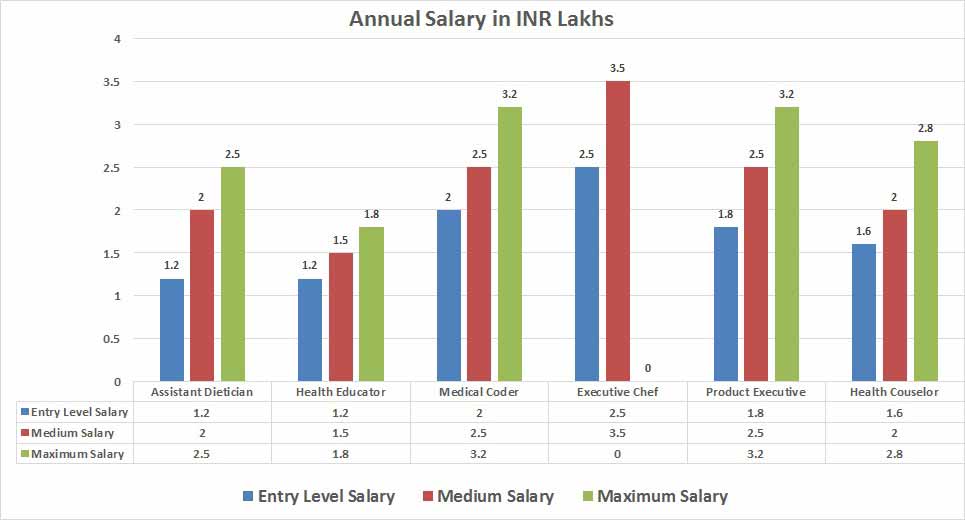
Salary Trends B.A in Home Science Course
| Bachelor of Arts [BA] (Home Science) | Entry Level Salary (LPA) | Medium Salary (LPA) | Maximum Salary (LPA) |
|---|---|---|---|
| Assistant Dietician | 1.2 | 2 | 2.5 |
| Health Educator | 1.2 | 1.5 | 1.8 |
| Medical Coder | 2 | 2.5 | 3.2 |
| Executive Chef | 2.5 | 3.5 | NA |
| Product Executive | 1.8 | 2.5 | 3.2 |
| Health Counselor | 1.6 | 2 | 2.8 |
Frequently Asked Questions (FAQs)
1. What is B.A in Home Science?
B.A in Home Science is an undergraduate degree that blends arts with practical life sciences focusing on nutrition, human development, family resource management, textiles, and community well‑being. It teaches how to improve family and community quality of life.
2. How long is the course?
The programme usually lasts 3 years (6 semesters) as a full‑time regular course.
3. What are the eligibility criteria?
Students must have passed Class 12 (10+2) or equivalent in any stream from a recognised board. Some colleges ask for a minimum around 50% aggregate in 10+2.
4. What subjects are covered in this course?
Typical subjects include human development, family resource management, food science & nutrition, interior design, clothing & textiles, dietetics, consumer education, psychology, and community extension studies.
5. What skills will I gain?
You’ll gain skills in nutrition planning, resource management, child and family welfare, clothing & textiles understanding, communication, and community support programmes. These improve both personal and professional life decision‑making.
6. What career options are available after this course?
Graduates can work in fields such as:
• Nutritionist / Dietician
• Health & Wellness Educator
• Child Development Specialist
• Family & Consumer Sciences Teacher / Educator
• Textile and Apparel Designer
• Food Analyst / Food Technologist
• Health Counsellor or Extension Worker
• Hospitality or Catering Consultant
7. Where can B.A Home Science graduates work?
You can find jobs in hospitals, health centres, food & nutrition sectors, fashion & textiles firms, restaurants, hotels, NGOs, educational institutes, community development projects and government welfare programmes.
8. What is the typical salary range?
Salaries vary by job role and experience. Entry‑level packages often range from ₹2 LPA to ₹4 LPA, with roles in food, nutrition, design, or education potentially reaching ₹5 LPA or higher as you gain experience.
9. Can I pursue higher studies after a B.A in Home Science?
Yes — many students go on to M.A/M.Sc in Home Science or related fields (Nutrition, Human Development, Textiles), MBA (Hospitality/Healthcare/Management), MSW (Social Work), MPH (Public Health), teaching degrees like B.Ed, or specialised diplomas.
10. Is B.A in Home Science a good career choice?
Yes — it’s a versatile and human‑centric degree suited for people who enjoy nutrition, family care, community development, lifestyle education, design and communication. It opens diverse work paths in healthcare, education, hospitality, design, and social services, and can be a stepping stone to advanced degrees.
Other Popular Courses
Applications for Admissions are open
 Bennett University, Greater NoidaGreater Noida
 Swami Devi Dyal Group of Professional InstitutionsPanchkula
 Ramkumari College of Veterinary SciencesJhunjhunu
 Lovely Professional UniversityJalandhar
 Amity University, GurugramGurgaon
 Graphic Era University, DehradunDehradun
 Manav Rachna University, FaridabadFaridabad
 SDGI Global UniversityGhaziabad
 Gian Sagar medical College & HospitalPatiala
 Atria UniversityBangalore
 IIFA Lancaster Institute of DesignBangalore
 Himachal Institute of Dental Sciences, SirmaurSirmaur
 ITS Dental College, Greater NoidaGreater Noida
 DBS Global UniversityDehradun
 SRM University - APGuntur
 Guru Nanak Dev Dental College & Research InstitutePatiala
 Nims UniversityJaipur
 HRIT UniversityGhaziabad
 Om Sterling Global UniversityHisar
 GD Goenka University, GurgaonGurgaon
 Lamrin Tech Skill UniversityRupnagar
 Desh Bhagat UniversityFatehgarh Sahib
 JK Lakshmipat Universityjaipur
 Institute of Management StudiesNoida
 GNIOT Institute of Management Studies (GIMS)Greater Noida
 Muthoot Business SchoolKochi
 ATLAS SkillTech UniversityMumbai
 Woxsen UniversityHyderabad
 Shri Bhawani Niketan Shiksha Samitijaipur
 St Andrews Institute Of Technology And ManagementGurgaon