Need Counselling

BHMS
 Job Pressure
Medium
 Academic Pressure
Medium
 Early Salary
1.2 L LPA - 7 L LPA
Mid Level Salary3.2 L LPA - 19 L LPA
Senior Salary6.1 L LPA - 26 LPA
Table of Contents
BHMS Course Highlights
| Course Level | Under Graduate |
| Duration | 5.5 Years |
| Examination type | Semester System |
| Eligibility | 10+2 with a minimum aggregate of 50 % in physics, chemistry, and biology as mandatory subjects |
| Admission Process | Qualify National level CET or State level PMT |
| Course Fee | INR 2,00,000 to 3,00,000 |
| Average Starting Salary | INR 2,00,000 to 19,00,000 |
| Course Level | Under Graduate |
BHMS Course Overview
This is an undergraduate bachelor's degree in the homeopathic system. The homeopathic medical system is getting popularity among the new generation because there is no side effect of these medicines on the human body.
According to this system the emotions, mind, and body are interlinked and remedies that effect them will seem to fit for the patient. A person gets sick if gets a disturbance in the harmony of these three. The medicines in homeopathy are given according to the physical symptoms, emotional problems, and the lifestyle of the patient.
Introduction to herbology, Fundamentals of Ayurvedic plant healing, Healing through nutritional therapies, Mind, and body healing techniques are some of the fundamental topics that are covered during the methodology of teaching homeopathy.
Eligibility Criteria for BHMS Course
- Should pass 10+2 with a minimum aggregate of 50 % in physics, chemistry, and biology as mandatory subjects.
- Have to qualify National level CET or State level PMT
Require Skills set for BHMS Course
- Have a thorough understanding of the complex equipment to operate it
- Handle stressful situations.
- Pay keen attention to even minute details
- Communicate with the healthcare team effectively
- Thorough understanding of the Homeopathic.
- Keep updating themselves with the new developments in the profession.
Common Entrance Examination for BHMS Course
- National level CET
- State-level PMT
BHMS Course Syllabus
| YEAR I | YEAR II |
|---|---|
| Organon of Medicine, Principles of Homeopathic Philosophy and Psychology | Pathology and Microbiology including Parasitological Bacteriology and Virology |
| Anatomy, Histology, and Embryology | Forensic Medicine & Toxicology |
| Physiology including Biochemistry | Organon of Medicine and Principles of Homoeopathic Philosophy |
| Homoeopathic Pharmacy | Homoeopathic Material Medical-I |
| Homoeopathic Material Medical | Surgery including ENT, Eye, Dental, and Homoeopathic Therapeutics |
| - | Obstetrics & Gynecology Infant care & Homoeopathic therapeutics |
| - | The practice of Medicine and Homoeopathic Therapeutics |
| YEAR III | YEAR IV |
| The practice of Medicine & Homoeo therapeutics-I | The practice of Medicine & Homoeo therapeutics-II |
| Surgery including ENT, Ophthalmology & dental & Homoeo therapeutics | Homoeopathic Materia Medical |
| Obstetrics & Gynecology Infant care & Homoeopathic therapeutics | Organon of Medicine |
| Homoeopathic Material Medical-II | Repertory |
| Organon of Medicine | Community Medicine |
Job Profile after BHMS Course
- Doctor
- Private Practice
- Public Health Specialists
- Teachers
- Researches
- Consultant
- Pharmacist
Top Recruiting Companies
BHMS Course Approx. Salary Trends in Lakh Per Annum*
| Job Profile | Average Entry Level Salary | Average Medium Salary | Average Maximum Salary |
| Doctor | 10 | 15 | 25 |
| Pharmacist | 1.5 | 2.1 | 7.0 |
| Pathologist | 1.4 | 2.5 | 8.5 |
| Paramedic | 3.2 | 10.1 | 8.5 |
| Private Practitioner | 5.0 | 7.0 | 20 |
| Public Health Specialist | 5.0 | 8.0 | 12 |
Annual Salary Trend
Frequently Asked Questions (FAQs) 2. Who is eligible to study this course? 3. How long is the M.Sc in Mental Health Nursing programme? 4. What subjects are studied in this course? 5. How do admissions work for M.Sc in Mental Health Nursing? 6. What skills will I develop from this degree? 7. What career options are available after completing this course? 8. Where can graduates work? 9. What is the average salary after this course? 10. Is M.Sc in Mental Health Nursing a good career choice?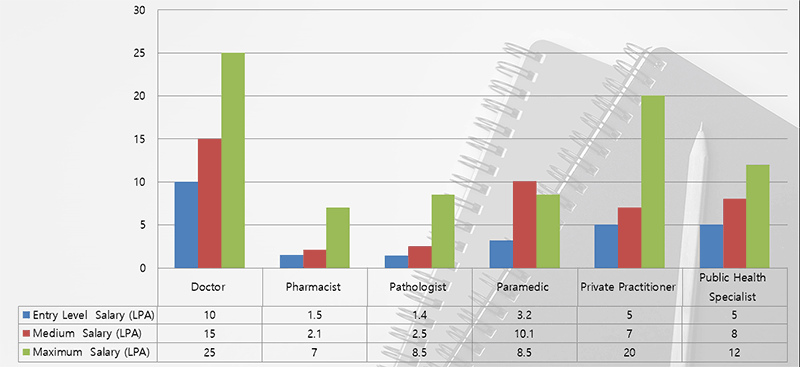
1. What is M.Sc in Mental Health Nursing?
M.Sc in Mental Health Nursing (often known as M.Sc in Psychiatric Nursing) is a 2‑year postgraduate nursing programme that trains nurses to care for people with mental and emotional health issues by combining clinical practice with advanced mental health principles.
To be eligible, you must have a Bachelor of Science in Nursing (B.Sc Nursing), B.Sc (Hons) Nursing, or Post Basic B.Sc Nursing with a minimum required percentage (usually 55 %) and be a Registered Nurse/Midwife with State Nursing Council registration. Many colleges also require a minimum of one year of clinical work experience after B.Sc. Nursing.
The programme lasts 2 years, usually divided into four semesters with classroom learning, clinical training, research and practical assessment.
The curriculum covers topics such as advanced psychiatric/mental health nursing, psychopharmacology, mental health assessment, therapeutic communication, counselling techniques, community mental health, and nursing research.
Admissions are typically based on academic merit, entrance tests or counselling depending on the university or institute. You usually need to have completed your B.Sc Nursing and be a registered nurse before applying.
You’ll gain advanced skills in mental health assessment, psychiatric care, counselling, patient communication, clinical decision‑making, behavioural interventions, teamwork, and research — all essential for working with individuals with mental health challenges.
After completing M.Sc in Mental Health Nursing, you can work as:
• Mental Health Nurse Practitioner
• Psychiatric Nurse Specialist
• Clinical Nurse Specialist
• Mental Health Counsellor
• Community Mental Health Nurse
• Nurse Educator or Lecturer
• Rehabilitation Specialist
• Research Nurse
Graduates can work in hospitals, psychiatric and mental health clinics, rehabilitation centres, community health programmes, NGOs, government healthcare services, educational institutions, and research organisations.
Salaries vary by role and experience. In India, typical salary ranges include around ₹3.5 L to ₹7 L per year for entry‑level roles and higher pay (around ₹8 L–₹10 L+) for specialist and senior positions in clinical or teaching roles.
Yes — it’s a meaningful and in‑demand healthcare career especially as awareness and services for mental health grow. This degree helps you make a real impact on patient well‑being, opens leadership and specialised clinical roles, and supports further studies such as Ph.D. or advanced certifications in mental health and counselling.
Other Popular Courses
Applications for Admissions are open
 Atria UniversityBangalore
 Mai Bhago Ayurvedic Medical CollegeFirozpur
 Kalka Group of InstitutionsMeerut
 Ramkumari College of Veterinary SciencesJhunjhunu
 City College JayanagarBengaluru
 Sunder Deep Group of InstitutionsGhaziabad
 IIFA Lancaster Institute of DesignBangalore
 NIIT UniversityAlwar
 JK Business School GurugramGurgaon
 Presidency UniversityBangalore
 Apeejay Stya UniversitySohna
 MERI CollegeNew Delhi
 Lamrin Tech Skill UniversityRupnagar
 Alliance UniversityBangalore
 Chandigarh University OnlineMohali
 Hierank Business SchoolNoida
 Greater Noida Institute of TechnologyGreater Noida
 Saraswati Group of Colleges, MohaliMohali
 Manav Rachna International Institute Of Research And StudiesFaridabad
 Institute of Management StudiesNoida
 GNIOT Institute of Management Studies (GIMS)Greater Noida
 Kalka Dental collegeMeerut
 Rai Technology UniversityBangalore
 UID Ahemdabad & Delhi NCRGurgaon
 Gokul Global UniversitySiddhpur
 Muthoot Business SchoolKochi
 Baddi University of Emerging Sciences & TechnologySolan
 ITS Dental College, Greater NoidaGreater Noida
 Nims UniversityJaipur
 GD Goenka University, GurgaonGurgaon