Need Counselling
B.Tech in Electrical Engineering
 Job Pressure
Medium
 Academic Pressure
Medium
 Early Salary
2L LPA - 8L LPA
Mid Level Salary2.7L LPA - 10L LPA
Senior Salary3.7L LPA - 19.8L LPA
Table of Contents
- B.Tech in Electrical Engineering Highlights
- Know All about B.Tech in Electrical Engineering
- Eligibility Criteria for B.Tech in Electrical Engineering
- Require Skills set
- Common Entrance Examination for B.Tech in Electrical Engineering
- B.Tech in Electrical Engineering Syllabus
- Top Recruiting Companies
- B.Tech in Electrical Engineering Approx. Salary Trends in Lakh Per Annum*
- Annual Salary Trend
B.Tech in Electrical Engineering Highlights
| Course Level | Graduate |
| Duration | 4 Years |
| Examination type | Semester System |
| Eligibility | 10+2, PCM with Minimum score of 55% |
| Admission Process | Based on counseling after clearing Entrance Tests |
| Course Fee | INR 3,00,000 to 4,00,000 Lacs |
| Average Starting Salary | INR 2,00,000 to 5,00,000 |
| Job Profiles | Sr. Electrical Manager, Professor, Maintenance Engineer, Lecturer, Electrical Engineer, Senior Electrical Engineer, Project Engineer, Electrical Sales Engineer, etc. |
| Top Recruiting Organizations | SAIL, NTPC, BHEL, NSPCL, Power Grid Corporation of India Ltd BALCO, Jindal Steel & Power Limited, etc. |
Know All about B.Tech in Electrical Engineering
This branch of engineering is mostly in demand in big industries worldwide. This is an undergraduate program, which enables the student to get to the core of electrical energy and its transmission.
This undergraduate program in Electrical Engineering is of four years duration and it covers all details related to Electrical Engineering in depth. It enables the student to know every detail with regard to electrical transmission, circuit analysis, details on electromagnetic machines, power electronics etc. This field focuses on the core of electrical engineering starting from basic fundamental knowledge to advance techniques.
The entire fee structure for this program ranges between INR 2-4 lakhs. After successful completion of this program, a student can apply for a lucrative job in the field of IT, petrochemical firms, consulting firms, power grids, textile companies, etc., at an attractive remuneration.
Eligibility Criteria for B.Tech in Electrical Engineering
- In order to get admission in B.Tech Electrical Engineering, a student must have scored at least 55% marks in 10 + 2 from a recognized board or a University with PCM (Physics, Chemistry, and Mathematics) as his or her main subjects.
Require Skills set
- Engineers are problem solvers
- Technological knowledge
- Organizational skills
- Complex Problem Solving
- Innovative Thinking
- Good Communication Skills
- Work With Active Mind
Common Entrance Examination for B.Tech in Electrical Engineering
- JEE Main
- JEE Advanced
- BITSAT
- SRMJEEE
- COMEDK
B.Tech in Electrical Engineering Syllabus
| Semester I | Semester II | Semester III | Semester IV |
| Communicative English I | Humanities Elective I | Integral Transforms and Complex Analysis | Mathematical Statistics and Numerical Methods |
| Physics/Chemistry | Chemistry/Physics | Electric Circuits | Electrical Measurements and Instrumentation |
| Calculus, Matrix Algebra | Vector Calculus and Ordinary Differential Equations | Digital Systems | Electrical Machines I |
| Electrical Engineering | Electronics Engineering | Mechanical Engineering | Electromagnetic Theory |
| Computer Programming | Object-Oriented Programming | Science Elective I | Science Elective II |
| Engineering Mechanics / Introduction to Thermodynamics | Engineering Mechanics / Introduction to Thermodynamics | Humanities Elective I | Humanities Elective II |
| Engineering Drawing I | Engineering Drawing II | Simulation Lab and Electrical Workshop | Electrical Machines Lab I |
| Physics Lab / Chemistry Lab | Chemistry Lab. / Physics Lab. | Electric Circuits Lab | Measurements and Digital Circuits Lab |
| Workshop A / Workshop B | Workshop B / Workshop A | - | SOFT SKILLS I |
| Computer Programming Lab | Object-Oriented Programming Lab. | - | - |
| Cultural Education | Cultural Education | - | - |
| Semester V | Semester VI | Semester VII | Semester VIII |
| Introduction to Microcontrollers and Applications | VLSI Design | Power System Protection and Switchgear | Elective IV |
| Electronic Circuits II | Digital Communication | Electrical Drives and Control | Management Elective |
| Microprocessors | Transmission Lines and Radiating Systems | Environmental Studies | Project |
| Analog Communication | Elective I | Elective II | - |
| Control Engineering | Environmental Studies | Elective III | - |
| Microcontroller Lab | VLSI Design Lab | Principles of Management | - |
| Electronic Circuits Lab II | Digital Communication Lab | Power System Simulation Lab | - |
| SOFT SKILLS II | Seminar | Power Electronics Lab | - |
| - | SOFT SKILLS III | - | - |
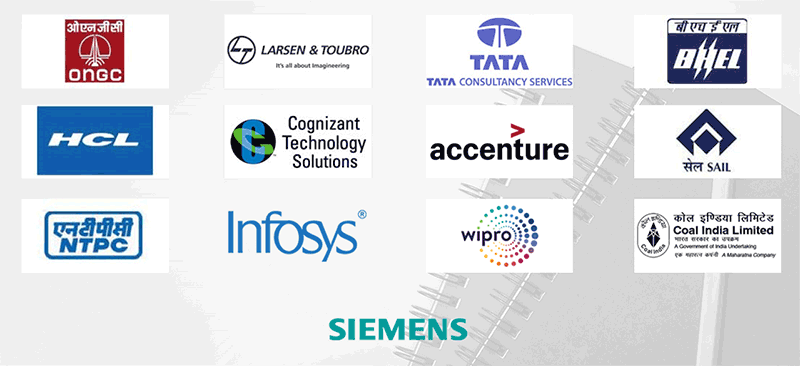
Top Recruiting Companies
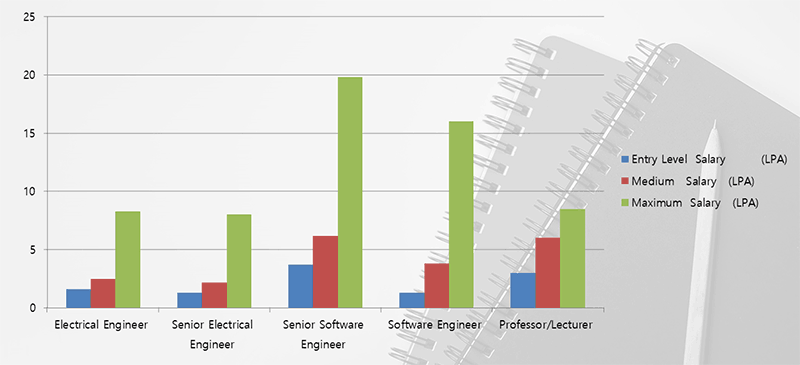
B.Tech in Electrical Engineering Approx. Salary Trends in Lakh Per Annum*
| Job Profile | Average Entry Level Salary | Average Medium Salary | Average Maximum Salary |
| Electrical Engineer | 1.6 | 2.5 | 8.3 |
| Senior Electrical Engineer | 1.3 | 2.2 | 8 |
| Senior Software Engineer | 3.7 | 6.2 | 19.8 |
| Software Engineer | 1.3 | 3.8 | 16 |
| Professor/Lecturer | 3 | 6 | 8.5 |
Annual Salary Trend
 Frequently Asked Questions (FAQs)
1. What is B.Tech in Electrical Engineering? 2. Who is eligible to study Electrical Engineering? 3. How long does the B.Tech Electrical Engineering course last? 4. What subjects are studied in this programme? 5. How do I get admission into B.Tech in Electrical Engineering? 6. What skills will I learn in this course? 7. What career options are available after B.Tech in Electrical Engineering? 8. Which industries hire Electrical Engineering graduates? 9. What is the average starting salary after this degree? 10. Is B.Tech in Electrical Engineering a good career choice?
B.Tech in Electrical Engineering is a 4-year undergraduate engineering degree that teaches students how to design, analyse, maintain, and improve electrical systems, machines, and power networks used in many industries.
To join this course, students must have completed Class 12 with Physics, Chemistry, and Mathematics (PCM) from a recognised board.
The course lasts 4 years, usually split into eight semesters.
Students study circuit theory, electrical machines, power systems, control systems, electronics, power electronics, microcontrollers, and labs to develop both theory and practical skills.
Admission is usually based on entrance exam scores like JEE Main or other state/university engineering exams and then counselling.
You will learn skills like problem-solving, analytical thinking, electrical design, use of tools like CAD, teamwork, and technical troubleshooting.
Graduates can work as Electrical Engineer, Power Systems Engineer, Control Systems Engineer, Design Engineer, Maintenance Engineer, or Renewable Energy Specialist in many sectors.
Electrical engineers are needed in power generation and distribution, manufacturing, automation, electronics, telecommunications, renewable energy, and infrastructure sectors.
Starting salaries for electrical engineers in India usually range from about ₹3 to ₹6 lakh per year for fresh graduates, and can grow with experience and specialisation.
Yes, it’s a good choice if you enjoy technology, electricity, machines, and solving real-world engineering problems, with a wide range of job opportunities and growth in core and emerging sectors.
Other Popular Courses
Applications for Admissions are open
 Rai Technology UniversityBangalore
 Acharya Bangalore Business SchoolBangalore
 Bhagwant Institute of TechnologyMuzaffarnagar
 Somnath Goel Paramedical InstituteYamunanagar
 Gokul Global UniversitySiddhpur
 HRIT UniversityGhaziabad
 SRM University - APGuntur
 SDGI Global UniversityGhaziabad
 Ganga Group Of InstitutionsNew Delhi
 Apeejay Stya UniversitySohna
 NIIT UniversityAlwar
 Kalka Group of InstitutionsMeerut
 Guru Kashi UniversityBathinda
 IILM University, GurugramGurgaon
 Guru Nanak Ayurvedic Medical College & HospitalMuktsar
 Chandigarh University OnlineMohali
 Bhojia Dental College and HospitalSolan
 Bennett University, Greater NoidaGreater Noida
 GD Goenka University, GurgaonGurgaon
 Graphic Era University, DehradunDehradun
 Om Sterling Global UniversityHisar
 Atria UniversityBangalore
 Pimpri Chinchwad UniversityPune
 UNITEDWORLD INSTITUTE OF DESIGNAhmedabad
 JK Lakshmipat Universityjaipur
 GNIOT Institute of Management Studies (GIMS)Greater Noida
 City College JayanagarBengaluru
 Karnavati UniversityGandhinagar
 Shoolini UniversitySolan
 MERI CollegeNew Delhi