Need Counselling

MBA Finance
 Job Pressure
Medium
 Academic Pressure
Medium
 Early Salary
1.9 LPA - 3.5 LPA
Mid Level Salary3.7 LPA - 9.7 LPA
Senior Salary7.5 LPA - 19.8 LPA
Table of Contents
- MBA in Finance Management Highlights
- About MBA in Finance Course
- Why MBA in Finance?
- MBA in Finance Eligibility Criteria
- MBA Finance Syllabus Semester Wise
- MBA in Finance Career Options
- MBA in Finance Scope (Job Types)
- Top Recruiting Companies
- MBA in Finance Salary
- Watch the video
- Watch the video MBA in Finance Course Details
MBA in Finance Management Highlights
| Full Name | Master of Business Administration in Finance Management |
| Level | Post Graduate |
| Short Name | MBA in Finance Management |
| Field | Management |
| Specialisation | Finance |
| Duration | 2 Years |
| Exam Type | Semester |
| Minimum Qualification Requirement | 50% marks in Bachelor’s Degree |
| Selection Process | Entrance Exam + Scores in Bachelors’ degree |
| Recruiting Companies | Merrill Lynch, Bain & Co, Boston Consulting Group, Goldman Sachs, JP Morgan, Barclays, Deutsche Bank, Morgan Stanley, Lehman Brothers, McKinsey, etc. |
| Average Initial Salary | INR 7 to 20 lacs per annum |
About MBA in Finance Course
MBA with a major in Finance is one of the most sought post-graduate degree courses in India. It is offered in many universities and requires two years to complete when done on a full-time basis. Students can also pursue this course through distance learning.
The course is designed for students who are willing to pursue their career in the field of finance.
Why MBA in Finance?
During this course, the students will get to know the resources of capital/ money which are required in building a/ an organization/ company.
MBA in Finance Eligibility Criteria
- Students who are seeking admission in this course must have a Bachelor’s degree or any equivalent from a recognized university. They must have scored a minimum of 55% aggregate.
- Some of the colleges in India hold their own eligibility test whereas a common entrance exam for MBA is held at the national level on the basis of which students are admitted.
MBA Finance Syllabus Semester Wise
| Semester I | Semester II |
|---|---|
| Corporate Social Responsibility | Supply Chain Management |
| Micro Economics | Financial Modeling |
| Principles of Accounting | Business Intelligence |
| Principles of Marketing Management | Strategic Management |
| Tools and Frameworks for Decision Making | Managerial Economics |
| Quantitative Methods and Statistics | Marketing Research |
| Business Communication And Soft skills | Corporate Governance and Business Ethics |
| Organizational Behaviour-1 | Corporate Finance-2 |
| Semester III | Semester IV |
| Business Law | Project Submissions |
| Macro Economics | Internship Projects |
| Operations Management | Organization Behaviour-2 |
| Corporate Management | Marketing Management |
| Optimization and Project Research | Project Management |
MBA in Finance Career Options
Finance Analyst, Corporate Treasurer, Financial Risk Manager, Financial Consultant, Tax Inspector, Investment Analyst, Financial Manager.
MBA in Finance Scope (Job Types)
1) Private Sector Career options after MBA in Finance
- Financial Analyst
- Business Analyst
- Finance Manager
- Research Analyst
2) Private Sector Employment areas after MBA in Finance
- Asset Management
- Credit Risk Management
- Derivative Structuring
- Hedge Fund Management
- Private Equity
- Treasury
3) Public Sector Employment areas after MBA in Finance
- Corporate Finance
- Corporate Banking
- Ministry of Commerce and Industry/ Ministry of Business
- Ministry of Corporate Affairs
- Ministry of Finance
Top Recruiting Companies

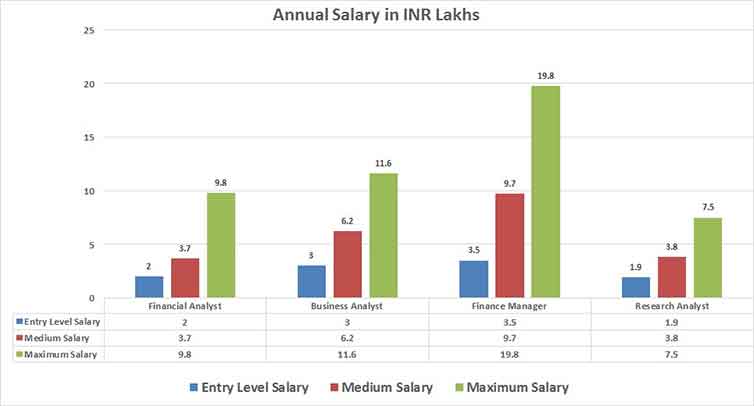
MBA in Finance Salary
| Master of Business Administration [MBA] (Finance) | Entry Level Salary (LPA) | Medium Salary (LPA) | Maximum Salary (LPA) |
|---|---|---|---|
| Financial Analyst | 2 | 3.7 | 9.8 |
| Business Analyst | 3 | 6.2 | 11.6 |
| Finance Manager | 3.5 | 9.7 | 19.8 |
| Research Analyst | 1.9 | 3.8 | 7.5 |
 Frequently Asked Questions (FAQs)
What is an MBA in Finance? Who is eligible to apply for this course? How long does the MBA in Finance programme last? What subjects are typically included in this MBA? What skills will I develop through this programme? Is practical experience or internships part of the MBA? What career opportunities are available after MBA in Finance? Which industries hire MBA Finance graduates? Can I pursue higher studies after this MBA?
10. What is the scope and future growth for MBA in Finance professionals?
MBA in Finance is a two-year postgraduate management programme that combines general business administration with specialised finance knowledge such as investment analysis, financial planning, budgeting, risk management and corporate finance. It prepares students for strategic roles in finance and business management.
To pursue an MBA in Finance in India, candidates generally need a bachelor’s degree from a recognised university with a minimum aggregate (often around 50 %, with relaxations for reserved categories). Many colleges also consider entrance exam scores like CAT, MAT, XAT or CMAT as part of admission.
The standard full-time MBA in Finance programme is two years, divided into four semesters with core management and specialised finance subjects.
Students study a mix of core management subjects (like accounting, economics, marketing and operations) and finance-specialised topics such as corporate finance, investment studies, risk management, international finance, portfolio management and financial modelling.
The MBA in Finance develops key skills such as financial analysis, strategic thinking, decision-making, budgeting, risk evaluation, data interpretation, leadership and communication — all essential for leadership roles in finance.
Many MBA Finance programmes include internships, live projects, case studies and industry exposure to help students apply theoretical knowledge to real-world financial challenges and improve employability.
Graduates can pursue a wide range of roles such as Financial Analyst, Investment Banker, Corporate Finance Manager, Risk Manager, Portfolio Manager, Wealth Manager, Credit Analyst, Financial Consultant and Treasury Manager.
MBA in Finance professionals are in demand across banking and financial services, investment firms, consulting companies, corporate finance departments, insurance and fintech sectors, among others.
Yes. Graduates can go on to pursue professional certifications (e.g., CFA, FRM), specialised master’s degrees, executive programmes or doctoral research to deepen their expertise and enhance career growth.
MBA in Finance offers strong career growth and global opportunities — with graduates moving into leadership and strategic roles such as Finance Director, CFO (Chief Financial Officer), Investment Banking Associate or Financial Consultant as financial markets and corporate finance functions grow in complexity and demand.
Watch the video
MBA in Finance, Eligibility, Course Fee, Top Colleges, Jobs and Salary
Watch the video MBA in Finance Course Details
MBA in Finance || MBA in Finance Course Details , Colleges , Salary ,Scope
Other Popular Courses
Applications for Admissions are open
 Atria UniversityBangalore
 Bhojia Dental College and HospitalSolan
 Gian Sagar medical College & HospitalPatiala
 Hierank Business SchoolNoida
 Chandigarh University OnlineMohali
 Karnavati UniversityGandhinagar
 Centurion University of Technology and Management, BhubaneswarBhubaneswar
 IILM University, GurugramGurgaon
 SRM University - APGuntur
 I.T.S College of Health and Wellness Sciences, Greater NoidaGreater Noida
 Desh Bhagat UniversityFatehgarh Sahib
 Guru Nanak Ayurvedic Medical College & HospitalMuktsar
 MERI CollegeNew Delhi
 Manav Rachna University, FaridabadFaridabad
 Bhagwant Institute of TechnologyMuzaffarnagar
 ATLAS SkillTech UniversityMumbai
 Rai Technology UniversityBangalore
 Alliance UniversityBangalore
 K.R. Mangalam University, GurgaonGurgaon
 JK Business School GurugramGurgaon
 Bennett University, Greater NoidaGreater Noida
 Om Sterling Global UniversityHisar
 ITS Dental College, Greater NoidaGreater Noida
 Pimpri Chinchwad UniversityPune
 Harmony Ayurvedic Medical College & HospitalFirozpur
 IILM University, Greater NoidaGreater Noida
 Gokul Global UniversitySiddhpur
 Vidya Siri College of PharmacyBangalore
 City College JayanagarBengaluru
 Guru Kashi UniversityBathinda