Need Counselling

M.Tech Agricultural Engineering
 Job Pressure
Medium
 Academic Pressure
Medium
 Early Salary
2 LPA - 3.2 LPA
Mid Level Salary3 LPA - 6.4 LPA
Senior Salary4 LPA - 23.7 LPA
Table of Contents
- M.tech Agriculture Engineering Course Highlights
- About M.Tech in Agricultural Engineering
- What is M.Tech in Agricultural Engineering?
- M.Tech in Agricultural Engineering Eligibility
- M.tech Agriculture Engineering Syllabus
- M.Tech in Agricultural Engineering Career Options
- M.Tech in Agricultural Engineering Scope (Job Types)
- Top Recruiting Companies
- M.Tech in Agricultural Engineering Salary
M.tech Agriculture Engineering Course Highlights
| Duration | 2 years |
| Course Level | Post Graduate Course |
| Full Form | Masters of Technology in Agriculture |
| Examination Type | Semester Examinations |
| Eligibility | Candidate with Bachelor’s degree (B.E./ B.tech) in the similar specialisation from a recognized university with minimum 60% aggregate marks |
| Admission Process | Merit Based/ Entrance Examination |
| Course Fee | INR 30,000 – INR 75,000 |
| Average Salary | INR 1,50,000 – 3,00,000 |
| Job Positions | Breeder, Agronomist, Corporate Sales Manager, Research Scientist etc |
About M.Tech in Agricultural Engineering
M.Tech with a major in Agricultural Engineering is a postgraduate degree course that is offered at the university level. It generally requires two years to complete when done on a regular basis. One can also pursue this course through distance learning however the duration, in this case, may vary.
The course is designed to introduce students to using concepts of Engineering and Science to improve agriculture productivity. It helps them understand the latest techniques that can be used to make farming easy.
What is M.Tech in Agricultural Engineering?
M.Tech in Agriculture Engineering is a master’s degree that includes various topics such as plant breeding and genetics, agronomy and soil science, seed science and technology, plant pathology, and agricultural meteorology.
The course helps them to understand the nature and impact of farming on the environment.
M.Tech in Agricultural Engineering Eligibility
- Students applying for this course must have a Bachelor’s degree or any equivalent (in the related stream) from a recognized university in which they must have scored a minimum of 50% aggregate.
- SC/ ST students have 5% of relaxation in the minimum aggregate.
M.tech Agriculture Engineering Syllabus
| Semester I | Semester II |
|---|---|
| Principles of Analytical Chemistry | Refrigeration Engineering |
| Applied Mathematics | Crop Physiology |
| Food Chemistry and Microbiology | Process Instrumentation and Control |
| Nursery Technology | Food Engineering –I |
| Fundamentals of Information Technology | Agricultural Microbiology |
| Fundamentals of Agricultural Meteorology | Principles of Agricultural Economics |
| English for Effective Communication | Engineering Properties of Biological Materials |
| Semester III | Semester IV |
| Fundamentals of Entomology | Industrial visit I (Fruit, Vegetable and Floriculture Industry) |
| Food Preservation Technology | Principles of Biotechnology |
| Biomass Utilization and Renewable Energy Management | Livestock and Aquaculture Food Products Processing |
| Commercial Production of Spices and Plantation Crops | Fundamentals of Soil Science |
| Principles of Seed Production and Quality control in agricultural crops | Seed production technology of agricultural crops |
| Livestock and Poultry Production Management | Fundamentals of Agribusiness Management |
| Farm Power and Machinery | Applied Statistics |
M.Tech in Agricultural Engineering Career Options
M.Tech in Agriculture Engineering broadens the career options for students as they can seek employment in many areas such as Food Processing Industry, Research Organizations, Agribusiness Firms, Retail Industry, Banks and Financial Corporations, etc.
M.Tech in Agricultural Engineering Scope (Job Types)
1) Private Sector Career options after M.Tech in Agricultural Engineering
- Agricultural Engineer
- Agronomist
- Agricultural Scientist
- Agricultural Lecturer
- Equipment Officer
- Agriculture Research Scientist
2) Private Sector Employment areas after M.Tech in Agricultural Engineering
- Agribusiness Firms
- Food Processing Industry
- Retail Industry
- Research Organizations
- Banks and Financial Corporations
3) Public Sector Employment areas after M.Tech in Agricultural Engineering
- Ministry of Agriculture
Top Recruiting Companies

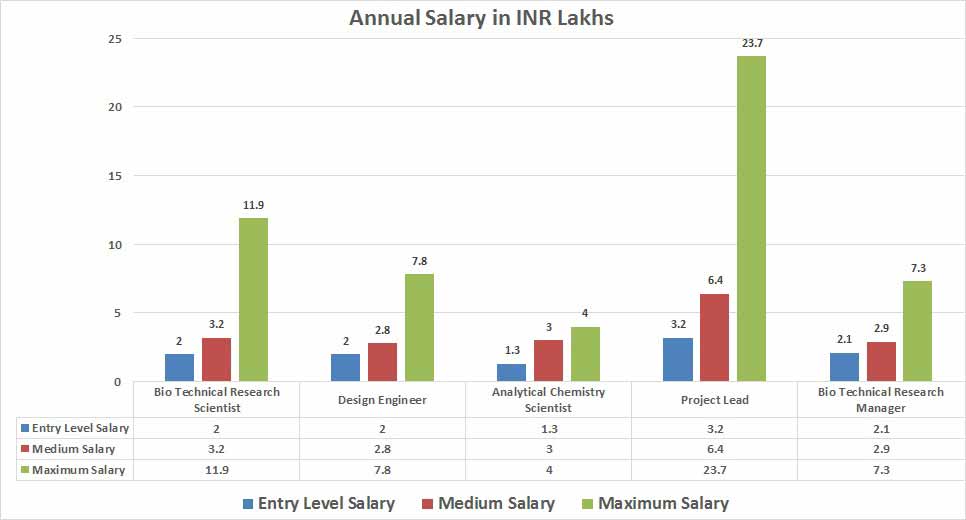
M.Tech in Agricultural Engineering Salary
| Master of Technology [M.Tech] (Agricultural Engineering) | Entry Level Salary (LPA) | Medium Salary (LPA) | Maximum Salary (LPA) |
|---|---|---|---|
| Bio Technical Research Scientist | 2 | 3.2 | 11.9 |
| Design Engineer | 2 | 2.8 | 7.8 |
| Analytical Chemistry Scientist | 1.3 | 3 | 4 |
| Project Lead | 3.2 | 6.4 | 23.7 |
| Bio Technical Research Manager | 2.1 | 2.9 | 7.3 |
1. What is M.Tech in Agricultural Engineering?
M.Tech in Agricultural Engineering is a 2-year postgraduate programme that focuses on applying engineering principles to improve farming techniques, machinery, irrigation systems, soil and water conservation, and food processing.
2. Who is eligible to study M.Tech in Agricultural Engineering?
Students who have completed a Bachelor’s degree in Agricultural Engineering or a related engineering field from a recognised university with the required minimum percentage are eligible.
3. How long is the M.Tech Agricultural Engineering course?
The program typically lasts two years, divided into four semesters.
4. What subjects are studied in this programme?
Students learn advanced topics like soil and water conservation, farm machinery and power engineering, irrigation and drainage, agricultural processing, and renewable energy in agriculture.
5. How do admissions work for this degree?
Admission is usually based on entrance exams such as GATE, university tests, or merit from the undergraduate degree, depending on the institution.
6. What skills will I gain from M.Tech in Agricultural Engineering?
You will gain skills in designing agricultural machinery, analysing soil and water systems, using engineering tools, problem-solving, research, and practical field methods.
7. What career options are available after completing this course?
Graduates can work as Agricultural Engineer, Research Scientist, Farm Machinery Specialist, Irrigation Engineer, Project Manager, Lecturer, or Consultant in various sectors related to agriculture and food technology.
8. Where can M.Tech in Agricultural Engineering graduates work?
They can find jobs in agribusiness firms, food processing companies, research organisations, government agriculture departments, and banks or financial corporations dealing with agriculture projects.
9. What is the average salary after M.Tech in Agricultural Engineering?
Starting salaries vary, but many graduates earn competitive packages, and roles like project lead or research scientist can offer higher pay as experience grows.
10. Is M.Tech in Agricultural Engineering a good career choice?
Yes, it’s a promising choice if you enjoy science, engineering, innovation in farming, and solving real-world agricultural challenges, as the sector needs skilled professionals for sustainable farming and food production.
Other Popular Courses
Applications for Admissions are open
 Desh Bhagat UniversityFatehgarh Sahib
 Karnavati UniversityGandhinagar
 NIIT UniversityAlwar
 Chanakya UniversityBangalore
 IILM University, Greater NoidaGreater Noida
 K.R. Mangalam University, GurgaonGurgaon
 MERI CollegeNew Delhi
 Sri Sukhmani Institute of ManagementNew Delhi
 Rai Technology UniversityBangalore
 Atria UniversityBangalore
 Greater Noida Institute of TechnologyGreater Noida
 Lovely Professional UniversityJalandhar
 Hierank Business SchoolNoida
 Guru Nanak Dev Dental College & Research InstitutePatiala
 Vidya Siri College of PharmacyBangalore
 Somnath Goel Paramedical InstituteYamunanagar
 ITS Dental College, Greater NoidaGreater Noida
 UNITEDWORLD INSTITUTE OF DESIGNAhmedabad
 Harmony Ayurvedic Medical College & HospitalFirozpur
 Manav Rachna International Institute Of Research And StudiesFaridabad
 Centurion University of Technology and Management, BhubaneswarBhubaneswar
 Manav Rachna University, FaridabadFaridabad
 DBS Global UniversityDehradun
 I.T.S Dental college, Murad NagarGhaziabad
 Om Sterling Global UniversityHisar
 Kalka Dental collegeMeerut
 GD Goenka University, GurgaonGurgaon
 Gian Sagar medical College & HospitalPatiala
 UID Ahemdabad & Delhi NCRGurgaon
 Bhagwant Institute of TechnologyMuzaffarnagar