Need Counselling

BBA in Banking and Finance
 Job Pressure
Medium
 Academic Pressure
Medium
 Early Salary
2.5 LPA - 2.8 LPA
Mid Level Salary4 LPA - 5.5 LPA
Senior Salary6 LPA - 10 LPA
Table of Contents
- BBA Banking Course Highlights
- About BBA in Banking and Finance Course
- BBA in Banking and Finance Eligibility
- BBA in Banking and Finance Course Syllabus
- Require Skills set
- BBA in Banking and Finance Career Options
- Top Colleges
- BBA Banking vs B.Com
- Top Recruiting Companies
- Approx. Salary Trends in Lakh Per Annum
- Annual Salary in INR after BBA in Banking and Finance
- Youtube Video
- Find:Business Administration Colleges in India
- FAQs — BBA in Banking and Finance
BBA Banking Course Highlights
| Full Form | Bachelor of Business Administration |
| Course Level | Under Graduate Programme |
| Duration | 3 Years |
| Examination Type | Semester Wise |
| Eligibility | 10+2 with minimum 50% aggregate |
| Admission Process | Merit and Entrance Based ( Depends on College) |
| Course Fee | INR 10,000 to INR 9,00,000 |
| Average Salary | INR 3,00,000 to INR 10,00,000 |
| Top Recruiting Companies | Reliance, SBI, HDFC, Axis, ICICI, Om Kotak Mahindra |
| Top Recruiting Areas | Bank, Savings & Loan Association, Business School etc. |
| Job Positions | Financial Advisor, Financial Manager, Tax Assistant, Credit Analyst, Internal Auditor |
About BBA in Banking and Finance Course
The degree course includes the study of business management and related fields. It is a professional degree where theoretical concepts like management information systems, fundamentals of Human Resource Management (HRM), Financial Law, and fundamentals of marketing are taught and supplemented by a practical experience of case studies, industry visits, presentations, and summer placements.
The B.B.A. (Banking) degree course covers the study of the basic concepts of management with specialized training in subjects such as International Banking and Insurance, Treasury Operations, Risk Management, Investment Banking, Project & Infrastructure, etc.
BBA in Banking and Finance Eligibility
1. The candidates should complete their 10+2 or its equivalent exam in any stream. students.
2. The marks of admission for this course may vary from college to college. In various colleges, it conducts entrance exams plus interview and percentage of 12th class for the admission of
BBA in Banking and Finance Course Syllabus
| Year 1 | Year 2 |
|---|---|
| Principles of Management | Banking, Theory Law and Practice |
| Organizational Behavior | Operations Research |
| Business Environment | Business Taxation |
| Legal Systems in Business | Practical Auditing |
| Business Statistics | Human Resources Management |
| Treasury Operations | Risk Management |
| Year 3 | |
| Investment Management | |
| International Banking | |
| Marketing of Banking Services | |
| Technology in Banking Financial Management | |
| Business Ethics and Values | |
| Investment Banking | |
Require Skills set
| Skills |
| Good Communicator |
| Strong Customer Service Skills |
| Professional |
| Problem-Solving Skills |
| Self-Confident |
| Strong Negotiator |
Apply Now Get More Information
BBA in Banking and Finance Career Options
Career is defined as 'A particular occupation for which one is trained'. We understand it's far-reaching impact and it's scope, even better, than we have ever realized. This scenario wasn't evident in ancient times, nobody cared about career, everybody was happy with whatever profession they were pursuing.
Top Colleges
| College Name | City/State | Average Annual Fees (Approx.)* |
|---|---|---|
| ICFAI UNIVERSITY - [IUJ] | RANCHI | INR 110,000 P.A |
| CMJ UNIVERSITY | SHILLONG | INR 65,000 P.A |
| VIT-AP SCHOOL OF BUSINESS | AMARAVATHI | INR 275,000 P.A |
| SUNRISE UNIVERSITY - [SRU] | ALWAR | INR 73,000 P.A |
| KIIT SCHOOL OF MANAGEMENT – [KSOM] |
BHUBANESWAR | INR 359,000 P.A |
| KUNTHAVAI NAACCHIYAR GOVERNMENT ARTS COLLEGE FOR WOMEN - [KNGAC] |
THANJAVUR | INR 210,000 P.A |
Apply Now Get More Information
BBA Banking vs B.Com
BBA is Bachelor of Business Administration in the Banking sector and BCom is Bachelor of Commerce. Both the courses are good and are offered by colleges in numerous specializations. Check out the difference between the two:
| Parameters | BBA Banking | BCom |
|---|---|---|
| Full-Form | Bachelor of Business Administration | Bachelor of Commerce |
| Overview | Students learn to develop management skills as well as get the proper training to work with numerous financial tools | It deals with subjects related to accounting |
| Degree Type | Professional | Academic |
| Admission Process | Merit and Entrance Based | Merit and Entrance Based |
| Exam Type | Semester | Semester |
| Duration | 3 Years | 3 Years |
| Eligibility | 10+2 Passed | 10+2 with Commerce Stream |
| Top Colleges | Prestige Institute of Management & Research, The Oxford College of Business Management, Bangalore, JK Lakshmipat University | Hindu College, Gargi College, Stella Maris College, Kirori Mal College |
| Average Annual Fees | INR 10,000 to INR 9,00,000 | INR 50,000 to INR 1,20,000 |
| Job Roles | Financial Advisor, Financial Manager, Tax Assistant, Credit Analyst, Internal Auditor | Junior Accountant, Tax Practitioner |
| Average Annual Salary | INR 3,00,000 to INR 10,00,000 | INR 2,00,000 to INR 5,00,000 |
| Top Companies | HDFC, ICICI, Goldman Sachs | IBM, Sony, ITC |
| Further Studies | MBA in numerous specializations | M. Com |
Top Recruiting Companies
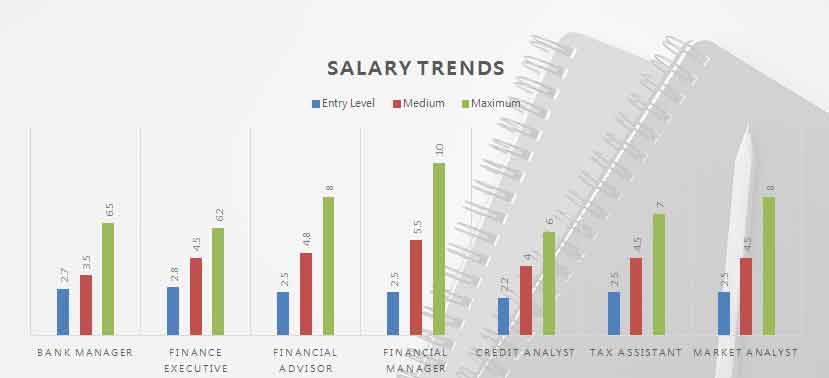
Approx. Salary Trends in Lakh Per Annum
| Job Profile | Entry Level Salary (LPA) | Medium Salary (LPA) | Maximum Salary (LPA) |
|---|---|---|---|
| Bank Manager | 2.7 | 3.5 | 6.5 |
| Finance Executive | 2.8 | 4.0 | 6.2 |
| Financial Advisor | 2.5 | 4.8 | 8 |
| Financial Manager | 2.5 | 5.5 | 10 |
| Credit Analyst | 2.2 | 4.0 | 6 |
| Tax Assistant | 2.5 | 4.5 | 7 |
| Market Analyst | 2.5 | 4.5 | 8 |
Annual Salary in INR after BBA in Banking and Finance
Youtube Video
BBA in Banking and Finance Course
Find:Business Administration Colleges in India
Business Administration Colleges in India
FAQs — BBA in Banking and Finance
Q1:-What are the job options after doing BBA in Banking?
Ans:-There are ample job opportunities after the completion of courses like Financial Advisor, Financial Manager, Asset Manager, Investment Banker, etc.
Q2:-What further course can I choose after completing BBA Banking?
Ans:-You can choose Master of Business Administration (MBA) or Post Graduate Diploma in Management (PGDM) for further studies. You can select the specialization as per your interest.
Q3:-What are some BBA Banking subjects?
Ans:-Some of the subjects that you will study in BBA Banking incorporate Principles of Management, Baking Theory Law and Practice, Business Taxation, Organizational Behavior, Operations Research, Business Environment, and many more.
Q4:-What is the eligibility criterion for doing a BBA course?
Ans:-In order to get admission to this course, the candidate must have completed 10+2 and must have scored at least 50% marks in aggregate.
Q5:-Is there any specific stream for doing the BBA Banking course?
Ans:-No, candidates of any stream can apply for this course in any college.
Q6:-Is there any Entrance Test for getting admission to the BBA Banking course?
Ans:-It depends on College since some colleges select students on the basis of marks obtained in 10+2 while some conduct their own Entrance Tests.
Q7:-Is it necessary that I must choose MBA in banking specialization only after the completion of the BBA Banking course?
Ans:-No, it’s not necessary. It depends on your interest like in which sector you wish to do a job in after your MBA.
Q8:-Will I get better job options only after doing an MBA?
Ans:-No, it depends on your knowledge and skillsets. Graduate pass-outs also get better job options but after doing Post Graduation programme you can get high-profile jobs and a better pay scale.
Q9:-What is the average starting salary of a BBA Banking programme?
Ans:-The average starting salary is from INR 3,00,000 to INR 10,00,000/-
Q10:-What is the duration of this course?
Ans:-The duration of this course is 3 years which means a total of 6 semesters will be there in the entire programme.
Q11:-Is Mathematics subject compulsory for doing BBA Banking?
Ans:-No, it’s not necessary. Candidates of any stream can easily get admission to this programme; however, they must have passed 10+2 in English level.
Q12:- What is BBA in Banking and Finance?
Ans:- BBA in Banking and Finance is a three-year undergraduate programme that teaches students the fundamentals of business, banking systems, financial markets, investment management, risk assessment, and financial planning — equipping them to work in finance and banking roles.
Q13:- Who is eligible to apply for BBA in Banking and Finance?
Ans:- Students who have completed 10+2 senior secondary education from a recognised board with the minimum required marks can apply. This includes students from commerce, science, or arts streams who meet eligibility criteria.
Q14:- What subjects are covered in this course?
Ans:- The curriculum includes subjects like Financial Accounting, Business Statistics, Banking Theory and Practice, Business Environment, Financial Management, Taxation, Risk Management, Marketing of Financial Services and International Banking.
Q15:- What skills will I develop through this programme?
You will gain important skills such as financial analysis, risk assessment, communication skills, decision-making, customer handling, budgeting and banking operations knowledge that are highly valued by employers.
Q16:- What are the career options after BBA in Banking and Finance?
Graduates can pursue careers as Financial Analyst, Bank Manager, Credit Analyst, Investment Banking Associate, Finance Executive, Treasury Manager, Insurance Advisor and Business Development Executive in banks, financial institutions, consultancies and corporate finance departments.
Q17:- Is this course suitable for non-commerce students?
Yes. While commerce students may find some subjects familiar, students from other streams (science or arts) are also eligible and can succeed by focusing on the finance and accounting subjects taught during the programme.
Q18:- Does BBA in Banking and Finance include internships or practical training?
Many colleges include internships, industry projects and practical training as part of the curriculum to give students real-world experience in financial environments and improve employability.
Q19:- Can I pursue higher studies after completing this degree?
Yes. Graduates can choose to pursue an MBA, CA/ICWA, CFA, CFP, M.Com or specialised finance certifications to strengthen their finance profile and open more advanced career pathways.
Q20:- What industries hire BBA Banking and Finance graduates?
Graduates are in demand in commercial banks, investment banks, insurance firms, NBFCs, financial consultancies, corporate finance teams, asset management firms and fintech companies.
Q21:- What is the salary scope for fresh graduates?
Entry-level salaries vary by organisation and city, but fresh graduates typically begin with competitive packages that grow with experience, role and performance. As professionals gain experience in finance, salaries increase significantly with roles in management and specialised financial analysis.
Other Popular Courses
Applications for Admissions are open
 Muthoot Business SchoolKochi
 HRIT UniversityGhaziabad
 Mai Bhago Ayurvedic Medical CollegeFirozpur
 NIIT UniversityAlwar
 Pimpri Chinchwad UniversityPune
 Guru Nanak Ayurvedic Medical College & HospitalMuktsar
 Acharya Bangalore Business SchoolBangalore
 UID Ahemdabad & Delhi NCRGurgaon
 Greater Noida Institute of TechnologyGreater Noida
 Solan Homoeopathic Medical College & HospitalSolan
 JK Lakshmipat Universityjaipur
 Amity University, MohaliMohali
 City College JayanagarBengaluru
 Hierank Business SchoolNoida
 GD Goenka University, GurgaonGurgaon
 Kalka Dental collegeMeerut
 I.T.S Engineering CollegeGreater Noida
 Institute of Management StudiesNoida
 DBS Global UniversityDehradun
 Sunder Deep Group of InstitutionsGhaziabad
 SDGI Global UniversityGhaziabad
 Manav Rachna International Institute Of Research And StudiesFaridabad
 Ramkumari College of Veterinary SciencesJhunjhunu
 Chandigarh University OnlineMohali
 Somnath Goel Paramedical InstituteYamunanagar
 Centurion University of Technology and Management, BhubaneswarBhubaneswar
 Presidency UniversityBangalore
 Jayoti Vidyapeeth Women’s UniversityJaipur
 Lovely Professional UniversityJalandhar
 Kalka Group of InstitutionsMeerut