Need Counselling
B.Sc Life Sciences
 Job Pressure
Medium
 Academic Pressure
Medium
 Early Salary
2 LPA - 2.7 LPA
Mid Level Salary2.1 LPA - 3.2 LPA
Senior Salary8.2 LPA - 11 LPA
Table of Contents
B.Sc Life Sciences Course Highlights
| Duration | Course Duration of Bachelor of Science [B.Sc] (Life Sciences) is 3 Years. |
| Degree | Bachelors |
| Full Form | Bachelor of Science in Life Sciences |
| Minimum Percentage | 50% Aggregate in 10+2 |
| Subjects Required | Physics, Chemistry & Biology |
| Average Fees Incurred | INR 4000 - 50,000 PA |
| Average Salary Offered | INR 2 - 5 LPA |
| Employment Roles | Manager, Research Scientist, Research Analyst, Food Scientist, Nutritionist, etc. |
B.Sc Life Sciences Syllabus
| Semester-I | Semester-II |
|---|---|
| Alcohols, Phenols and Ethers | Ionic Equilibria |
| Chemical Bonding and Molecular Structure | Fundamentals of Organic Chemistry |
| Atomic Structure | Stereochemistry |
| Alkyl and Aryl Halides | Aromatic Hydrocarbons |
| - | Aldehydes and Ketones (aliphatic and aromatic) |
| Semester-III | Semester-IV |
| Cell Cycle: Interphase, Mitosis, and Meiosis | Cell Organelles |
| Biological Systems, Evolution and Biodiversity | Techniques in Biology |
| Cell Membrane and Cell Wall | Cell as a Unit of Life |
| - | Chemical Context of Living Systems |
| Semester-V | Semester- VI |
| Human Diseases | Project |
| Regulation of gene expression | Genetic Material |
| Cancer | Exams |
B.Sc in Life Sciences Course Scope(Job Types)
Private Sector Career Options
- Associate editor
- Medical Services Associate
- Medical coding
- Associate/Senior Associate -(Non-Technical)
- Product executives
- Healthcare counselor
- Food Scientist
Private Employment Area
- Agriculture
- Fisheries
- Sericulture
- Lac culture
- Plant Research
- Diesel control
- Pharmaceutical Company.
Public Employment Area
- Ministry of Health and Family Welfare
Apply Now Get More Information
Top Recruiting Companies

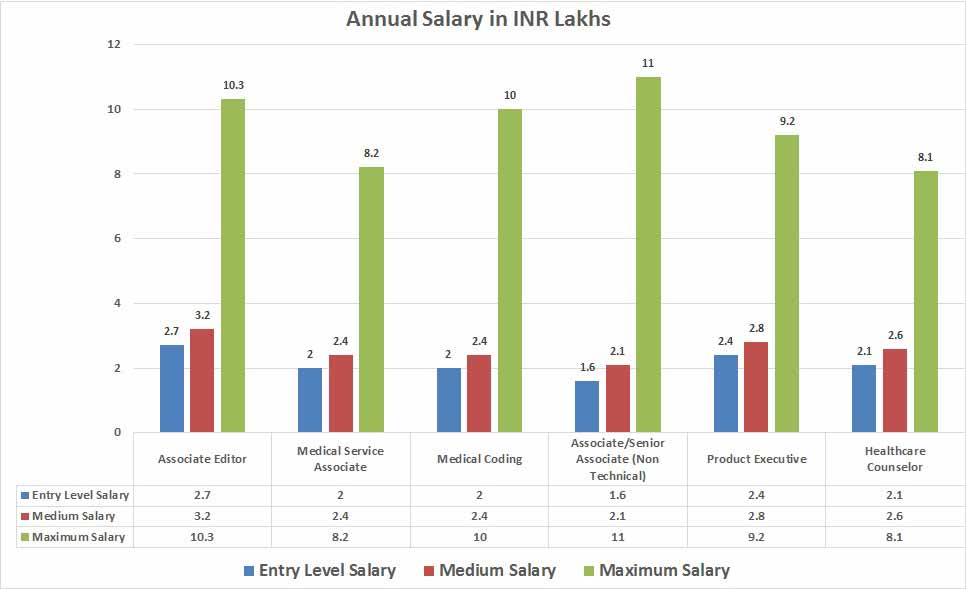
Salary Trends
| Bachelor of Science [B.Sc] (Life Sciences) | Entry Level Salary (LPA) | Med Salary (LPA) | Max Salary (LPA) |
|---|---|---|---|
| Associate Editor | 2.7 | 3.2 | 10.3 |
| Medical Service Associate | 2 | 2.4 | 8.2 |
| Medical Coding | 2 | 2.4 | 10 |
| Associate/Senior Associate (Non Technical) |
1.6 | 2.1 | 11 |
| Product Executive | 2.4 | 2.8 | 9.2 |
| Healthcare Counselor | 2.1 | 2.6 | 8.1 |
Frequently Asked Questions (FAQs)
1. What is B.Sc. Life Sciences?
B.Sc. Life Sciences is a 3-year undergraduate degree program that focuses on the scientific study of living organisms, including biology, genetics, ecology and related disciplines.
2. What are the eligibility criteria for B.Sc. Life Sciences?
Candidates must have completed 10+2 (Senior Secondary) with Physics, Chemistry and Biology as core subjects and usually a minimum of 50% aggregate marks.
3. How long is the B.Sc. Life Sciences course?
The course duration is typically 3 years, divided into six semesters.
4. What subjects are taught in B.Sc. Life Sciences?
The syllabus includes subjects like cell biology, evolution and biodiversity, genetic material, human diseases, plus fundamentals of chemistry and biological techniques.
5. What are common career options after B.Sc. Life Sciences?
Graduates can work as a research scientist, healthcare counselor, food scientist, medical services associate, product executive, research analyst, and more.
6. What is the average salary after completing B.Sc. Life Sciences?
Salary ranges vary by role, but typical packages are around INR 2–5 LPA at entry level, with higher earnings possible with experience.
7. Can I pursue higher studies after B.Sc. Life Sciences?
Yes. After B.Sc. you can pursue M.Sc. Life Sciences, Biotechnology, Microbiology, or other related master’s degrees, enhancing career and research prospects.
8. Do I need an entrance exam to get admission?
Admission may be merit-based (12th marks) or through entrance exams, depending on the college or university.
9. What skills are important for B.Sc. Life Sciences students?
Important skills include analytical thinking, lab techniques, research ability, communication, and problem-solving.
10. Where can graduates of B.Sc. Life Sciences work?
Graduates can find opportunities in pharmaceutical companies, healthcare institutes, agriculture, biotechnology labs, research organizations, and public health sectors.
Other Popular Courses
Applications for Admissions are open
 UID Ahemdabad & Delhi NCRGurgaon
 Swami Devi Dyal Group of Professional InstitutionsPanchkula
 IILM University, Greater NoidaGreater Noida
 Hierank Business SchoolNoida
 Sri Sukhmani Institute of ManagementNew Delhi
 Bhojia Dental College and HospitalSolan
 ATLAS SkillTech UniversityMumbai
 Gokul Global UniversitySiddhpur
 Guru Nanak Ayurvedic Medical College & HospitalMuktsar
 Gian Sagar medical College & HospitalPatiala
 Bhagwant Institute of TechnologyMuzaffarnagar
 Acharya Bangalore Business SchoolBangalore
 Ajeenkya DY Patil UniversityPune
 Muthoot Business SchoolKochi
 Doon Business SchoolDehradun
 HRIT UniversityGhaziabad
 Ganga Group Of InstitutionsNew Delhi
 UNITEDWORLD INSTITUTE OF DESIGNAhmedabad
 Graphic Era University, DehradunDehradun
 SRM University - APGuntur
 Ramkumari College of Veterinary SciencesJhunjhunu
 Desh Bhagat UniversityFatehgarh Sahib
 Kalka Dental collegeMeerut
 Bennett University, Greater NoidaGreater Noida
 Swami Devi Dyal Hospital and Dental CollegePanchkula
 Rai Technology UniversityBangalore
 SDGI Global UniversityGhaziabad
 Manav Rachna International Institute Of Research And StudiesFaridabad
 MERI CollegeNew Delhi
 Atria UniversityBangalore