Need Counselling

MBA Real Estate
 Job Pressure
Medium
 Academic Pressure
Medium
 Early Salary
1.6 LPA - 3.2 LPA
Mid Level Salary3.2 LPA - 5.3 LPA
Senior Salary12.2 LPA - 20.4 LPA
Table of Contents
- MBA in Real Estate Management Highlights
- About MBA in Real Estate Course
- Why MBA in Real Estate?
- MBA in Real Estate Eligibility
- MBA in Real Estate Management Syllabus
- MBA in Real Estate Career Options
- MBA in Real Estate Scope (Job Types)
- Top Recruiting Companies
- MBA in Real Estate Salary
- Watch the video
MBA in Real Estate Management Highlights
| Course Name | MBA in Real Estate Management |
| Short Name | MBA in REM / MBA (REM) |
| Course Level | Postgraduate |
| Course Type | Degree Course |
| Degree | Master of Business Administration (MBA) |
| Specialization | Real Estate Management |
| Duration | 2 year |
| Internship | Not Mandatory |
| Mode | Full Time / Part-Time |
| Minimum Qualification | Graduation in any stream |
| Selection Process | Entrance Exam + GD / PI |
| Average Course Fee | Rs. 1,50,000 to Rs. 2,50,000 |
| Average Starting Salary | Rs. 3,50,000 to Rs. 20,00000 |
About MBA in Real Estate Course
MBA with a major in Real Estate is a post graduate degree course which is offered in many universities in India. It generally requires two years to complete when done in a regular basis. Students can also pursue this course through distance learning.
The course is designed to introduce students with the conceptual knowledge and management skills required in Real Estate Management.
MBA in Real Estate is the study of planning and execution of real estate projects and infrastructure projects. It also covers topics like investment, marketing, risk, and financing etc.
Why MBA in Real Estate?
MBA in Real Estate provides them the thorough understanding of fundamentals and principles of real estate. The course helps students to analyze different scenarios for investment and development in this field. It enhances their critical thinking and problem-solving abilities.
MBA in Real Estate Eligibility
Students/ Candidates who are willing to apply for this course must fulfill the following criteria:
- They must have a Bachelor’s degree or any equivalent from a recognized university.
- They must have scored a minimum of 50% aggregate in the graduation. SC/ ST candidates have 5% of relaxation in the minimum aggregate.
MBA in Real Estate Management Syllabus
| First Year | Second Year |
|---|---|
| Real Estate Market Analysis | Real Estate Valuation |
| Principles of Management | Risk Management |
| Organizational Behaviour | Customer Relationship Management |
| Introduction to Real Estate | Construction Finance |
| Business Communication | Risk Management |
| Marketing Management | Regulatory Process and Laws |
| Finance Management | Asset Management |
| Real Estate Economics | Computer Application in Real Estate |
| Real Estate Development | Land Survey and Acquisition |
| Human Resource Management | Taxation in Real Estate |
Note:- The eligibility criteria may vary from college to college; students are advised to check it from the respective college or institute.
MBA in Real Estate Career Options
Real Estate Broker, Investment Analyst, Property Manager, Real Estate Credit Underwriter, Appraiser, Asset Manager, Developer.
MBA in Real Estate Scope (Job Types)
1) Private Sector Career options after MBA in Real Estate
- Real Estate Appraiser
- Investment Analyzer
- Real Estate Broker
- Financier
- Corporate or Property Asset Manager
- Community Association Manager
2) Private Sector Employment areas after MBA in Real Estate
- Residential
- Commercial
- Retail
- Hotel
- Real Estate Development
Top Recruiting Companies

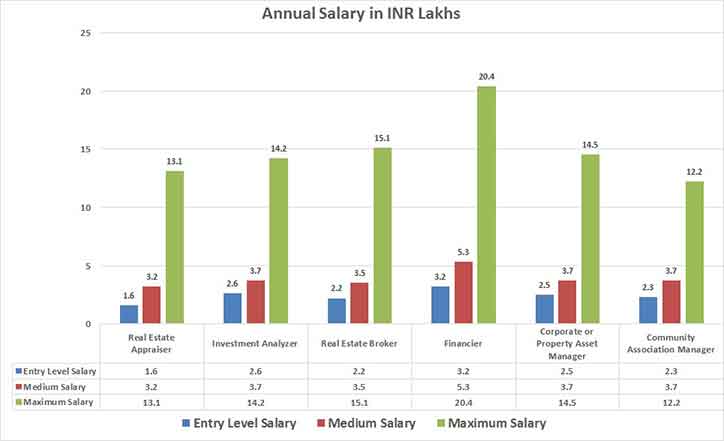
MBA in Real Estate Salary
| Master of Business Administration [MBA] (Real Estate) | Entry Level Salary (LPA) | Medium Salary (LPA) | Maximum Salary (LPA) |
|---|---|---|---|
| Real Estate Appraiser | 1.6 | 3.2 | 13.1 |
| Investment Analyzer | 2.6 | 3.7 | 14.2 |
| Real Estate Broker | 2.2 | 3.5 | 15.1 |
| Financier | 3.2 | 5.3 | 20.4 |
| Corporate or Property Asset Manager | 2.5 | 3.7 | 14.5 |
| Community Association Manager | 2.3 | 3.7 | 12.2 |
Frequently Asked Questions (FAQs)
What is an MBA in Real Estate? Who is eligible to apply for this course? What subjects will I study in an MBA in Real Estate? What skills will I develop during this programme? Can I get practical experience during the MBA? What career opportunities are available after MBA in Real Estate? Which industries hire MBA Real Estate graduates? Can this MBA help me start my own real estate business? Is work experience required to join this MBA? What is the scope and future growth in this field?
MBA in Real Estate is a two-year postgraduate management programme that equips students with business and specialised real estate skills — including property investment, real estate finance, market analysis, asset valuation and property management — to lead in the dynamic property industry.
To pursue this MBA, candidates generally need a bachelor’s degree from a recognised university. Some colleges may also consider entrance exam scores, interviews and work experience in related fields.
The curriculum blends core MBA subjects such as management, finance, marketing and strategy with real estate-specific topics like property valuation, real estate finance and investment, urban development, commercial and residential property management, and real estate law.
Students build strategic planning, financial analysis, property valuation, market research, negotiation, project management and leadership skills that are essential for successful roles in real estate and asset management.
Many programmes include industry internships, real estate projects, case studies, site visits and industry interactions so students gain real-world exposure to property markets and development activities.
Graduates can work in roles such as Real Estate Investment Manager, Property Manager, Real Estate Analyst, Development Manager, Asset Manager, Valuation Consultant, Real Estate Consultant and Urban Planner.
Professionals are in demand across real estate firms, property development companies, investment consultancies, banking and finance sectors, infrastructure firms, urban planning agencies and asset management firms.
Yes. With expertise in property investment, market analysis, finance and strategic planning, graduates can pursue entrepreneurial ventures such as property consultancy, real estate development firms or investment advisory services.
Many MBA in Real Estate programmes accept fresh graduates, although some institutions may give preference to candidates with professional experience in finance, construction, planning or real estate sectors.
With urbanisation, housing demand, commercial development, smart city projects and growing property markets, demand for professionals with strategic real estate and business skills remains strong, offering diverse career and leadership opportunities.
Watch the video
MBA in Real Estate Details in Hindi || MBA in Real Estate Admission, Fees, Salary, Scope
Other Popular Courses
Applications for Admissions are open
 JK Business School GurugramGurgaon
 Desh Bhagat UniversityFatehgarh Sahib
 I.T.S Engineering CollegeGreater Noida
 Solan Homoeopathic Medical College & HospitalSolan
 SRM University - APGuntur
 K.R. Mangalam University, GurgaonGurgaon
 Nims UniversityJaipur
 Chandigarh University OnlineMohali
 Muthoot Business SchoolKochi
 Hierank Business SchoolNoida
 Kalka Dental collegeMeerut
 Kalka Group of InstitutionsMeerut
 Somnath Goel Paramedical InstituteYamunanagar
 Atria UniversityBangalore
 Rai Technology UniversityBangalore
 Gokul Global UniversitySiddhpur
 Alliance UniversityBangalore
 Bennett University, Greater NoidaGreater Noida
 ITS Dental College, Greater NoidaGreater Noida
 ATLAS SkillTech UniversityMumbai
 Presidency UniversityBangalore
 Guru Kashi UniversityBathinda
 Saraswati Group of Colleges, MohaliMohali
 Manav Rachna International Institute Of Research And StudiesFaridabad
 Vidya Siri College of PharmacyBangalore
 Manav Rachna University, FaridabadFaridabad
 City College JayanagarBengaluru
 Mai Bhago Ayurvedic Medical CollegeFirozpur
 UNITEDWORLD INSTITUTE OF DESIGNAhmedabad
 Guru Nanak Dev Dental College & Research InstitutePatiala