Need Counselling
M.Tech Chemical Engineering
 Job Pressure
Medium
 Academic Pressure
Medium
 Early Salary
1.4 LPA - 3.1 LPA
Mid Level Salary2.7 LPA - 10 LPA
Senior Salary10.5 LPA - 26.3 LPA
Table of Contents
- M.Tech Chemical Engineering Course Highlights
- About M.Tech in Chemical Engineering
- What is M.Tech in Chemical Engineering?
- M.Tech in Chemical Engineering Eligibility
- M.Tech Chemical Engineering Syllabus
- M.Tech in Chemical Engineering Career Options
- M.Tech in Chemical Engineering Scope (Job Types)
- Top Recruiting Companies
- M.Tech in Chemical Engineering Salary
M.Tech Chemical Engineering Course Highlights
| Duration | Course Duration of Master of Technology [M.Tech] (Chemical Engineering) is 2 Years. |
| Degree | Masters |
| Full Form | Master of Technology in Chemical Engineering |
| Age | No specific age limit |
| Minimum Percentage | 50% |
| Average Fees Incurred | INR 20K - 1 LPA |
| Similar Options of Study | M.Tech (Structural Engineering), M.Tech (Thermal Engineering), M.Tech (Biotechnology), M.Tech (Power System Engineering) etc. |
| Average Salary Offered | INR 8.26 LPA |
| Employment Roles | Process Engineer, Marketing Manager, Deputy General Manager, process Engineer, Senior process Engineer, Data Analyst, R&D Manager, etc. |
About M.Tech in Chemical Engineering
M.Tech with a specialization in Chemical Engineering is a postgraduate degree course which is offered in many universities in India. Generally, the duration of the course is two years when done on a regular basis. But one can also pursue this course through distance learning however the duration, in this case, may vary.
The aim of this course is to educate students with the best possible knowledge of chemical reactions and its uses.
The students undergo an extensive course work and laboratory practice in advanced areas of Chemical Engineering.
What is M.Tech in Chemical Engineering?
M.Tech in Chemical Engineering is the study of designing as well as maintenance of chemical plants. Some of the common subjects under this course are reactions engineering, transfer operations, thermodynamics, computational fluid dynamics, transport phenomena, materials science, biochemical engineering, semiconductor processing, environmental engineering and process control.
M.Tech in Chemical Engineering Eligibility
- Students applying for this course must have a Bachelor’s degree or any equivalent (in the related stream) from a recognized university in which they must have scored a minimum of 50% aggregate.
- SC/ ST students have 5% of relaxation in the minimum aggregate.
M.Tech Chemical Engineering Syllabus
| Semester I | Semester II |
|---|---|
|
Process Modelling and Simulation |
Chemical Process Design |
|
Advanced Process Control |
Advances in Fluidization Engineering |
|
Chemical Reactor Analysis and Design |
Nanotechnology |
|
Computational Techniques in Chemical Engineering |
Polymer Dynamics |
|
Advanced Separation Process |
Fuel Cell Technology |
| Semester III | Semester IV |
|
Wastewater and Solid Waste Treatment |
BioEnergy and Bio-Refinery Engineering |
|
Bioprocess Engineering |
Process Optimization |
|
Multiphase Flow |
Ecology for Engineers |
|
Industrial Energy Systems |
Computational Fluid Dynamics |
M.Tech in Chemical Engineering Career Options
Many of the career options are available for M.Tech (Chemical Engineering) graduates. Some of these are Project Manager, Technical Specialist, Senior Chemist, Process Engineer and Chemical Engineer etc.
M.Tech in Chemical Engineering Scope (Job Types)
1) Private Sector Career options after M.Tech in Chemical Engineering
- Chemical Research Scientist
- Analytical Chemistry Scientist
- Chemical Research Manager
- Analytical Chemistry Manager
- Formulation Scientist
2) Private Sector Employment areas after M.Tech in Chemical Engineering
- Mining Processing Industries
- Tyre Manufacturing
- Chemical Engineering Designs
- Petrochemical
- Mineral Based Industries
- Paper Manufacturing Industries
- Paint Manufacturing Industries
3) Public Sector Employment areas after M.Tech in Chemical Engineering
- Ministry of Science & Technology
- Ministry of Chemicals and Fertilizers (Including Pharmaceuticals)
Top Recruiting Companies

M.Tech in Chemical Engineering Salary
| Master of Technology [M.Tech] (Chemical Engineering) | Entry Level Salary (LPA) | Medium Salary (LPA) | Maximum Salary (LPA) |
|---|---|---|---|
| Chemical Research Scientist | 1.8 | 6.5 | 16.2 |
| Analytical Chemistry Scientist | 1.4 | 2.7 | 10.5 |
| Chemical Research Manager | 3.1 | 10 | 26.3 |
| Analytical Chemistry Manager | 2.1 | 3.7 | 14 |
| Formulation Scientist | 1.7 | 5.8 | 15 |
Frequently Asked Questions (FAQs) 1. What is M.Tech in Chemical Engineering? 2. Who is eligible to study this course? 3. How long is the M.Tech Chemical Engineering programme? 4. What subjects will I study in this programme? 5. How do admissions work for M.Tech in Chemical Engineering? 6. What skills will I gain from this degree? 7. What career options are available after this degree? 8. Which industries hire Chemical Engineering graduates? 9. What is the average salary after completing this degree? 10. Is M.Tech in Chemical Engineering a good career choice?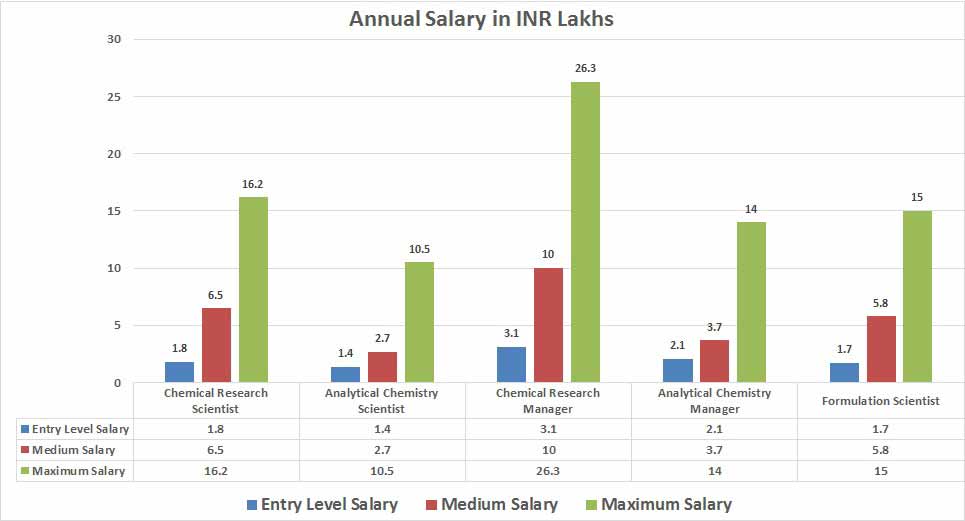
M.Tech in Chemical Engineering is a 2‑year postgraduate engineering programme that teaches advanced knowledge of chemical processes, process design, reactions, transport phenomena, and industrial applications to prepare students for specialised roles in the chemical and related industries.
You must have a Bachelor’s degree (B.Tech/B.E.) in Chemical Engineering or a related engineering field with at least 50 % aggregate marks (some institutes may require 55 %) to be eligible.
The course typically lasts 2 years, divided into four semesters with coursework, practicals, and research/project work.
Core subjects usually include process modelling and simulation, advanced process control, chemical reactor design, advanced separation processes, computational fluid dynamics, and bioprocess engineering, among others.
Admissions are mainly based on entrance exam scores like GATE, university‑level exams, or merit from your undergraduate degree, depending on the institute’s selection process.
You will learn advanced process design, simulation, optimisation, chemical plant safety, environmental process knowledge, research skills, and problem‑solving abilities useful in engineering roles.
Graduates can work as Process Engineer, Chemical Engineer, Research Scientist, Production Manager, Environmental Engineer, Bioprocess Specialist, and Quality Control Analyst, among other roles.
Job opportunities exist in petrochemicals, pharmaceuticals, chemicals manufacturing, energy and power, environmental engineering, materials and polymers, food processing, and research organisations.
Salary varies by role and company, but many graduates earn competitive packages. Entry‑level salaries can be around ₹4–10 lakh per year, and experienced professionals in specialised roles can earn more.
Yes, it’s a good choice if you are interested in advanced chemical processes, industrial applications, research and development, and solving real‑world engineering problems with strong demand in many technical industries.
Other Popular Courses
Applications for Admissions are open
 Chandigarh University OnlineMohali
 NIIT UniversityAlwar
 Somnath Goel Paramedical InstituteYamunanagar
 ATLAS SkillTech UniversityMumbai
 Bennett University, Greater NoidaGreater Noida
 Sri Sukhmani Institute of ManagementNew Delhi
 MERI CollegeNew Delhi
 Nims UniversityJaipur
 UNITEDWORLD INSTITUTE OF DESIGNAhmedabad
 SRM University - APGuntur
 Gian Sagar medical College & HospitalPatiala
 GD Goenka University, GurgaonGurgaon
 UID Ahemdabad & Delhi NCRGurgaon
 HRIT UniversityGhaziabad
 DBS Global UniversityDehradun
 Institute of Management StudiesNoida
 Desh Bhagat UniversityFatehgarh Sahib
 I.T.S Engineering CollegeGreater Noida
 Acharya Bangalore Business SchoolBangalore
 Muthoot Business SchoolKochi
 Bhagwant Institute of TechnologyMuzaffarnagar
 Swami Devi Dyal Hospital and Dental CollegePanchkula
 Manav Rachna International Institute Of Research And StudiesFaridabad
 Shoolini UniversitySolan
 Alliance UniversityBangalore
 Apeejay Stya UniversitySohna
 Shri Bhawani Niketan Shiksha Samitijaipur
 Guru Kashi UniversityBathinda
 Gokul Global UniversitySiddhpur
 Harmony Ayurvedic Medical College & HospitalFirozpur