Need Counselling

B.Tech in Civil Engineering
 Job Pressure
Medium
 Academic Pressure
Medium
 Early Salary
2.6L LPA - 11.1L LPA
Mid Level Salary2.9L LPA - 12.2L LPA
Senior Salary3.5L LPA - 15.2L LPA
Table of Contents
- B.Tech in Civil Engineering Highlights
- Know All about B.Tech in Civil Engineering
- Eligibility Criteria for B.Tech in Civil Engineering
- B.Tech in Civil Engineering Course Syllabus
- Require Skills set
- Common Entrance Examination for B.Tech in Civil Engineering
- Top Recruiting Companies
- B.Tech in Civil Engineering Approx. Salary Trends in Lakh Per Annum*
- Annual Salary Trend
- Watch the video
B.Tech in Civil Engineering Highlights
| Course Level | Graduate |
| Duration | 4 Years |
| Examination type | Semester System |
| Eligibility | 10+2, PCM with Minimum score of 55% |
| Admission Process | Based on counselling after clearing Entrance Tests |
| Course Fee | INR 2,50,000 to 5,00,000 Lacs in Public Institutes/INR 3,50,000 to 7,00,000 Lacs in Private Institutes |
| Average Starting Salary | INR 3,00,000 to 5,00,000 |
| Job Profiles | Civil Engineer Highway, Civil Engineer Land Development, Structural Engineer, Construction Engineer, Maintenance Engineer, etc. |
| Top Recruiting Organizations | L&T, Sobha developers Ltd, Maytas Infra Ltd, Shapoorji Pallonji, Shimizu Corp, Jones Lang LaSalle, Jacobs Engineering, Alacriti Infosystems, TATA consulting engineers Ltd, Land Transport Authority, etc. |
Know All about B.Tech in Civil Engineering
This professional course grooms individuals who are interested in pursuing civil engineering in a private or public sector. With India developing rapidly, the need for skilled engineers is also on the rise, making this one of the most lucrative career options available.
B.Tech in Civil Engineering is a 4 year professional under graduate course. The average tuition fee ranges from INR 2 to 6 lakhs, with the private institutions charging a higher fee. The starting salary for engineers is INR 3 – 6 lakhs per annum.
This is perhaps one of the oldest disciplines of engineering. The course prepares candidates to explore other specialized branches such as environmental engineering, Geotechnical engineering, structural engineering and architectural engineering. You can purse MS in the subjects above to ensure a secure spot for yourself in this industry. You can even opt for an MBA degree to take up jobs at a managerial level.
Eligibility Criteria for B.Tech in Civil Engineering
- Candidates who have passed 10+2 with an aggregate of 50% at least are eligible for the course. They are required to have a background in science with the core subjects of study being Mathematics, chemistry and physics.
- You may even apply for this course in the second year if you have a diploma in either mechanical engineering or other related fields. Some colleges accept candidates with a bachelor degree in science as well.
B.Tech in Civil Engineering Course Syllabus
| Semester 1 | Semester 2 |
|---|---|
| Functions of Several Variables | Series and Matrices |
| Physics I | Physics II |
| Physics Lab. 1 | Engg Mechanics |
| Intro to Civil Engg. | Chemistry I |
| Intro to Programming | Chemistry Lab. |
| Engg. Drawing | CE Materials and Construction |
| Ecology and Environment | Life Skills II |
| Life Skills I | - |
| Semester 3 | Semester 4 |
| Math. 3 | Structural Analysis |
| Mechanics of Materials | Geotechnical Engg. 1 |
| Transportation Engg. I | Transportation Engg. 2 |
| Hydraulic Engg. | Environmental Engg. |
| Surveying | Science Electives (Maths/Physics/Chemistry) |
| - | Humanities Elec. 1 |
| Semester 5 | Semester 6 |
| Life Sciences | Basic Steel Design |
| Geotechnical Engg. 2 | Construction Project Management |
| Water Resources Engg. | Humanities Elective 2 |
| Basic RC Design | - |
| Hydraulic & Environ. Engg. Lab. | - |
| Construction Material Lab | - |
| Semester 7 | Semester 8 |
| Humanities Elective 3 | Professional Ethics |
Require Skills set
- Project Management
- Planning and conducting research
- Teamwork
- Leadership
- Professional Communication
- Critical thinking
- Data Analysis and Interpretation
Common Entrance Examination for B.Tech in Civil Engineering
- JEE Main
- JEE Advanced
- BITSAT
- SRMJEEE
- COMEDK
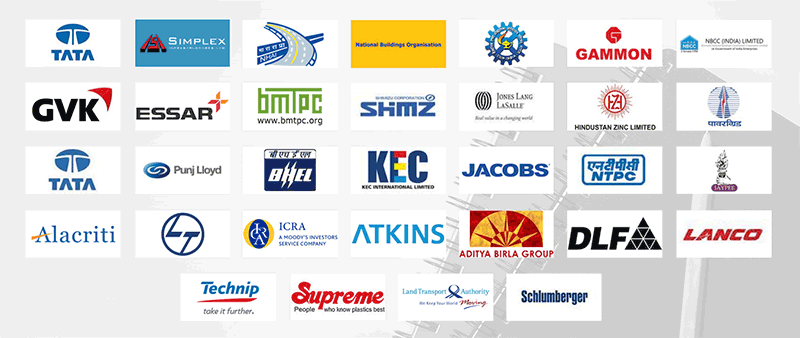
Top Recruiting Companies
B.Tech in Civil Engineering Approx. Salary Trends in Lakh Per Annum*
| Job Profile | Average Entry Level Salary | Average Medium Salary | Average Maximum Salary |
| Civil Engineer Highway | 3.2 | 9.2 | 12.2 |
| Civil Engineer Land Development | 2.6 | 8.1 | 11.1 |
| Structural Engineer | 3.5 | 7.8 | 13 |
| Construction Engineer | 3.4 | 7.7 | 15.2 |
| Maintenance Engineer | 2.9 | 8 | 11.3 |
| Aerospace Chief Engineer | 4.5 | 10.5 | 20 |
| Lecturer Professor | 3.0 | 9.0 | 18 |
Annual Salary Trend
1. What is B.Tech in Civil Engineering? 2. Who can apply for B.Tech in Civil Engineering? 3. How long does the B.Tech Civil Engineering course last? 4. What main subjects are studied in this course? 5. How do admissions work for B.Tech Civil Engineering? 6. What skills will I learn from this degree? 7. What career options are available after B.Tech in Civil Engineering? 8. Which industries hire Civil Engineering graduates? 9. What is the average starting salary after this degree? 10. Is B.Tech in Civil Engineering a good career choice?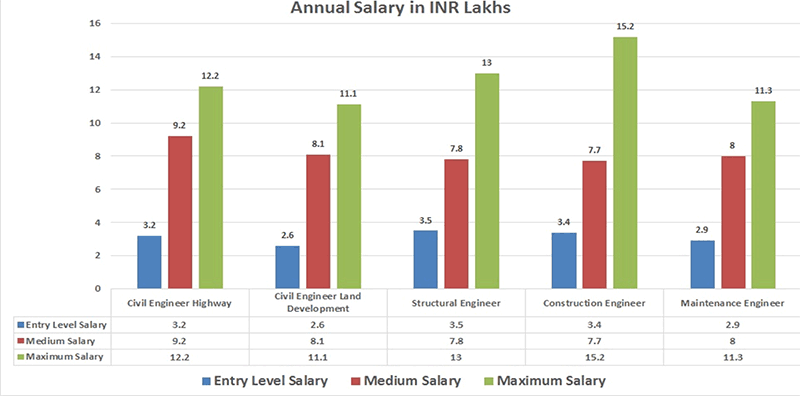 Frequently Asked Questions (FAQs)
B.Tech in Civil Engineering is a 4-year undergraduate engineering program where students learn to design, build, and maintain infrastructure like buildings, roads, bridges, dams, and water systems.
Students who have completed Class 12 with Physics, Chemistry, and Mathematics (PCM) from a recognised board with minimum required marks can apply for the course.
The program typically lasts 4 years, divided into eight semesters.
Key subjects include structural analysis, fluid mechanics, surveying, geotechnical engineering, transportation engineering, construction management, and environmental engineering.
Admission is usually based on entrance exam scores like JEE Main, state CET exams, or institute-level tests, followed by counselling.
Students develop problem-solving, analytical thinking, technical design, project management, software use (like AutoCAD and STAAD Pro), and teamwork skills.
Graduates can work as Site Engineer, Structural Engineer, Project Engineer, Transportation Engineer, Geotechnical Engineer, Environmental Engineer, and Construction Manager.
Civil engineers are hired in construction companies, infrastructure development firms, government departments, urban planning agencies, and consulting organisations.
Starting salaries in India typically range from around ₹3 to ₹6 lakh per year, and can increase with experience and specialisation.
Yes, it is a solid choice for students who enjoy designing and building infrastructure, as infrastructure projects like highways, metro systems, and smart cities continue to grow.
Watch the video
BTech in Civil Engineering Course, eligibility, subjects, fees, scope, salary, Top Civil Engineering
Other Popular Courses
Applications for Admissions are open
 Guru Nanak Dev Dental College & Research InstitutePatiala
 Gokul Global UniversitySiddhpur
 Sage University, IndoreIndore
 City College JayanagarBengaluru
 Manav Rachna University, FaridabadFaridabad
 Ramkumari College of Veterinary SciencesJhunjhunu
 SDGI Global UniversityGhaziabad
 Atria UniversityBangalore
 Solan Homoeopathic Medical College & HospitalSolan
 St Andrews Institute Of Technology And ManagementGurgaon
 GD Goenka University, GurgaonGurgaon
 Himachal Institute of Dental Sciences, SirmaurSirmaur
 Shoolini UniversitySolan
 I.T.S College of Health and Wellness Sciences, Greater NoidaGreater Noida
 JK Business School GurugramGurgaon
 Swami Devi Dyal Group of Professional InstitutionsPanchkula
 Amity University, GurugramGurgaon
 Desh Bhagat UniversityFatehgarh Sahib
 Lamrin Tech Skill UniversityRupnagar
 Greater Noida Institute of TechnologyGreater Noida
 Bhojia Dental College and HospitalSolan
 Amity University, MohaliMohali
 SRM University - APGuntur
 Pimpri Chinchwad UniversityPune
 Sunder Deep Group of InstitutionsGhaziabad
 Mai Bhago Ayurvedic Medical CollegeFirozpur
 Centurion University of Technology and Management, ParalakhemundiParalakhemundi
 Apeejay Stya UniversitySohna
 Rai Technology UniversityBangalore
 Doon Business SchoolDehradun