Need Counselling
BSc Geology
 Job Pressure
 Academic Pressure
 Early Salary
2 L LPA - 3 L LPA
Mid Level Salary4 L LPA - 5 L LPA
Senior Salary10 L LPA - 12 L LPA
BSc Geologist - Studying Earth
Geology is the branch of Science that deals with the study of the earth and the earth processes. It can be said to be a branch of Science but some also refer to it as a part of Environmental Studies. At best, it can be described as an amalgamation of both. It comprises of subjects such as Geophysics, Oceanography (study of the behavior of the ocean, the types of wave patterns, coastal erosion, etc.), Atmospheric Science, Crystallography, the study of soils, Paleontology (the study of fossils), Hydrogeology (the study of the movement of ground water inside the crust of the earth as well as its distribution), Geostatistics, Geochemistry and the study of the Origin of life.
Geologists are people who conduct such studies and researches. They are more popularly known as Earth Scientists. India being such a rich country when it comes to resources, soils and other physical features, this proves to be a great career option. In our country, Earth Scientists or Geologists are employed in many Government organizations like the Central and Groundwater Authorities, the Geological Survey of India and the Indian Bureau of Mines. For those who are more academically motivated, taking up teaching in this field as a profession and conducting researches under some university proves to be a good option. Some oil exploration companies and mining agencies are also in great need of Earth Scientists.
If employed by the Government, Geologists are designated the position of Class I Officers. They can earn around 30,000 INR on a monthly basis. As they gain experience and get promoted, their salary keeps on getting a hike too. At high levels, Geologists earn up to 80,000 INR a month. The scope for employment in this field is very wide. The Geological survey of India itself alone recruits around 1000 Officers every year. As more and more students are showing interest in the field of Geology now- a- days, the need for teachers and professors of this profession has also gone up manifold.
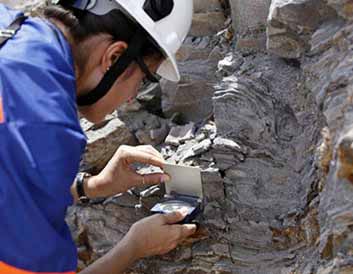
Most of the work is done on the field by visiting and spending time at the places of concern. This requires a lot of stamina. One should also be able to interpret and understand even the minutest of details of nature and the intricacies of natural processes to become a successful Geologist.
Anyone who is interested in taking up the extensive study of the earth and its processes as a career should take up Science at the plus- two levels with Physics, Chemistry and Mathematics. After school, they should go for a Bachelor’s degree in Science (B.Sc.) with Geology as the major subject. This should be followed up by a Master’s degree in Science (M.Sc.). If one wants to make teaching their profession in this field, they must also apply for a Doctorate. To emerge as a success in the field of Geology, a thorough knowledge of Math, Physics, Chemistry, Botany, Zoology and Geography is the most important requisite.
Institutes in India that offer courses in Geology are the University of Delhi, New Delhi, the Banaras Hindu University, Varanasi, the Jadavpur University, Kolkata and the Presidency College, Kolkata. Majority of the universities offer these courses. Some of the Indian Institutes of Technologies (IITs) also offer programs related to Geology and Earth Sciences.
Frequently Asked Questions (FAQs) 2. How long is the programme?
1. What is B.Sc Geology?
B.Sc Geology is a three‑year undergraduate science degree that focuses on the study of the Earth — its structure, materials (rocks, minerals), processes and history. It covers how the earth formed, how resources like minerals and groundwater exist, and how geological processes shape the planet.
The course lasts 3 years, typically divided into six semesters with both classroom learning and practical fieldwork, labs and geological mapping.
3. Who is eligible to study B.Sc Geology?
You must have completed Class 12 (10+2) from a recognised board in the Science stream with subjects such as Physics, Chemistry and Mathematics or Biology (and often English). Admissions may be merit‑based or through entrance exams depending on the university.
4. What core subjects are studied?
Typical subjects include Mineralogy, Petrology (study of rocks), Paleontology (fossils), Structural Geology, Economic Geology, Stratigraphy, Hydrogeology, Remote Sensing & GIS, and Environmental Geology. Fieldwork and lab experiments are key parts of training.
5. What skills will students gain?
Students develop earth observation, field surveying, rock/mineral identification, mapping and GIS skills, analytical/geochemical reasoning, research and critical thinking — useful for both academic and professional work.
6. What careers are available after B.Sc Geology?
Graduates can work in roles including:
• Geologist – studying rocks and underground structures
• Hydrogeologist – focusing on water resources
• Petrologist or Mineralogist
• Environmental Consultant – advising on land and resource issues
• Mining Supervisor – managing extraction operations
• Petroleum Geologist – in oil and gas exploration
• Remote Sensing or GIS Specialist in mapping and spatial analysis.
7. Where can geology graduates work?
Job opportunities exist in government departments like the Geological Survey of India (GSI), mining & natural resource companies, oil & gas firms (like ONGC), environmental consultancies, research organisations, water resource agencies, and academic institutions.
8. What is the typical starting salary?
In India, entry‑level salaries after B.Sc Geology generally range from ₹3 LPA to ₹6 LPA, depending on job role, employer and location. With experience or specialised roles (e.g., hydrogeology or petroleum geology), salaries can rise further.
9. Can I pursue higher studies after B.Sc Geology?
Yes. After graduation you can do M.Sc in Geology or Earth Sciences, M.Tech in related branches (like Petroleum Geology), or research degrees (M.Phil/Ph.D.). Higher degrees improve career prospects in research, academia and specialised fields.
10. Is B.Sc Geology a good course choice?
B.Sc Geology is a good choice if you enjoy earth science, outdoor fieldwork, mapping, environmental and natural resource studies. It combines practical learning with scientific knowledge and opens opportunities in mining, energy, environmental consulting and research. Preparing for higher education or specialised training (e.g., GIS, petroleum exploration) can significantly enhance career growth.
Other Popular Courses
Applications for Admissions are open
 Lamrin Tech Skill UniversityRupnagar
 Kalka Dental collegeMeerut
 UNITEDWORLD INSTITUTE OF DESIGNAhmedabad
 HRIT UniversityGhaziabad
 Guru Kashi UniversityBathinda
 NIIT UniversityAlwar
 Lovely Professional UniversityJalandhar
 Sri Sukhmani Institute of ManagementNew Delhi
 DBS Global UniversityDehradun
 Presidency UniversityBangalore
 Saraswati Group of Colleges, MohaliMohali
 ATLAS SkillTech UniversityMumbai
 Om Sterling Global UniversityHisar
 MERI CollegeNew Delhi
 GD Goenka University, GurgaonGurgaon
 Bhojia Dental College and HospitalSolan
 Vidya Siri College of PharmacyBangalore
 Alliance UniversityBangalore
 Mai Bhago Ayurvedic Medical CollegeFirozpur
 Bhagwant Institute of TechnologyMuzaffarnagar
 Guru Nanak Dev Dental College & Research InstitutePatiala
 UID Ahemdabad & Delhi NCRGurgaon
 Shoolini UniversitySolan
 Muthoot Business SchoolKochi
 Gian Sagar medical College & HospitalPatiala
 IIFA Lancaster Institute of DesignBangalore
 Kalka Group of InstitutionsMeerut
 Shri Bhawani Niketan Shiksha Samitijaipur
 Ajeenkya DY Patil UniversityPune
 Manav Rachna University, FaridabadFaridabad