Need Counselling

M.Sc Obstetrics Gynecology
 Job Pressure
Medium
 Academic Pressure
Medium
 Early Salary
12L LPA - 16L LPA
Mid Level Salary20L LPA - 30L LPA
Senior Salary55L LPA - 60L LPA
Table of Contents
- M.Sc in Obstetrics Gynecology Nursing Course Highlights
- Know All about M.Sc in Obstetrics Gynecology Nursing Course
- Eligibility Criteria for M.Sc in Obstetrics Gynecology Nursing Course
- Require Skills set
- Common Entrance Examination for M.Sc in Obstetrics Gynecology Nursing Course
- M.Sc in Obstetrics Gynecology Nursing Course Syllabus
- Job Profile after M.Sc in Obstetrics Gynecology Nursing Course
- Top Recruiting Companies
- M.Sc in Obstetrics Gynecology Nursing Course Approx. Salary Trends in Lakh Per Annum*
- Annual Salary Trend
- Watch the video M.Sc in Obstetrics & Gynecology Eligibility, Top Colleges, Syllabus, Duration, Salary
M.Sc in Obstetrics Gynecology Nursing Course Highlights
| Course Level | Post Graduate |
| Duration | 2 Years |
| Examination type | Semester System |
| Eligibility | A Bachelor's degree from any recognized University with minimum 45% marks in aggregate |
| Admission Process | Entrance Exam + Group Discussion/ Personal Interview |
| Course Fee | INR 10,000 to 5,00,000 |
| Average Starting Salary | INR 4,00,000 to 20,00,000 |
| Employment Areas | Colleges & Universities, Medical Colleges, Govt./ Pvt. Hospitals, Content Writing (Medical), Nursing Homes, Medical Labs, etc. |
| Job Profiles | Obstetrician/ Gynecologist, Senior Registrar, Lecturer, Clinical Associate, Junior Consultant, Senior Resident, Consultant, General Physician, etc. |
| Top Recruiting Organizations | Fortis Healthcare, Max Healthcare, Care Hospitals, Indian Council of Medical Research, Apollo Hospitals, Kailash Hospital, Adecco India Private Limited, Jaypee healthcare limited, Meditrina Hospitals Private Limited, etc. |
Know All about M.Sc in Obstetrics Gynecology Nursing Course
M. Sc. Obstetrics and Gynecology Nursing or Master of Science in Obstetrics and Gynecology, also known as M. Sc. (OBG) is a two-year advanced post-graduation. It trains candidates towards dealing with the reproductive organs and health of women. Women having issues with reproductive organs or having difficulty in conception, pregnancy and childbirth are taken care of by these specialists who help them throughout their journey right from conception to the birth of their baby. Furthermore, they even educate women about birth control, how to maintain their physical and sexual health, and also information from child control to mammograms.
The course is quite extensive, beginning from the menstruation cycle in women, through pregnancy, childbirth, and then menopause. Nurses trained in this segment are even taught how to handle diseases and disorders of the reproductive system in women such as cancer, endometriosis, and other sexually transmitted diseases.
Eligibility Criteria for M.Sc in Obstetrics Gynecology Nursing Course
- Candidates should have passed a bachelor’s degree from any recognized University with a minimum of 45% marks in aggregate or any other equivalent qualification
- Some of the very reputed universities and colleges conduct an entrance examination for admission.
Require Skills set
- Good communication and observation
- Ability to answer questions and offer advice
- Dealing with emotionally charged situations
- Decision Making Skills
- Organizational Skills
Common Entrance Examination for M.Sc in Obstetrics Gynecology Nursing Course
- JIPMER PG
- NEET PG
- AIIMS PG
- COMEDK PGET
- CMC Vellore
- AIAPGET
- PU CET
M.Sc in Obstetrics Gynecology Nursing Course Syllabus
| Subjects of Study |
| Introduction |
| Human reproduction |
| Pregnancy |
| Normal Labour and Nursing management |
| Role of nurse-midwifery practitioner |
| Normal Newborn |
| Pharmacy dynamics in obstetrics |
| Family welfare services |
| Infertility |
| Menopause |
| Abortion |
Job Profile after M.Sc in Obstetrics Gynecology Nursing Course
- Obstetrician/ Gynecologist
- Senior Registrar
- Lecturer
- Clinical Associate
- Junior Consultant
- Senior Resident
- Consultant
- General Physician
Top Recruiting Companies

M.Sc in Obstetrics Gynecology Nursing Course Approx. Salary Trends in Lakh Per Annum*
| Job Profile | Average Entry Level Salary | Average Medium Salary | Average Maximum Salary |
| Obstetrician/ Gynecologist | 11 | 12.2 | 14 |
| Professors | 7.0 | 9.5 | 11 |
| General Physician | 5.0 | 5.35 | 6.0 |
Annual Salary Trend
Frequently Asked Questions (FAQs) 2. Who is eligible to study this course? 3. How long is the M.Sc Obstetrics & Gynecology Nursing programme? 4. How are admissions done for this course? 5. What subjects are studied in this programme? 6. What skills will I gain from this degree? 7. What career options are available after this course? 8. Where can M.Sc Obstetrics & Gynecology Nursing graduates work? 9. What is the average starting salary after completing this course? 10. Is M.Sc in Obstetrics & Gynecology Nursing a good career choice?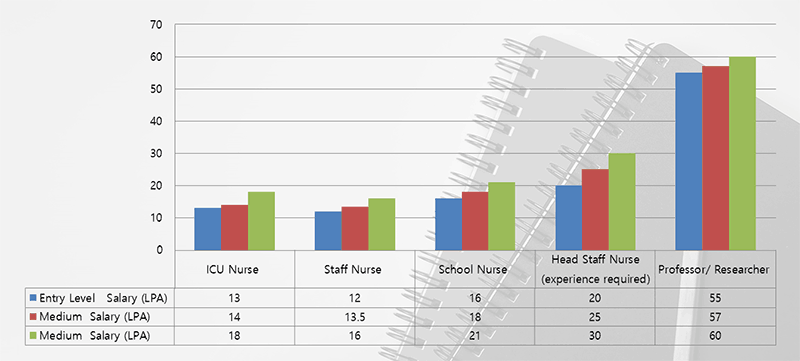
1. What is M.Sc in Obstetrics & Gynecology Nursing?
M.Sc in Obstetrics & Gynecology Nursing is a 2‑year postgraduate nursing programme that trains nurses to provide advanced care for women’s reproductive health, including pregnancy, childbirth, postpartum care and gynaecological conditions.
To be eligible, you must have a B.Sc Nursing, B.Sc Hons Nursing, or Post Basic B.Sc Nursing degree from a recognised university with a minimum required aggregate score (often around 45–55 % depending on the institute) and be registered as a nurse and midwife. Some institutes may also require clinical work experience.
The programme usually lasts 2 years, divided into four semesters, combining classroom study and hands‑on clinical experience in maternal and women’s health settings.
Admissions typically involve merit from the qualifying degree and/or entrance exams and interviews as per university rules. Some colleges use institution‑level tests or counselling for selection.
Subjects include advanced obstetric and gynaecologic nursing, human reproduction, pregnancy management, high‑risk obstetrics, neonatal care, family welfare, infertility and menopause nursing, along with research and leadership topics.
You will gain advanced clinical skills in maternal and newborn care, gynaecology nursing, health assessment, critical thinking, research methods, leadership, communication, and patient education.
Graduates can work as Clinical Nurse Specialists (OBG), Nurse Educators, Nurse Consultants, Nursing Administrators, Midwifery Practitioners, Research Nurses, or Lecturers in nursing colleges.
Job opportunities exist in hospitals (especially maternity and women’s health units), maternity clinics, community health centres, research institutions, educational institutions, NGOs focused on women’s health and reproductive care.
Salaries vary widely depending on role and employer. In India, postgraduate nursing specialists often earn higher packages than general nurses, with entry‑level annual packages that can rise significantly with experience and leadership roles.
Yes — it’s a good career choice if you are passionate about women’s health, maternal care, and advanced nursing practice, as it provides specialised clinical, teaching, research and leadership opportunities in the growing healthcare sector.
Watch the video M.Sc in Obstetrics & Gynecology Eligibility, Top Colleges, Syllabus, Duration, Salary
Watch the video: M.Sc in Obstetrics & Gynecology Eligibility, Top Colleges, Syllabus, Duration, Salary
Other Popular Courses
Applications for Admissions are open
 Amity University, GurugramGurgaon
 Sunder Deep Group of InstitutionsGhaziabad
 Himachal Institute of Dental Sciences, SirmaurSirmaur
 Rai Technology UniversityBangalore
 Om Sterling Global UniversityHisar
 Chanakya UniversityBangalore
 Woxsen UniversityHyderabad
 Guru Kashi UniversityBathinda
 IILM University, Greater NoidaGreater Noida
 Ganga Group Of InstitutionsNew Delhi
 Pimpri Chinchwad UniversityPune
 Atria UniversityBangalore
 Shri Bhawani Niketan Shiksha Samitijaipur
 Solan Homoeopathic Medical College & HospitalSolan
 ITS Dental College, Greater NoidaGreater Noida
 Manav Rachna International Institute Of Research And StudiesFaridabad
 Sage University, IndoreIndore
 Bhagwant Institute of TechnologyMuzaffarnagar
 Swami Devi Dyal Group of Professional InstitutionsPanchkula
 DBS Global UniversityDehradun
 SRM University - APGuntur
 Guru Nanak Ayurvedic Medical College & HospitalMuktsar
 Kalka Dental collegeMeerut
 City College JayanagarBengaluru
 Amity University, MohaliMohali
 Karnavati UniversityGandhinagar
 I.T.S College of Health and Wellness Sciences, Greater NoidaGreater Noida
 Guru Nanak Dev Dental College & Research InstitutePatiala
 Presidency UniversityBangalore
 HRIT UniversityGhaziabad