Need Counselling

B.Sc Physiology
 Job Pressure
Medium
 Academic Pressure
Medium
 Early Salary
2.5L LPA - 5.5L LPA
Mid Level Salary3.2L LPA - 6.6L LPA
Senior Salary4L LPA - 7L LPA
Table of Contents
- B.Sc Physiology Course Highlights
- About the Programme B.Sc Physiology
- Eligibility Criteria of B.Sc Physiology Course
- Require Skills set B.Sc Physiology Course
- B.Sc Physiology Course Syllabus
- Job Profile after B.Sc Physiology Course
- Top Recruiting Companies
- B.Sc Physiology Course Approx. Salary Trends in Lakh Per Annum*
- Video B.Sc Physiology Course, Job Scope, Salary, Top Recruiting Companies.
B.Sc Physiology Course Highlights
| Course Level | Graduate |
| Duration | 3 Years |
| Examination type | Semester System |
| Eligibility | 10+2 or equivalent qualification |
| Admission Process | Direct admission, and entrance test in some cases |
| Course Fee | INR 15,000 to 3,75,000 |
| Average Starting Salary | INR 4,00,000 to 6,00,000 |
| Employment Areas | Biomedical Companies, Hospitals & Clinics, Research Laboratories, Colleges & Universities, Health Sciences Agencies, State or Federal Agencies, Pharmaceutical and Biotechnology Companies, Teaching Private Institutions, University, and Hospital Research Laboratories, etc. |
| Job Profiles | Cardiovascular Tech, Geneticist Assistant, Health Care Administrator, Home Care Worker, Lab Assistant, Medical Laboratory Technician, Physiotherapist, Practical Nursing, Personal Trainer, Research Assistant, Science Technical Writer, Therapist Assistant, etc. |
About the Programme B.Sc Physiology
B. Sc. Physiology or Bachelor of Science in Physiology is a three-year under-graduation that educates students about the functions of living systems. It deals in educating and providing knowledge about how organs, cells, organ systems, and bio-molecules conduct physical and chemical functions within a living system. This course is highly job-oriented and has a lot of scope for young achievers.
Eligibility Criteria of B.Sc Physiology Course
- Admission to the course is merit-based, following the candidate’s performance at the 10+2 level.
- some universities often have an entrance test in place for assessing and shortlisting candidates.
Require Skills set B.Sc Physiology Course
- Good communication and observation
- Numeracy
- Research
- Ethics
- Patience
- Organisational Skills
- Problem-Solving
B.Sc Physiology Course Syllabus
| YEAR I | YEAR II |
|---|---|
| Biochemistry | Conservation of Matter |
| Biochemical Tests | Energy in Human Systems |
| Biophysical and Biochemical Principles involved in Human System | Endocrine System |
| Biostatistics | Environmental Physiology |
| Blood and Body Fluids | Hematological Tests |
| Cardiovascular System | Histology |
| Clinical Biochemistry | Immunology and Immunization Programs |
| YEAR III | |
| Microbiology | |
| Nervous System | |
| Nerve Muscle Physiology | |
| Human Experiments | |
| Renal Physiology | |
| Reproductive Physiology | |
| Sensory Physiology | |
Job Profile after B.Sc Physiology Course
- Neuropsychiatrists
- Research Psychologist
- Forensic Psychologist
- Sociologist
- Career Counsellor
- Social Worker
Top Recruiting Companies

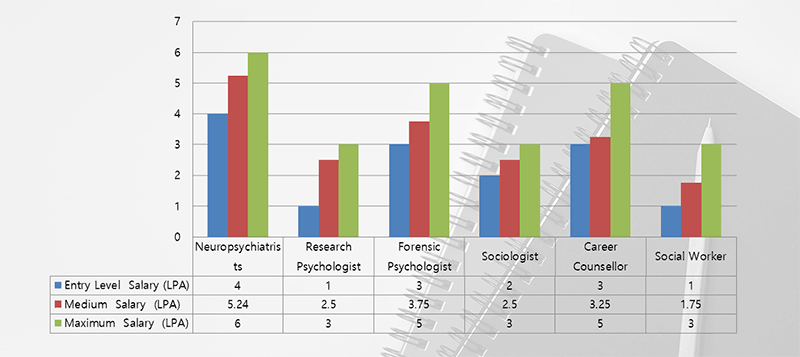
B.Sc Physiology Course Approx. Salary Trends in Lakh Per Annum*
| Job Profile | Average Entry Level Salary | Average Medium Salary | Average Maximum Salary |
| Neuropsychiatrists | 4.0 | 5.24 | 6.0 |
| Research Psychologist | 1.0 | 2.5 | 3.0 |
| Forensic Psychologist | 3.0 | 3.75 | 5.0 |
| Sociologist | 2.0 | 2.5 | 3.0 |
| Career Counsellor | 3.0 | 3.25 | 5.0 |
| Social Worker | 1.0 | 1.75 | 3.0 |
Annual Salary Trend
Frequently Asked Questions (FAQs) 2. Who is eligible to study this course? 3. How long is the B.Sc Physiology programme? 4. What subjects will I study in this course? 5. How do admissions work for B.Sc in Physiology? 6. What skills will I gain from this degree? 7. What career options are available after B.Sc in Physiology? 8. Which industries hire Physiology graduates? 9. What is the average starting salary after this course? 10. Can I pursue higher studies after B.Sc in Physiology?
1. What is B.Sc in Physiology?
B.Sc in Physiology is a 3‑year undergraduate science programme that teaches how the human body functions, covering topics like organ systems, cellular processes, biochemical functions, and how the body responds to changes. It’s a foundational course in life sciences and healthcare.
To be eligible, students must have completed Class 12 (10+2) with Physics, Chemistry, and Biology from a recognised board. Most colleges require around 50% marks for admission, either through merit or an entrance exam in some cases.
The programme lasts 3 years, usually divided into six semesters that include both theory and practical laboratory work.
Students study subjects such as biochemistry, blood and body fluids, cardiovascular system, renal and reproductive physiology, nervous system, endocrinology, immunology, and lab techniques, building a deep understanding of how the human body works.
Most colleges admit students based on Class 12 marks (merit). Some universities may also conduct entrance exams for selection. Admission processes vary by institution.
You’ll develop analytical thinking, lab and research skills, understanding of human biology, data interpretation, communication, and problem‑solving, which are useful in science, healthcare, and research careers.
Graduates can work as research assistants, lab technicians, clinical assistants, healthcare administrators, fitness or exercise consultants, medical content writers, or technical support staff in healthcare and research sectors.
Job opportunities are found in hospitals and clinics, biomedical and pharmaceutical research labs, public health agencies, fitness and wellness centres, academic institutions, and biotechnology companies.
In India, graduates typically earn around ₹2.5 LPA to ₹6 LPA depending on the job role and employer, with potential to earn more with experience or advanced degrees.
Yes — after B.Sc you can pursue M.Sc in Physiology or related fields, or specialised programmes like biomedical sciences, clinical research, public health, healthcare management, or even Ph.D. to expand your career opportunities.
Video B.Sc Physiology Course, Job Scope, Salary, Top Recruiting Companies.
Watch the video: Bachelor of Science in Physiology
Other Popular Courses
Applications for Admissions are open
 NIIT UniversityAlwar
 Amity University, GurugramGurgaon
 Himachal Institute of Dental Sciences, SirmaurSirmaur
 St Andrews Institute Of Technology And ManagementGurgaon
 Ajeenkya DY Patil UniversityPune
 IILM University, Greater NoidaGreater Noida
 Rai Technology UniversityBangalore
 Solan Homoeopathic Medical College & HospitalSolan
 Sunder Deep Group of InstitutionsGhaziabad
 Sri Sukhmani Institute of ManagementNew Delhi
 Bennett University, Greater NoidaGreater Noida
 Presidency UniversityBangalore
 Chanakya UniversityBangalore
 Gokul Global UniversitySiddhpur
 Jayoti Vidyapeeth Women’s UniversityJaipur
 Hierank Business SchoolNoida
 Muthoot Business SchoolKochi
 IIFA Lancaster Institute of DesignBangalore
 Centurion University of Technology and Management, ParalakhemundiParalakhemundi
 Karnavati UniversityGandhinagar
 Saraswati Group of Colleges, MohaliMohali
 I.T.S Dental college, Murad NagarGhaziabad
 Gian Sagar medical College & HospitalPatiala
 SRM University - APGuntur
 ATLAS SkillTech UniversityMumbai
 MERI CollegeNew Delhi
 Bhojia Dental College and HospitalSolan
 Shri Bhawani Niketan Shiksha Samitijaipur
 Kalka Group of InstitutionsMeerut
 GNIOT Institute of Management Studies (GIMS)Greater Noida